Tekin Cem, Caroprese Vincenzo, Bastings Maartje M C
Programmable Biomaterials Laboratory, Institute of Materials, School of Engineering, Ecole Polytechnique Fédérale Lausanne, 1015 Lausanne, Switzerland.
ACS Appl Mater Interfaces. 2024 Oct 30;16(43):59040-59048. doi: 10.1021/acsami.4c11813. Epub 2024 Oct 17.
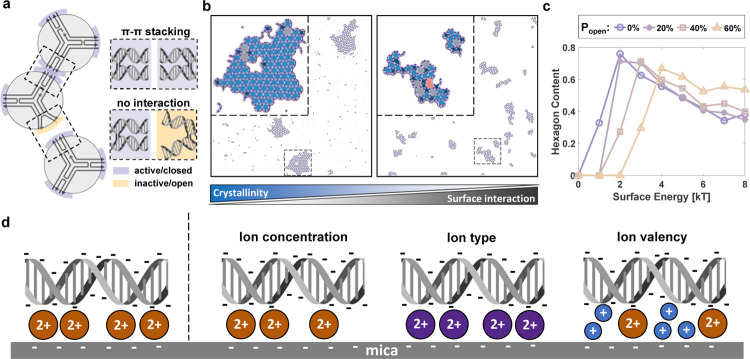
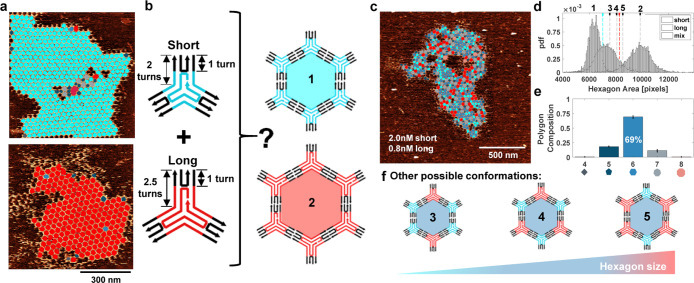
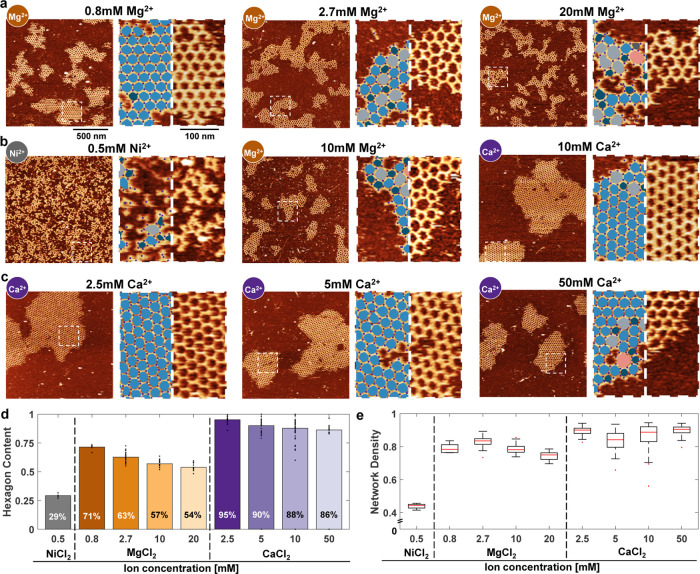
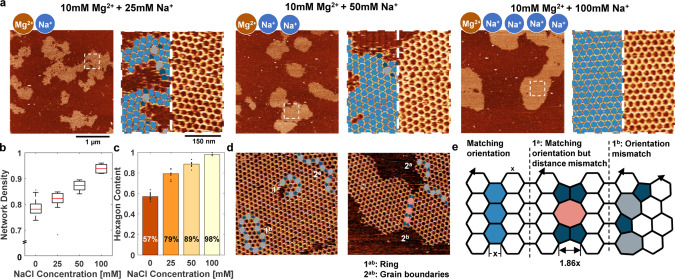
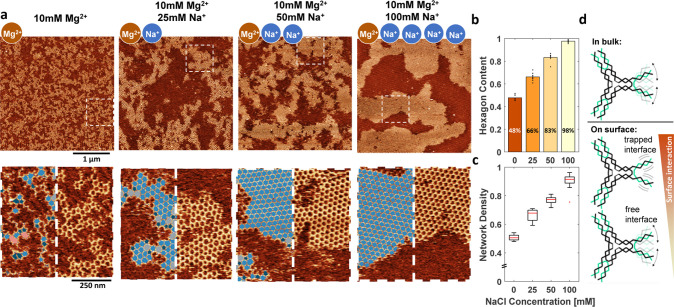
Supramolecular crystals arise from noncovalent interactions between macromonomers and allow for the engineering of dynamic functional materials. For two-dimensional (2D) crystals, the substrate surface can induce the formation of new polymorphs not available in solution, adding a layer of complexity to the supramolecular self-assembly process. Despite extensive studies on the 2D self-assembly of supramolecular crystals, unknowns remain regarding substrate-monomer interactions and the effects on network self-assembly and defect repair. Here, we used a DNA-mica model system to modulate and understand the impact of substrate-monomer interactions on the crystalline order. We controlled the surface interactions by tuning the Mg concentration, varying the divalent cation type, and adjusting the relative concentration of divalent and monovalent cations. The competition between monovalent and divalent cations yielded nearly defect-free crystals with minimal polygon defects. These findings highlight the critical role of surface interactions in achieving high crystalline order, which is essential for optimizing the efficiency and performance of supramolecular functional nanomaterials.
超分子晶体由大分子单体之间的非共价相互作用产生,并有助于动态功能材料的工程设计。对于二维(2D)晶体,基底表面可诱导溶液中不存在的新多晶型物的形成,给超分子自组装过程增加了一层复杂性。尽管对超分子晶体的二维自组装进行了广泛研究,但关于基底-单体相互作用以及对网络自组装和缺陷修复的影响仍存在未知之处。在此,我们使用DNA-云母模型系统来调节和理解基底-单体相互作用对晶体有序性的影响。我们通过调节镁浓度、改变二价阳离子类型以及调整二价和一价阳离子的相对浓度来控制表面相互作用。一价和二价阳离子之间的竞争产生了几乎无缺陷的晶体,多边形缺陷最少。这些发现突出了表面相互作用在实现高晶体有序性方面的关键作用,这对于优化超分子功能纳米材料的效率和性能至关重要。