Teigen Levi M, McCarter Stuart J, Ziegert Zachary, Staley Christopher, Grant Kiera M, Gupta Vinod K, Zhao Xiaowei, St Louis Erik K, Kantarci Kejal, Lowe Val J, Forsberg Leah K, Savica Rodolfo, Ramanan Vijay K, Jones David T, Petersen Ronald C, Sung Jaeyun, Khoruts Alexander, Boeve Bradley F, Ross Owen A
Department of Food Science and Nutrition, University of Minnesota, St. Paul, MN, 55108, USA.
Department of Neurology, Mayo Clinic, Rochester, MN, 55905, USA; Center for Sleep Medicine, Mayo Clinic, Rochester, MN, 55905, USA.
Parkinsonism Relat Disord. 2024 Dec;129:107176. doi: 10.1016/j.parkreldis.2024.107176. Epub 2024 Oct 16.
Microbial dysbiosis has been reported to contribute to development of neurodegenerative diseases, however, there is a need to identify causative/prognostic indicators.
To comparatively analyze gut microbiome composition in symptomatic LBD (dementia/mild cognitive impairment), iRBD, and cohabiting controls without LBD or iRBD.
16S rRNA amplicon sequencing was performed in 38 cases (27 LBD, 11 iRBD) and 39 cohabitant controls. 19 non-cohabitant healthy controls (HCs) were also included to contrast differences between cohabitant cases and controls.
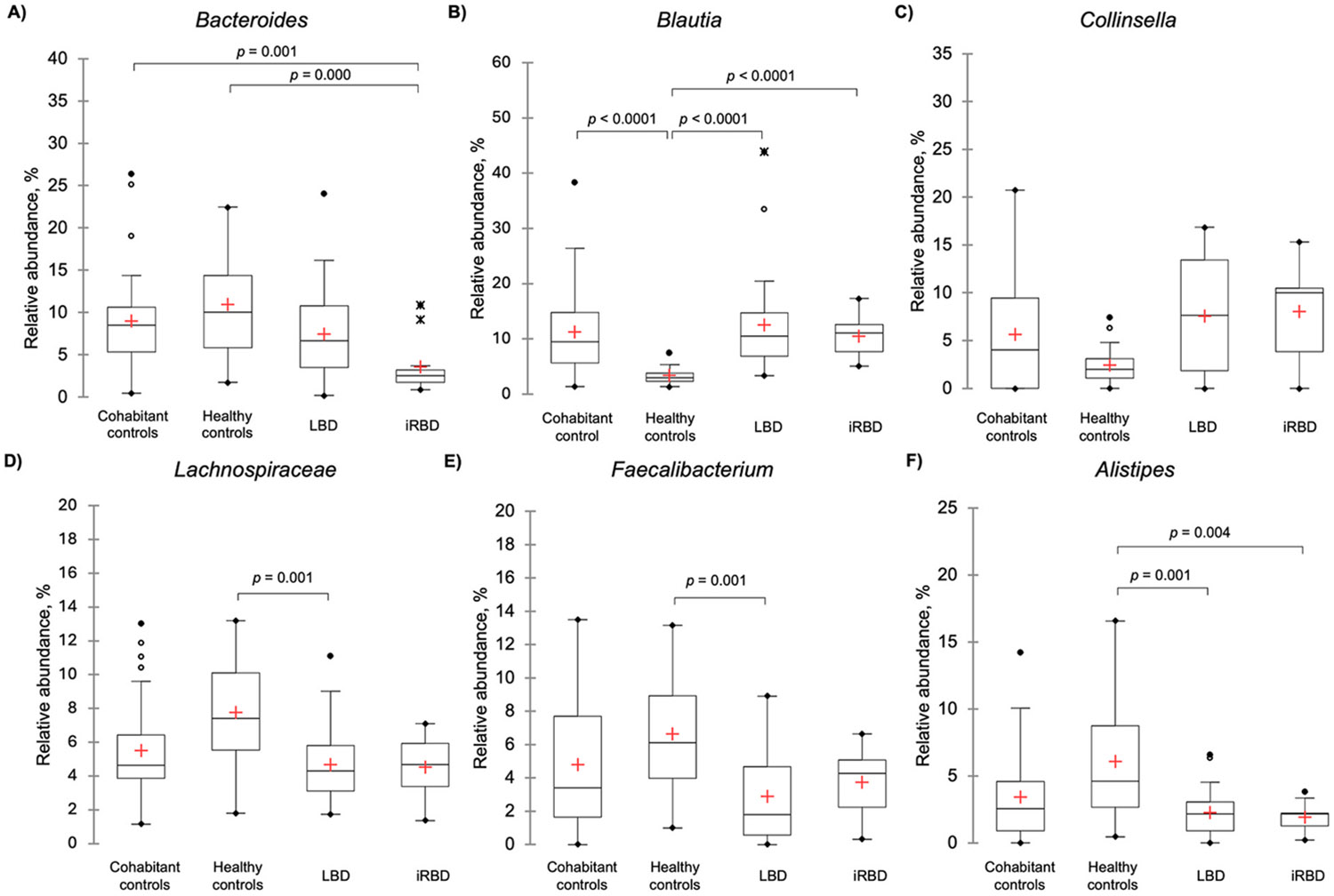
Microbiome composition of cohabitant controls and LBD and iRBD cases were strikingly similar. No differences were observed between LBD, and iRBD only showed reduced Bacteroides, compared with cohabitant controls. There were several taxonomic differences in gut microbiome composition between non-cohabitant HCs and cases.
Minimal microbiome differences were observed between iRBD or LBD cases and cohabitant controls. These findings underscore the importance of using cohabiting controls in future gut microbiome studies.
据报道,微生物群落失调会导致神经退行性疾病的发展,然而,需要确定病因/预后指标。
比较分析有症状的路易体痴呆(痴呆/轻度认知障碍)、快速眼动期行为障碍(iRBD)以及无路易体痴呆或快速眼动期行为障碍的同居对照者的肠道微生物群组成。
对38例患者(27例路易体痴呆,11例快速眼动期行为障碍)和39名同居对照者进行16S rRNA扩增子测序。还纳入了19名非同居健康对照者(HCs),以对比同居患者与对照者之间的差异。
同居对照者与路易体痴呆及快速眼动期行为障碍患者的微生物群组成极为相似。路易体痴呆患者之间未观察到差异,与同居对照者相比,快速眼动期行为障碍患者仅显示拟杆菌减少。非同居健康对照者与患者之间的肠道微生物群组成在分类学上存在若干差异。
在快速眼动期行为障碍或路易体痴呆患者与同居对照者之间观察到的微生物群差异极小。这些发现强调了在未来肠道微生物群研究中使用同居对照者的重要性。