Department of Endocrinology and Metabolism, The First Hospital of Jilin University, Changchun 130021, China.
Dis Markers. 2020 Aug 27;2020:3936247. doi: 10.1155/2020/3936247. eCollection 2020.
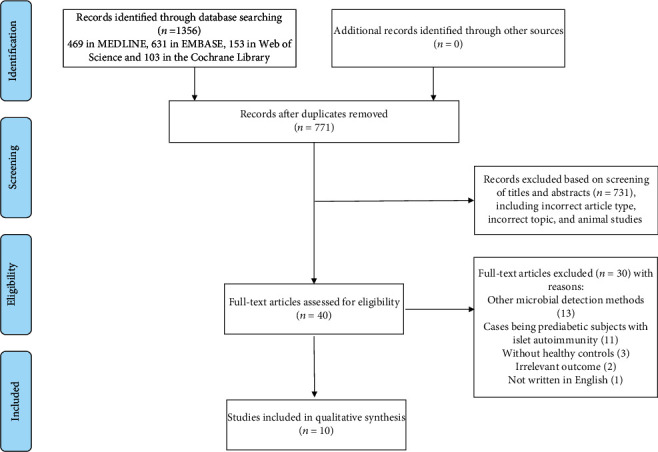
The gut microbiota has been presumed to have a role in the pathogenesis of type 1 diabetes (T1D). Significant changes in the microbial composition of T1D patients have been reported in several case-control studies. This study is aimed at systematically reviewing the existing literature, which has investigated the alterations of the intestinal microbiome in T1D patients compared with healthy controls (HCs) using 16S ribosomal RNA-targeted sequencing. The databases of MEDLINE, EMBASE, Web of Science, and the Cochrane Library were searched until April 2019 for case-control studies comparing the composition of the intestinal microbiome in T1D patients and HCs based on 16S rRNA gene sequencing techniques. The Newcastle-Ottawa Scale was used to assess the methodological quality. Ten articles involving 260 patients with T1D and 276 HCs were included in this systematic review. The quality scores of all included studies were 6-8 points. In summary, a decreased microbiota diversity and a significantly distinct pattern of clustering with regard to -diversity were observed in T1D patients when compared with HCs. At the phylum level, T1D was characterised by a reduced ratio of in the structure of the gut community, although no consistent conclusion was reached. At the genus or species level, T1D patients had a reduced abundance of and compared with HCs, whereas and were found to be more enriched in T1D patients. This systematic review identified that there is a close association between the gut microbiota and development of T1D. Moreover, gut dysbiosis might be involved in the pathogenesis of T1D, although the causative role of gut microbiota remains to be established. Further well-controlled prospective studies are needed to better understand the role of the intestinal microbiome in the pathogenesis of T1D, which may help explore novel microbiota-based strategies to prevent and treat T1D.
肠道微生物群被认为在 1 型糖尿病(T1D)的发病机制中起作用。几项病例对照研究报告称,T1D 患者的微生物组成发生了显著变化。本研究旨在系统综述现有文献,这些文献使用 16S 核糖体 RNA 靶向测序技术调查了 T1D 患者与健康对照者(HCs)肠道微生物组的变化。检索了 MEDLINE、EMBASE、Web of Science 和 Cochrane 图书馆数据库,截至 2019 年 4 月,以比较基于 16S rRNA 基因测序技术的 T1D 患者和 HCs 肠道微生物组组成的病例对照研究。使用纽卡斯尔-渥太华量表评估方法学质量。本系统评价纳入了 10 篇文章,涉及 260 例 T1D 患者和 276 例 HCs。所有纳入研究的质量评分均为 6-8 分。总之,与 HCs 相比,T1D 患者的微生物多样性降低,且在 -多样性方面聚类模式明显不同。在门水平上,T1D 患者肠道菌群结构中 的比例降低,尽管没有得出一致的结论。在属或种水平上,与 HCs 相比,T1D 患者 的丰度降低,而 和 则在 T1D 患者中更为丰富。本系统评价确定,肠道微生物群与 T1D 的发生发展密切相关。此外,肠道菌群失调可能参与 T1D 的发病机制,尽管肠道微生物群的因果作用仍有待确定。需要进一步进行良好对照的前瞻性研究,以更好地了解肠道微生物组在 T1D 发病机制中的作用,这可能有助于探索基于微生物组的新型策略来预防和治疗 T1D。