Kumari Chandrani, Menon Gautam I, Narlikar Leelavati, Ram Uma, Siddharthan Rahul
The Institute of Mathematical Sciences, Chennai, India.
Homi Bhabha National Institute, Mumbai, India.
Eur J Obstet Gynecol Reprod Biol X. 2024 Oct 3;24:100344. doi: 10.1016/j.eurox.2024.100344. eCollection 2024 Dec.
Monitoring of fetal growth and estimation of birth weight is of clinical importance. During pregnancy, ultrasound fetal biometry values including femur length, head circumference, abdominal circumference, biparietal diameter are measured and used to place fetuses on "growth charts". There is no simple growth-model-based, predictive formula in use for fetal biometry. Estimation of fetal weight at birth currently depends on ultrasound data taken a short time before birth.
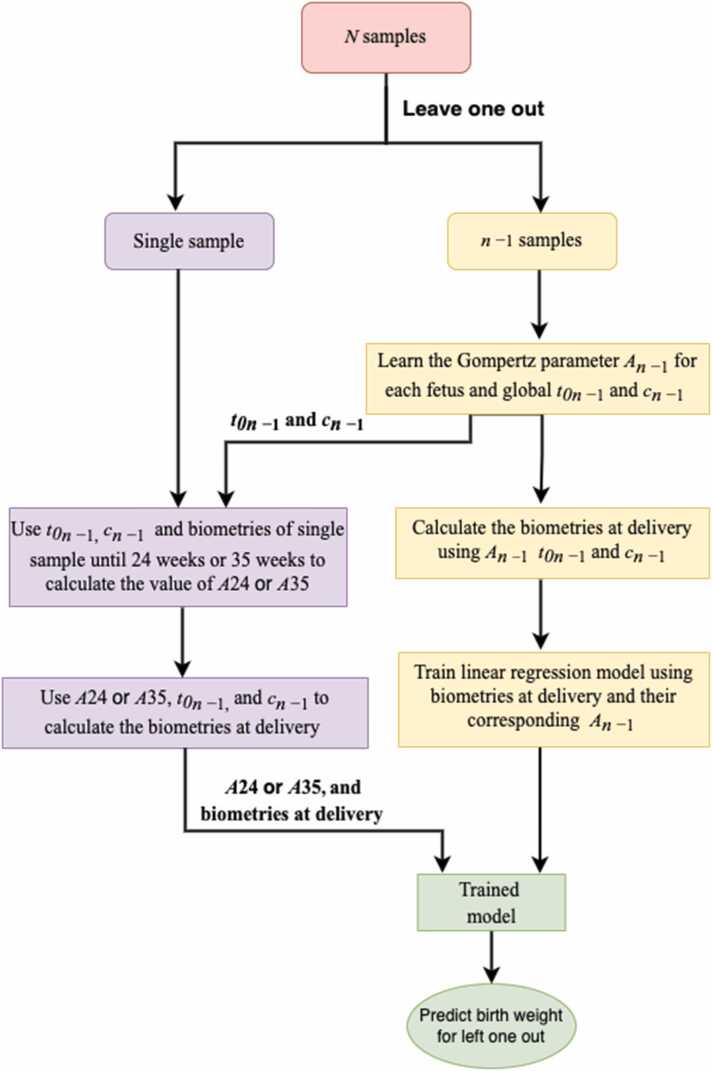
Our cohort ("Seethapathy cohort") consists of ultrasound biometry measurements and other data for 774 pregnant women in Chennai, India, 2015-2017. We use the Gompertz model, a standard model for constrained growth, with just three intuitive parameters, to model the growth of fetal biometry, and a machine learning (ML) model trained on these parameters to predict birth weight (BW).
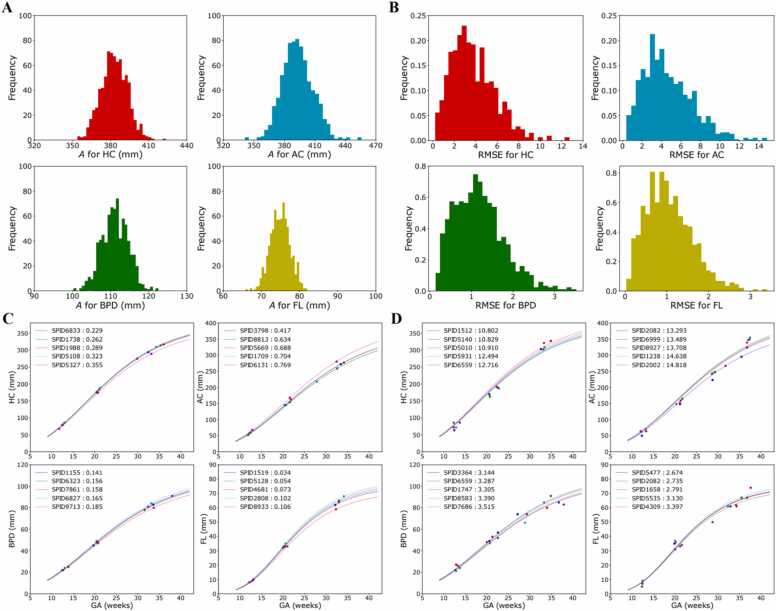
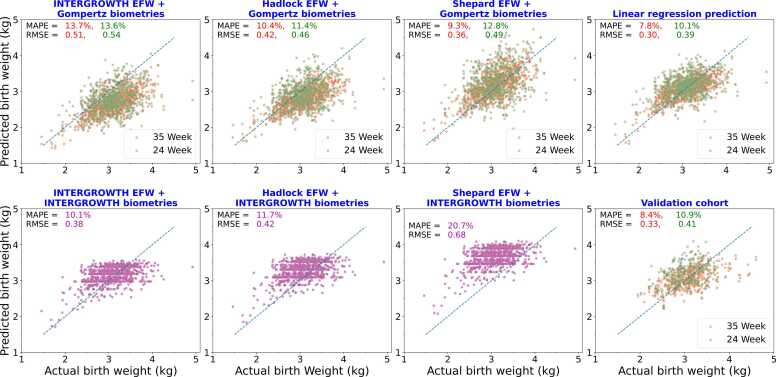
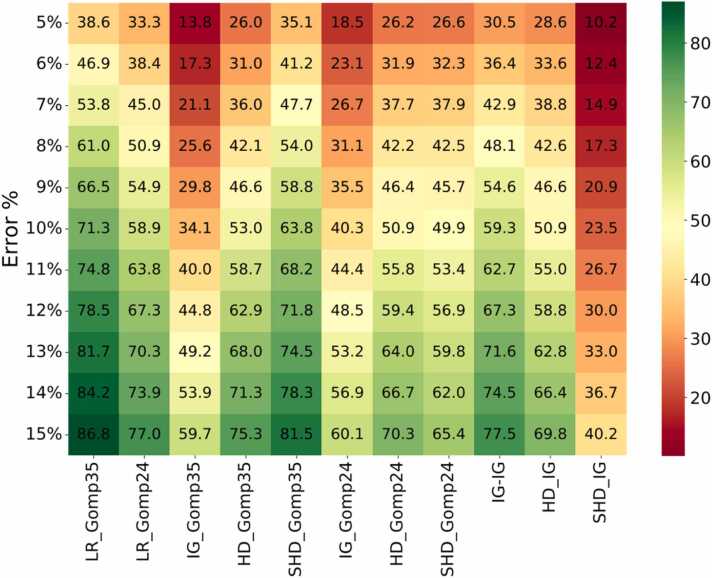
The Gompertz model convincingly fits the growth of fetal biometry values. Two Gompertz parameters- (inflection time) and (rate of decrease of growth rate)-seem universal to all fetuses, while the third, , is an overall scale specific to each fetus, capturing individual variation. On the Seethapathy cohort we can infer for each fetus from ultrasound data available by the 24 or 35 weeks. Our ML model predicts birth weight with < 8 % error, outperforming published methods that have access to late-term ultrasound data. The same model gives an 8.4 % error in BW prediction on an independent validation cohort of 365 women.
The Gompertz model fits fetal biometry growth and enables birth weight estimation without need of late-term ultrasounds. Aside from its clinical predictive value, we suggest its use for future growth standards, with almost all variation described by a single scale parameter .
监测胎儿生长及估计出生体重具有临床重要性。在孕期,会测量包括股骨长度、头围、腹围、双顶径在内的超声胎儿生物测量值,并用于将胎儿置于“生长图表”上。目前尚无基于简单生长模型的胎儿生物测量预测公式。目前出生时胎儿体重的估计依赖于出生前短时间内获取的超声数据。
我们的队列(“Seethapathy队列”)由2015 - 2017年印度钦奈774名孕妇的超声生物测量数据及其他数据组成。我们使用Gompertz模型(一种用于受限生长的标准模型,仅有三个直观参数)来模拟胎儿生物测量的生长,并使用基于这些参数训练的机器学习(ML)模型来预测出生体重(BW)。
Gompertz模型令人信服地拟合了胎儿生物测量值的生长。两个Gompertz参数—— (拐点时间)和 (生长速率下降率)——似乎对所有胎儿都是通用的,而第三个参数 是每个胎儿特有的总体尺度,捕获个体差异。在Seethapathy队列中,我们可以从24周或35周时可得的超声数据推断出每个胎儿的 。我们的ML模型预测出生体重的误差<8%,优于那些可获取晚期超声数据的已发表方法。同一模型在365名女性的独立验证队列中对出生体重预测的误差为8.4%。
Gompertz模型拟合胎儿生物测量生长,无需晚期超声即可实现出生体重估计。除了其临床预测价值外,我们建议将其用于未来的生长标准,几乎所有差异都由单个尺度参数 描述。