Lancet Respir Med. 2025 Jan;13(1):69-79. doi: 10.1016/S2213-2600(24)00295-9. Epub 2024 Oct 18.
Pulmonary arterial hypertension (PAH) is a vascular disease characterised by restricted flow and high pressure through the pulmonary arteries, leading to progressive right heart failure and death. This study reports the global burden of PAH, leveraging all available data and using methodology of the Global Burden of Diseases, Injuries, and Risk Factors Study (GBD) to understand the epidemiology of this under-researched and morbid disease.
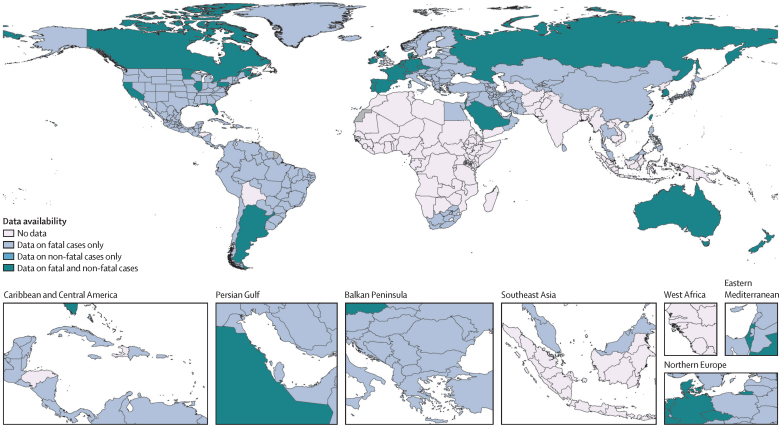
Prior to the current effort, the burden of PAH was included in GBD as a non-specific contributor to "other cardiovascular and circulatory disease" burden. In this study, PAH was distinguished as its own cause of death and disability in GBD, producing comparable and consistent estimates of PAH burden. We used epidemiological and vital registry data to estimate the non-fatal and fatal burden of PAH in 204 countries and territories from 1990 to 2021 using standard GBD modelling approaches. We specifically focused on PAH (group 1 pulmonary hypertension), and did not include pulmonary hypertension groups 2-5.
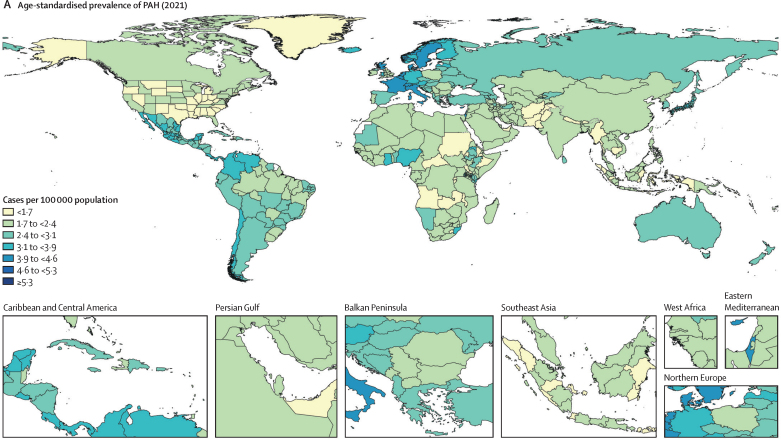
In 2021, there were an estimated 192 000 (95% uncertainty interval [UI] 155 000-236 000) prevalent cases of PAH globally. Of these, 119 000 (95 900-146 000) were in females (62%) and 73 100 (58 900-89 600) in males (38%). The age-standardised prevalence was 2·28 cases per 100 000 population (95% UI 1·85-2·80). Prevalence increased with age such that the highest prevalence was among individuals aged 75-79 years. In 2021, there were 22 000 deaths (18 200-25 400) attributed to PAH globally, with an age-standardised mortality rate of 0·27 deaths from PAH per 100 000 population (0·23-0·32). The burden of disease appears to be improving over time (38·2% improvement in age-standardised years of life lost [YLLs] in 2021 relative to 1990). YLLs attributed to PAH were similar to estimates for conditions such as chronic myeloid leukaemia, multiple sclerosis, and Crohn's disease.
PAH is a rare but fatal disease that accounts for a considerable health-associated burden worldwide. PAH is disproportionally diagnosed among females and older adults.
Cardiovascular Medical Research and Education Fund and the Bill & Melinda Gates Foundation.
肺动脉高压(PAH)是一种血管疾病,其特征是通过肺动脉的血流受限和压力升高,导致进行性右心衰竭和死亡。本研究报告了PAH的全球负担,利用所有可用数据并采用全球疾病、伤害和风险因素负担研究(GBD)的方法,以了解这种研究不足且致命疾病的流行病学。
在当前研究之前,PAH的负担在GBD中被列为“其他心血管和循环系统疾病”负担的非特定贡献因素。在本研究中,PAH在GBD中被区分出来作为其自身的死亡和残疾原因,从而得出PAH负担的可比且一致的估计值。我们使用流行病学和生命登记数据,采用标准的GBD建模方法,估计了1990年至2021年期间204个国家和地区PAH的非致命和致命负担。我们特别关注PAH(第1组肺动脉高压),未包括第2 - 5组肺动脉高压。
2021年,全球PAH的估计患病率为192,000例(95%不确定区间[UI]为155,000 - 236,000例)。其中,女性为119,000例(95,900 - 146,000例)(62%),男性为73,100例(58,900 - 89,600例)(38%)。年龄标准化患病率为每10万人口2.28例(95% UI为1.85 - 2.80)。患病率随年龄增长而增加,75 - 79岁人群中的患病率最高。2021年,全球有22,000例死亡(18,200 - 25,400例)归因于PAH,年龄标准化死亡率为每10万人口0.27例PAH死亡(0.23 - 0.32)。疾病负担似乎随时间推移有所改善(与1990年相比,2021年年龄标准化生命损失年数[YLLs]改善了38.2%)。归因于PAH的YLLs与慢性粒细胞白血病、多发性硬化症和克罗恩病等疾病的估计值相似。
PAH是一种罕见但致命的疾病,在全球范围内造成了相当大的健康相关负担。PAH在女性和老年人中的诊断比例过高。
心血管医学研究与教育基金以及比尔及梅琳达·盖茨基金会。