• 文献检索
  • 文档翻译
  • 深度研究
  • 学术资讯
  • Suppr Zotero 插件Zotero 插件
  • 邀请有礼
  • 套餐&价格
  • 历史记录
应用&插件
Suppr Zotero 插件Zotero 插件浏览器插件Mac 客户端Windows 客户端微信小程序
定价
高级版会员购买积分包购买API积分包
服务
文献检索文档翻译深度研究API 文档MCP 服务
关于我们
关于 Suppr公司介绍联系我们用户协议隐私条款
关注我们

Suppr 超能文献

核心技术专利:CN118964589B侵权必究
粤ICP备2023148730 号-1Suppr @ 2026

文献检索

告别复杂PubMed语法,用中文像聊天一样搜索,搜遍4000万医学文献。AI智能推荐,让科研检索更轻松。

立即免费搜索

文件翻译

保留排版,准确专业,支持PDF/Word/PPT等文件格式,支持 12+语言互译。

免费翻译文档

深度研究

AI帮你快速写综述,25分钟生成高质量综述,智能提取关键信息,辅助科研写作。

立即免费体验

基于中国局部大数据研究 COVID-19 对变应性鼻炎流行病学特征的影响。

To study the impact of COVID-19 on the epidemiological characteristics of allergic rhinitis based on local big data in China.

机构信息

Affiliated Hospital of Hangzhou Normal University, Hangzhou, China.

出版信息

Sci Rep. 2024 Oct 23;14(1):25101. doi: 10.1038/s41598-024-76252-w.

DOI:10.1038/s41598-024-76252-w
PMID:39443644
原文链接:https://pmc.ncbi.nlm.nih.gov/articles/PMC11500020/
Abstract

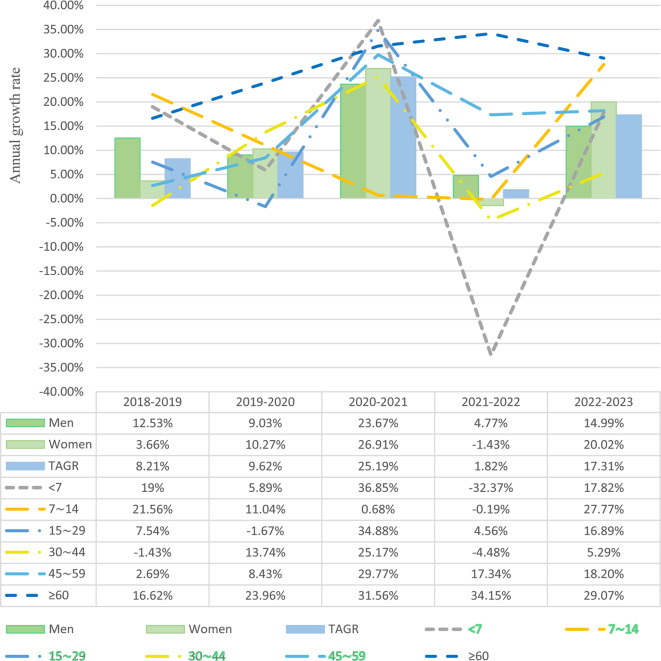
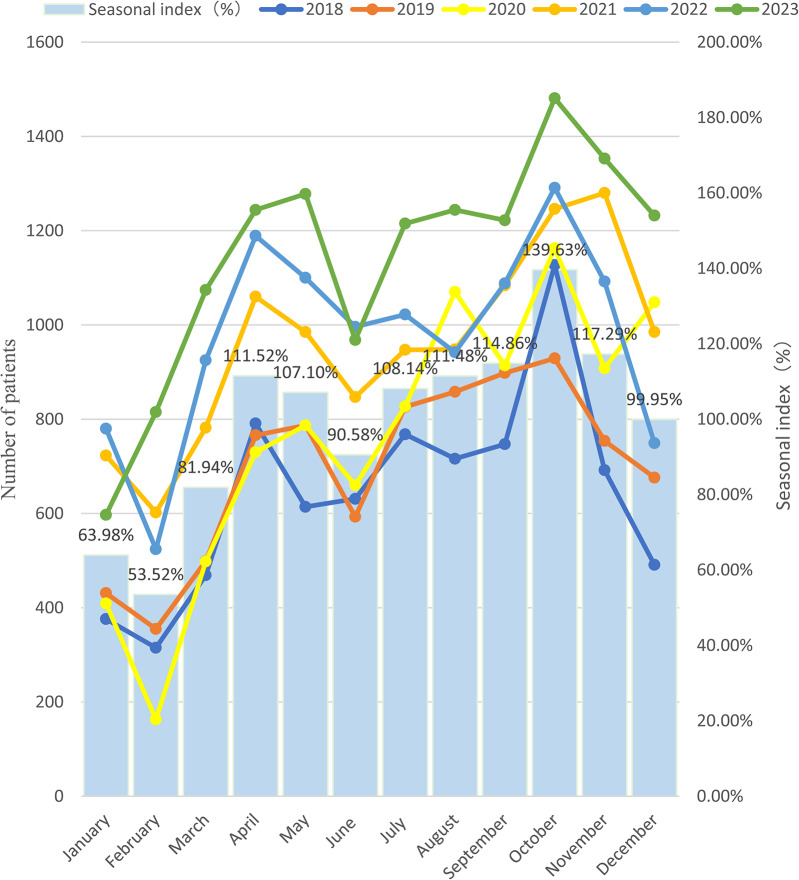
To investigate the big data characteristics and trend changes of patients with allergic rhinitis (AR) who sought medical attention at our hospital before (from 2018 to 2019) and after (from 2020 to 2023) COVID-19, and provide reference basis for the treatment of AR. This study used a descriptive epidemiological method to analyze the big data and trend changes of AR patients. A total of 62,196 AR patients were collected, of whom 32,874 were male and 29,322 were female, with an age range of 1-89 years. The monthly change trend of AR patients showed a marked seasonality. The number of AR patients increased year by year. There was no significant difference in the number of patients between different genders. There was a significant difference in the number of patients between different age groups. The number of AR patients increased markedly from 2018 to 2023, and COVID-19 seems to have accelerated this process. There is a clear seasonal pattern. The number of boy patients is significantly higher than that of girl patients, and the change in female hormones may affect the incidence of AR. Therefore, it is necessary to update management measures and formulate relevant policies in response to the changing trend of AR since the COVID-19 epidemic.

摘要

为了调查 COVID-19 前后(2018 年至 2019 年和 2020 年至 2023 年)我院就诊的变应性鼻炎(AR)患者的大数据特征和趋势变化,为 AR 的治疗提供参考依据。本研究采用描述性流行病学方法分析 AR 患者的大数据和趋势变化。共收集 62196 例 AR 患者,其中男 32874 例,女 29322 例,年龄 1-89 岁。AR 患者的月变化趋势显示出明显的季节性。AR 患者的数量逐年增加。不同性别患者数量无显著差异,不同年龄组患者数量有显著差异。AR 患者的数量从 2018 年到 2023 年显著增加,COVID-19 似乎加速了这一过程。有明显的季节性模式。男患者数量明显高于女患者,女性激素的变化可能影响 AR 的发病率。因此,有必要针对 COVID-19 疫情以来 AR 的变化趋势更新管理措施并制定相关政策。
https://cdn.ncbi.nlm.nih.gov/pmc/blobs/b9ba/11500020/9a65669e7b2c/41598_2024_76252_Fig2_HTML.jpg
https://cdn.ncbi.nlm.nih.gov/pmc/blobs/b9ba/11500020/d80a6c231027/41598_2024_76252_Fig1_HTML.jpg
https://cdn.ncbi.nlm.nih.gov/pmc/blobs/b9ba/11500020/9a65669e7b2c/41598_2024_76252_Fig2_HTML.jpg
https://cdn.ncbi.nlm.nih.gov/pmc/blobs/b9ba/11500020/d80a6c231027/41598_2024_76252_Fig1_HTML.jpg
https://cdn.ncbi.nlm.nih.gov/pmc/blobs/b9ba/11500020/9a65669e7b2c/41598_2024_76252_Fig2_HTML.jpg

相似文献

1
To study the impact of COVID-19 on the epidemiological characteristics of allergic rhinitis based on local big data in China.基于中国局部大数据研究 COVID-19 对变应性鼻炎流行病学特征的影响。
Sci Rep. 2024 Oct 23;14(1):25101. doi: 10.1038/s41598-024-76252-w.
2
The Association between Ambient Air Pollution and Allergic Rhinitis: Further Epidemiological Evidence from Changchun, Northeastern China.环境空气污染与变应性鼻炎之间的关联:来自中国东北长春的进一步流行病学证据。
Int J Environ Res Public Health. 2017 Feb 23;14(3):226. doi: 10.3390/ijerph14030226.
3
[Analysis of big data characteristics of allergic rhinitis patients in Beijing City from 2016 to 2021].[2016年至2021年北京市变应性鼻炎患者大数据特征分析]
Zhonghua Yu Fang Yi Xue Za Zhi. 2023 Sep 6;57(9):1380-1384. doi: 10.3760/cma.j.cn112150-20220928-00936.
4
Online public attention toward allergic rhinitis in Wuhan, China: Infodemiology study using Baidu index and meteorological data.中国武汉变应性鼻炎的网络公众关注度:基于百度指数和气象数据的信息流行病学研究。
Front Public Health. 2022 Oct 3;10:971525. doi: 10.3389/fpubh.2022.971525. eCollection 2022.
5
[Epidemiological investigation of allergic rhinitis in Ningxia].[宁夏变应性鼻炎的流行病学调查]
Zhonghua Er Bi Yan Hou Tou Jing Wai Ke Za Zhi. 2017 Jul 7;52(7):491-496. doi: 10.3760/cma.j.issn.1673-0860.2017.07.003.
6
Allergic rhinitis in Covid-19 patients.新冠病毒患者的变应性鼻炎。
Niger J Clin Pract. 2023 Mar;26(3):336-340. doi: 10.4103/njcp.njcp_359_22.
7
Impact of temperature variability on childhood allergic rhinitis in a subtropical city of China.温度变异性对中国亚热带城市儿童变应性鼻炎的影响。
BMC Public Health. 2020 Sep 17;20(1):1418. doi: 10.1186/s12889-020-09531-6.
8
[Prevalence of allergic rhinitis in Beijing--a community survey].[北京变应性鼻炎患病率——一项社区调查]
Lin Chuang Er Bi Yan Hou Tou Jing Wai Ke Za Zhi. 2014 Sep;28(17):1349-51.
9
Epidemiological characterization and risk factors of allergic rhinitis in the general population in Guangzhou City in china.中国广州市普通人群变应性鼻炎的流行病学特征及危险因素
PLoS One. 2014 Dec 16;9(12):e114950. doi: 10.1371/journal.pone.0114950. eCollection 2014.
10
The short-term effects of cold spells on pediatric outpatient admission for allergic rhinitis in Hefei, China.中国合肥寒冷天气对小儿变应性鼻炎门诊就诊的短期影响。
Sci Total Environ. 2019 May 10;664:374-380. doi: 10.1016/j.scitotenv.2019.01.237. Epub 2019 Jan 22.

本文引用的文献

1
Differential host responses to COVID-19: Unraveling the complexity.COVID-19 宿主反应的差异:揭示复杂性。
Diagn Microbiol Infect Dis. 2024 Jun;109(2):116281. doi: 10.1016/j.diagmicrobio.2024.116281. Epub 2024 Mar 24.
2
The Impact of Cytokines on Health-Related Quality of Life in Adolescents with Allergic Rhinitis.细胞因子对变应性鼻炎青少年健康相关生活质量的影响。
Biomedicines. 2024 Feb 13;12(2):428. doi: 10.3390/biomedicines12020428.
3
Environmental risks and infertility in China.中国的环境风险与不孕不育
Science. 2024 Jan 19;383(6680):267-268. doi: 10.1126/science.adn3214. Epub 2024 Jan 18.
4
Does China's residential mobility reduce fertility intentions? The mediating role of well-being.中国的居住流动性会降低生育意愿吗?幸福感的中介作用。
Acta Psychol (Amst). 2023 Nov;241:104082. doi: 10.1016/j.actpsy.2023.104082. Epub 2023 Nov 9.
5
[Analysis of big data characteristics of allergic rhinitis patients in Beijing City from 2016 to 2021].[2016年至2021年北京市变应性鼻炎患者大数据特征分析]
Zhonghua Yu Fang Yi Xue Za Zhi. 2023 Sep 6;57(9):1380-1384. doi: 10.3760/cma.j.cn112150-20220928-00936.
6
Examination of Homologies between COVID-19 Vaccines and Common Allergens: The Potential for T Cell-mediated Responses for Allergic Rhinitis and Asthma.新型冠状病毒肺炎疫苗与常见变应原之间的同源性检测:过敏性鼻炎和哮喘的T细胞介导反应潜力
Infect Dis Immun. 2022 Oct;2(4):282-284. doi: 10.1097/ID9.0000000000000056. Epub 2022 Aug 12.
7
Comparison of the prevalence and risk factors of chronic allergic diseases before and after COVID-19: using raw data from the Korea National Health and Nutrition Examination Survey in 2019 and 2021.比较 COVID-19 前后慢性过敏性疾病的患病率和危险因素:使用 2019 年和 2021 年韩国国家健康和营养检查调查的原始数据。
J Asthma. 2023 Dec;60(12):2093-2103. doi: 10.1080/02770903.2023.2220791. Epub 2023 Jun 9.
8
Face mask correlation with allergic rhinitis symptoms severity during COVID-19 pandemic: A cross-sectional study.新冠疫情期间口罩与过敏性鼻炎症状严重程度的相关性:一项横断面研究。
Health Sci Rep. 2023 Apr 19;6(4):e1226. doi: 10.1002/hsr2.1226. eCollection 2023 Apr.
9
Prevalence of rhinitis and associated factors in adolescents and adults: a Global Asthma Network study.青少年和成年人变应性鼻炎的患病率及相关因素:全球哮喘网络研究。
Rev Paul Pediatr. 2023 Mar 3;41:e2021400. doi: 10.1590/1984-0462/2023/41/2021400. eCollection 2023.
10
Incidence of Asthma, Atopic Dermatitis, and Allergic Rhinitis in Korean Adults before and during the COVID-19 Pandemic Using Data from the Korea National Health and Nutrition Examination Survey.利用韩国国民健康营养调查的数据,探讨新冠疫情前后韩国成年人哮喘、特应性皮炎和过敏性鼻炎的发病情况。
Int J Environ Res Public Health. 2022 Nov 1;19(21):14274. doi: 10.3390/ijerph192114274.