Estrada-Almeida Ana Gabriela, Castrejón-Godínez María Luisa, Mussali-Galante Patricia, Tovar-Sánchez Efraín, Rodríguez Alexis
Especialidad en Gestión Integral de Residuos, Facultad de Ciencias Biológicas, Universidad Autónoma del Estado de Morelos, Av. Universidad 1001, Col. Chamilpa, Cuernavaca C.P. 62209, Mexico.
Facultad de Ciencias Biológicas, Universidad Autónoma del Estado de Morelos, Av. Universidad 1001, Col. Chamilpa, Cuernavaca C.P. 62209, Mexico.
J Xenobiot. 2024 Oct 15;14(4):1465-1518. doi: 10.3390/jox14040082.
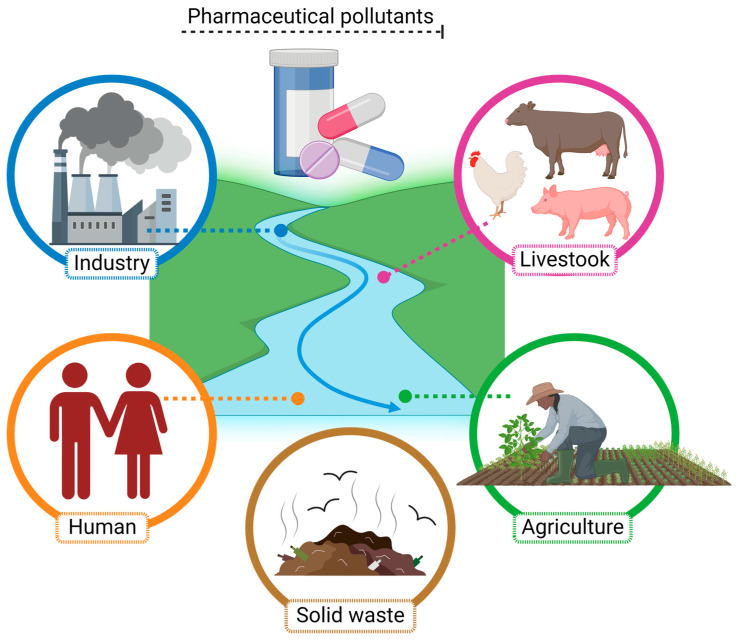
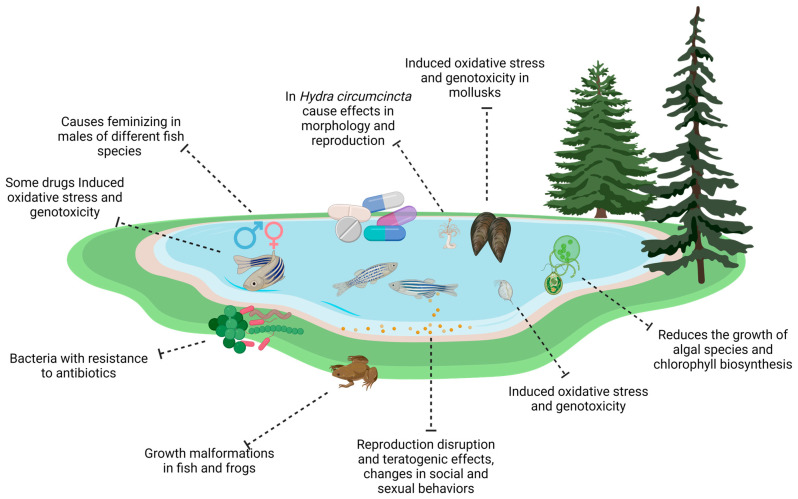
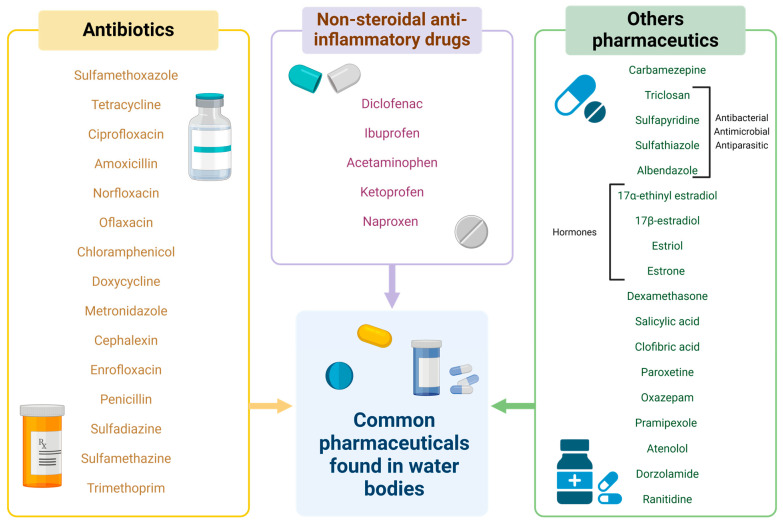
Medicines are pharmaceutical substances used to treat, prevent, or relieve symptoms of different diseases in animals and humans. However, their large-scale production and use worldwide cause their release to the environment. Pharmaceutical molecules are currently considered emerging pollutants that enter water bodies due to inadequate management, affecting water quality and generating adverse effects on aquatic organisms. Hence, different alternatives for pharmaceuticals removal from water have been sought; among them, the use of agro-industrial wastes has been proposed, mainly because of its high availability and low cost. This review highlights the adverse ecotoxicological effects related to the presence of different pharmaceuticals on aquatic environments and analyzes 94 investigations, from 2012 to 2024, on the removal of 17 antibiotics, highlighting sulfamethoxazole as the most reported, as well as 6 non-steroidal anti-inflammatory drugs (NSAIDs) such as diclofenac and ibuprofen, and 27 pharmaceutical drugs with different pharmacological activities. The removal of these drugs was evaluated using agro-industrial wastes such as wheat straw, mung bean husk, bagasse, bamboo, olive stones, rice straw, pinewood, rice husk, among others. On average, 60% of the agro-industrial wastes were transformed into biochar to be used as a biosorbents for pharmaceuticals removal. The diversity in experimental conditions among the removal studies makes it difficult to stablish which agro-industrial waste has the greatest removal capacity; therefore, in this review, the drug mass removal rate (DMRR) was calculated, a parameter used with comparative purposes. Almond shell-activated biochar showed the highest removal rate for antibiotics (1940 mg/g·h), while cork powder (CP) (10,420 mg/g·h) showed the highest for NSAIDs. Therefore, scientific evidence demonstrates that agro-industrial waste is a promising alternative for the removal of emerging pollutants such as pharmaceuticals substances.
药物是用于治疗、预防或缓解动物和人类不同疾病症状的药剂。然而,它们在全球范围内的大规模生产和使用导致其释放到环境中。目前,药物分子被认为是由于管理不善而进入水体的新兴污染物,影响水质并对水生生物产生不利影响。因此,人们一直在寻找从水中去除药物的不同替代方法;其中,有人提出使用农业工业废弃物,主要是因为其来源广泛且成本低廉。本综述强调了不同药物对水生环境的不利生态毒理学影响,并分析了2012年至2024年间关于去除17种抗生素的94项研究,其中磺胺甲恶唑的报道最多,还分析了6种非甾体抗炎药(NSAIDs),如双氯芬酸和布洛芬,以及27种具有不同药理活性的药物。使用小麦秸秆、绿豆壳、甘蔗渣、竹子、橄榄核、稻草、松木、稻壳等农业工业废弃物评估了这些药物的去除情况。平均而言,60%的农业工业废弃物被转化为生物炭,用作去除药物的生物吸附剂。去除研究中的实验条件各不相同,因此很难确定哪种农业工业废弃物的去除能力最强;因此,在本综述中,计算了药物质量去除率(DMRR),这是一个用于比较目的的参数。杏仁壳活化生物炭对抗生素的去除率最高(1940 mg/g·h),而软木粉(CP)(10420 mg/g·h)对非甾体抗炎药的去除率最高。因此,科学证据表明,农业工业废弃物是去除药物等新兴污染物的一种有前景的替代方法。