Moscardini-Martelli Júlia, Rodríguez-Camacho Alejandro, Torres-Ríos Jorge Alejandro, Meraz-Soto Juan Marcos, Flores-Vázquez José Guillermo, Hernández-Sánchez Laura Crystell, Lozano-Ruiz Francisco Javier, Maldonado-Magos Federico, Cid-Sánchez Dharely, Flores-Balcázar Christian Haydeé, Celis-López Miguel Ángel, Gutiérrez-Aceves Guillermo Axayacatl, Flores-Vázquez Fabiola, Moreno-Jiménez Sergio
Radioneurosurgery Unit, National Institute of Neurology and Neurosurgery Manuel Velasco Suárez, Mexico City 14269, Mexico.
Radiotherapy Service, National Cancer Institute, Mexico City 14080, Mexico.
Curr Issues Mol Biol. 2024 Oct 2;46(10):11075-11085. doi: 10.3390/cimb46100658.
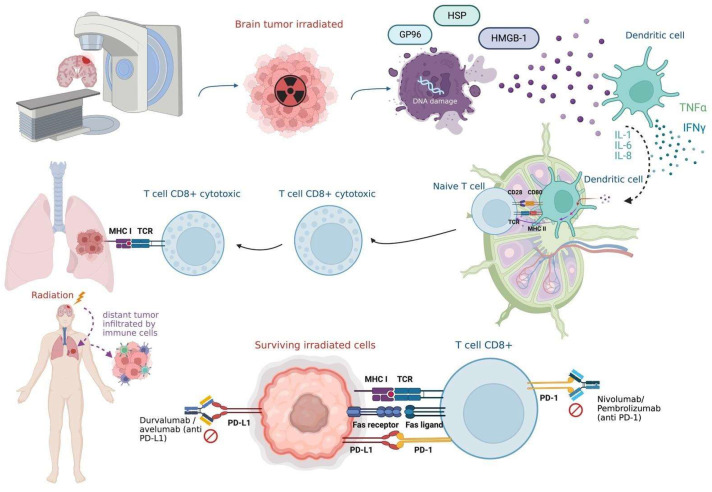
Seventy years ago, Robin Mole introduced the concept of the abscopal effect to describe a rare phenomenon. This occurs when local radiation triggers an immune-mediated reduction in tumors outside the treated area but within the same organism. Observing this effect has been linked to improved overall and progression-free survival in patients who experience it. While the abscopal effect was once considered rare, it is now being observed more frequently due to the combination of radiation with immunotherapy. As a result, more researchers are exploring this study area, which shows promise for excellent results. This review focuses explicitly on the immunological implications of activating the abscopal effect through ionizing radiation in the central nervous system and explores the potentially involved immunological pathways.
七十年前,罗宾·莫尔引入了远隔效应的概念来描述一种罕见现象。当局部放疗引发同一机体中治疗区域外肿瘤的免疫介导性缩小,这种现象就会发生。观察到这种效应与出现该效应的患者总生存期和无进展生存期的改善相关。虽然远隔效应曾被认为很罕见,但由于放疗与免疫疗法的联合应用,现在其被观察到的频率更高了。因此,越来越多的研究人员正在探索这一研究领域,该领域显示出取得优异成果的前景。这篇综述明确聚焦于通过中枢神经系统的电离辐射激活远隔效应的免疫学意义,并探讨潜在涉及的免疫途径。