Li Jiawen, Feng Guanyuan, Lv Jujian, Chen Yanmei, Chen Rongjun, Chen Fei, Zhang Shuang, Vai Mang-I, Pun Sio-Hang, Mak Peng-Un
School of Computer Science, Guangdong Polytechnic Normal University, Guangzhou 510665, China.
Hubei Province Key Laboratory of Occupational Hazard Identification and Control, Wuhan University of Science and Technology, Wuhan 430065, China.
Brain Sci. 2024 Sep 28;14(10):987. doi: 10.3390/brainsci14100987.
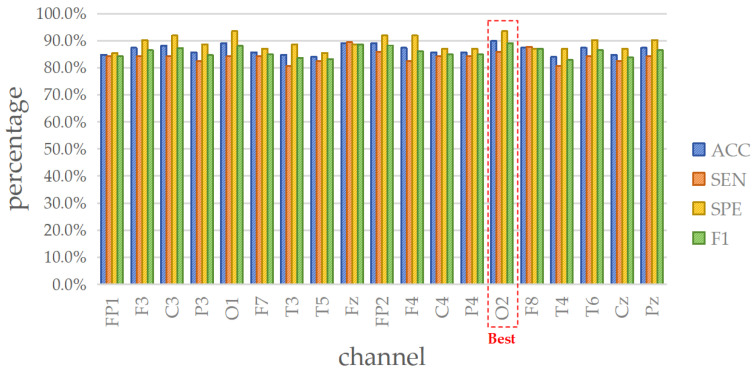
: Mental health issues are increasingly prominent worldwide, posing significant threats to patients and deeply affecting their families and social relationships. Traditional diagnostic methods are subjective and delayed, indicating the need for an objective and effective early diagnosis method. : To this end, this paper proposes a lightweight detection method for multi-mental disorders with fewer data sources, aiming to improve diagnostic procedures and enable early patient detection. First, the proposed method takes Electroencephalography (EEG) signals as sources, acquires brain rhythms through Discrete Wavelet Decomposition (DWT), and extracts their approximate entropy, fuzzy entropy, permutation entropy, and sample entropy to establish the entropy-based matrix. Then, six kinds of conventional machine learning classifiers, including Support Vector Machine (SVM), k-Nearest Neighbors (kNN), Naive Bayes (NB), Generalized Additive Model (GAM), Linear Discriminant Analysis (LDA), and Decision Tree (DT), are adopted for the entropy-based matrix to achieve the detection task. Their performances are assessed by accuracy, sensitivity, specificity, and F1-score. Concerning these experiments, three public datasets of schizophrenia, epilepsy, and depression are utilized for method validation. : The analysis of the results from these datasets identifies the representative single-channel signals (schizophrenia: O1, epilepsy: F3, depression: O2), satisfying classification accuracies (88.10%, 75.47%, and 89.92%, respectively) with minimal input. : Such performances are impressive when considering fewer data sources as a concern, which also improves the interpretability of the entropy features in EEG, providing a reliable detection approach for multi-mental disorders and advancing insights into their underlying mechanisms and pathological states.
心理健康问题在全球范围内日益突出,对患者构成重大威胁,并深刻影响其家庭和社会关系。传统的诊断方法主观且滞后,这表明需要一种客观有效的早期诊断方法。为此,本文提出了一种针对多精神障碍的轻量级检测方法,该方法所需数据源较少,旨在改进诊断程序并实现对患者的早期检测。首先,所提出的方法将脑电图(EEG)信号作为数据源,通过离散小波分解(DWT)获取脑节律,并提取其近似熵、模糊熵、排列熵和样本熵以建立基于熵的矩阵。然后,采用六种传统机器学习分类器,包括支持向量机(SVM)、k近邻(kNN)、朴素贝叶斯(NB)、广义相加模型(GAM)、线性判别分析(LDA)和决策树(DT),对基于熵的矩阵进行处理以完成检测任务。通过准确率、灵敏度、特异性和F1分数评估它们的性能。针对这些实验,利用了三个关于精神分裂症、癫痫和抑郁症的公共数据集进行方法验证。对这些数据集结果的分析确定了具有代表性的单通道信号(精神分裂症:O1,癫痫:F3,抑郁症:O2),在输入最少的情况下达到了令人满意的分类准确率(分别为88.10%、75.47%和89.92%)。考虑到所需数据源较少这一因素,这样的性能令人印象深刻,这也提高了脑电图中熵特征的可解释性,为多精神障碍提供了一种可靠的检测方法,并推进了对其潜在机制和病理状态的认识。