He Kang, Xu Yang, Ding Hong, Guo Qing, Ci Dunwei, Zhang Jialei, Qin Feifei, Xu Manlin, Zhang Guanchu
Shandong Peanut Research Institute, Qingdao 266100, China.
Shandong Academy of Agricultural Sciences, Jinan 250100, China.
Plants (Basel). 2024 Oct 18;13(20):2920. doi: 10.3390/plants13202920.
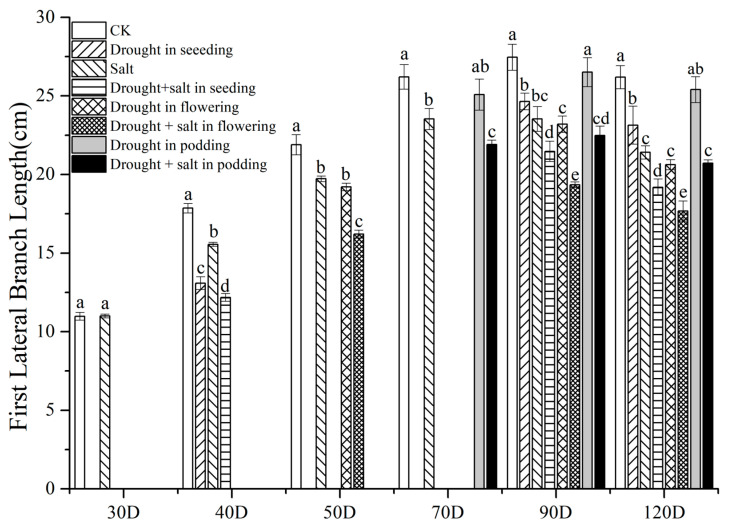
Peanuts grown in saline alkali soil are also subjected to drought stress caused by water scarcity. Therefore, we used HY25 (peanut variety) as an experimental material to investigate the effects of drought on the height of peanut main stems, length of the first lateral branch, leaf area per plant, SPAD value, net photosynthetic rate, and accumulation and distribution of photosynthetic products in saline alkali soil. The results showed that the combined stress of short-term drought and salt significantly reduced the main stem height, first lateral branch length, single plant leaf area, SPAD value, net photosynthetic rate (Pn), intercellular carbon dioxide concentration (Ci), and dry matter accumulation of peanuts, including a decrease in single plant pod yield, 100-pod weight, 100-kernel weight, and peanut yield. And the impact of drought stress on peanut yield varies at different growth stages. For example, under drought stress alone, the sensitive period is the 40th day after planting (40D) > 60th day after planting (60D) > 30th day after planting (30D). Short-term drought has the greatest impact on peanut yield at 40D, while in contrast, resuming watering after drought at 30D results in a slight but not significant increase in peanut yield in comparison with the control. Under the combined stress of drought and salt, the sensitive period of peanuts was 40D > 30D > 60D, and the single pod weight of peanuts was significantly reduced by 15.26% to 57.60% from the flowering stage to the pod stage under drought treatment compared to salt treatment, indicating a significant interaction between drought and salt stress, reducing the single leaf area and net photosynthetic rate of peanut leaves, ultimately leading to a decrease in peanut yield. Therefore, when planting peanuts in saline alkali soil, drought should be avoided, especially early drought, in order to prevent the combined effects of drought and salt stress from harming peanut yield.
种植在盐碱地的花生还会受到缺水导致的干旱胁迫。因此,我们以HY25(花生品种)为实验材料,研究干旱对盐碱地花生主茎高度、第一侧枝长度、单株叶面积、SPAD值、净光合速率以及光合产物积累与分配的影响。结果表明,短期干旱和盐分的复合胁迫显著降低了花生的主茎高度、第一侧枝长度、单株叶面积、SPAD值、净光合速率(Pn)、胞间二氧化碳浓度(Ci)以及干物质积累,包括单株荚果产量、百果重、百仁重和花生产量的下降。而且干旱胁迫对花生产量的影响在不同生长阶段有所不同。例如,仅在干旱胁迫下,敏感期为种植后第40天(40D)>种植后第60天(60D)>种植后第30天(30D)。短期干旱在40D时对花生产量影响最大,而相比之下,在30D干旱后恢复浇水,与对照相比花生产量略有增加但不显著。在干旱和盐分的复合胁迫下,花生的敏感期为第40天>第30天>第60天,与盐分处理相比,干旱处理下花生从开花期到结荚期的单荚重显著降低了15.26%至57.60%,表明干旱和盐分胁迫之间存在显著的相互作用,降低了花生叶片的单叶面积和净光合速率,最终导致花生产量下降。因此,在盐碱地种植花生时,应避免干旱,尤其是早期干旱,以防止干旱和盐分胁迫的复合效应损害花生产量。