Rodríguez-Morales Alfonso J, López-Medina Eduardo, Arboleda Iván, Cardona-Ospina Jaime A, Castellanos Jaime E, Faccini-Martínez Álvaro A, Gallagher Elaine, Hanley Riona, Lopez Pio, Mattar Salim, Pérez Carlos Eduardo, Kastner Randee, Reynales Humberto, Rosso Fernando, Shen Jing, Villamil-Gómez Wilmer E, Fuquen Marcela
Grupo de Investigación Biomedicina, Faculty of Medicine, Fundación Universitaria Autónoma de las Américas-Institución Universitaria Visión de las Américas, Pereira, Colombia.
Master of Clinical Epidemiology and Biostatistics, Universidad Científica del Sur, Lima, Perú.
Am J Trop Med Hyg. 2024 Oct 29;112(1):182-188. doi: 10.4269/ajtmh.23-0907. Print 2025 Jan 8.
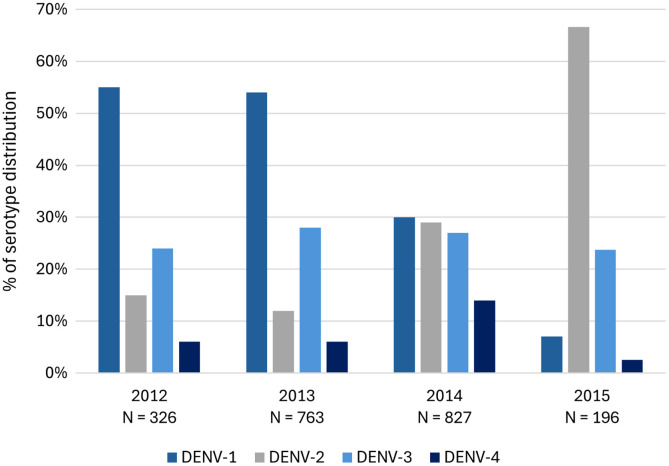
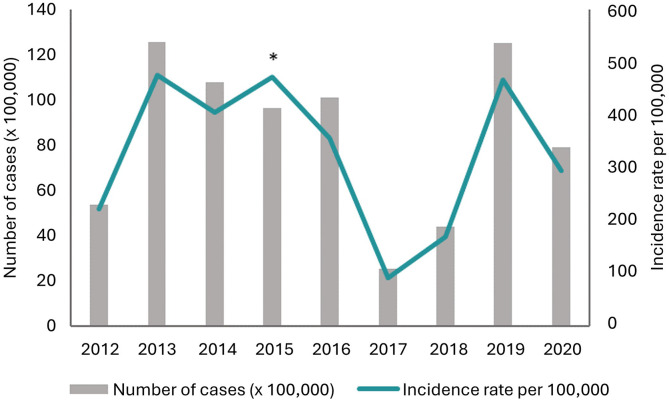
Dengue is the most important viral vector-borne disease in the tropics, with Colombia being one of the most affected countries. In this context, it is essential to identify and synthesize the existing evidence on the epidemiology of dengue in Colombia. A systematic review (PROSPERO CRD42021257985) was conducted by searching for epidemiological data in populations with suspected or confirmed dengue in Colombia from 2012 to 2020. We searched PubMed, EMBASE, the Cochrane Library, the LILACS, and SciELO databases, and 104 publications out of 1,234 records were selected. The dengue annual incidence rate varied through the years without a clear trend. The lowest annual incidence rate was observed in 2017 (90.7 per 100,000 population) and the highest in 2013 (476.2 per 100,000 population). The proportion of severe cases in the same period ranged between 0.89% in 2016 and 2.7% in 2012. The four dengue virus (DENV) serotypes co-circulated in the country, and DENV-2 was the predominant serotype. Fifty percent of dengue cases occurred in people under 20 years, and those between 5 and 14 years had the highest incidence rate. The mortality rate for all dengue cases ranged from 0.07% in 2020 to 0.16% in 2012 and 2015. In conclusion, dengue is a hyperendemic disease in Colombia with the circulation of four serotypes. New strategies must be implemented to prevent the contagion and impact of the disease on the population at risk.
登革热是热带地区最重要的病毒性媒介传播疾病,哥伦比亚是受影响最严重的国家之一。在此背景下,识别并综合哥伦比亚登革热流行病学的现有证据至关重要。通过检索2012年至2020年哥伦比亚疑似或确诊登革热人群的流行病学数据,进行了一项系统综述(PROSPERO CRD42021257985)。我们检索了PubMed、EMBASE、Cochrane图书馆、LILACS和SciELO数据库,从1234条记录中筛选出104篇出版物。登革热的年发病率多年来有所变化,没有明显趋势。2017年观察到最低年发病率(每10万人口90.7例),2013年最高(每10万人口476.2例)。同期重症病例的比例在2016年的0.89%至2012年的2.7%之间。该国四种登革热病毒(DENV)血清型共同流行,DENV-2是主要血清型。50%的登革热病例发生在20岁以下人群中,5至14岁人群的发病率最高。所有登革热病例的死亡率在2020年为0.07%,在2012年和2015年为0.16%。总之,登革热在哥伦比亚是一种高度地方性疾病,有四种血清型流行。必须实施新的策略来预防疾病的传播及其对高危人群的影响。