Universidad El Bosque, Grupo de Virología, Bogotá, Colombia.
Universidad El Bosque, Grupo de Virología, Bogotá, Colombia.
Braz J Infect Dis. 2020 Jan-Feb;24(1):13-24. doi: 10.1016/j.bjid.2019.11.003. Epub 2019 Dec 13.
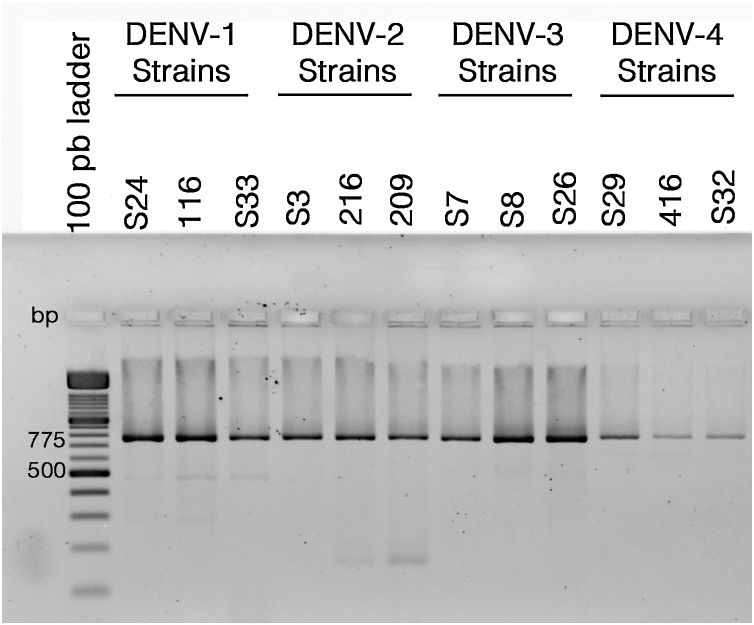
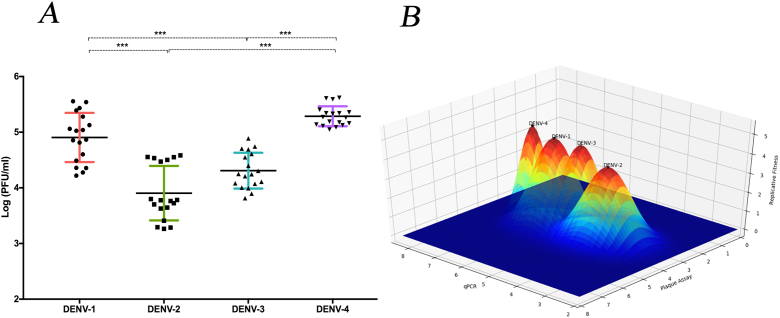
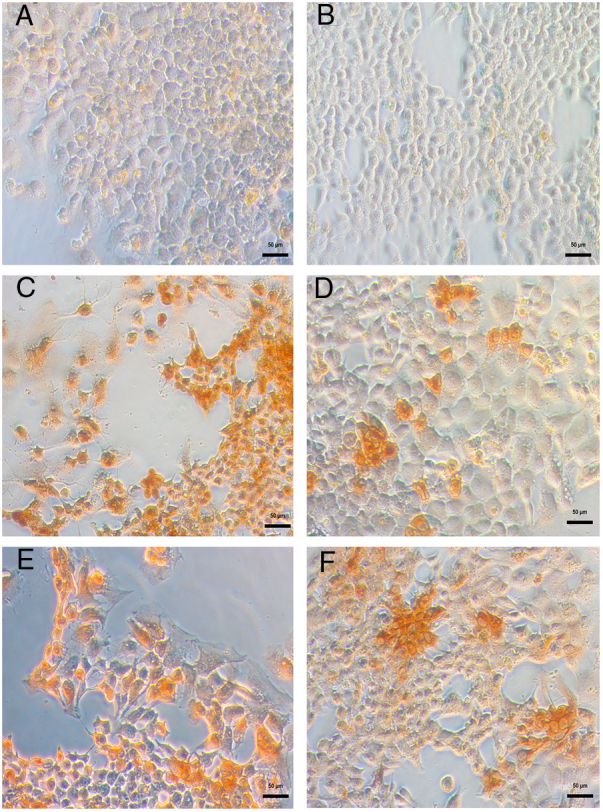
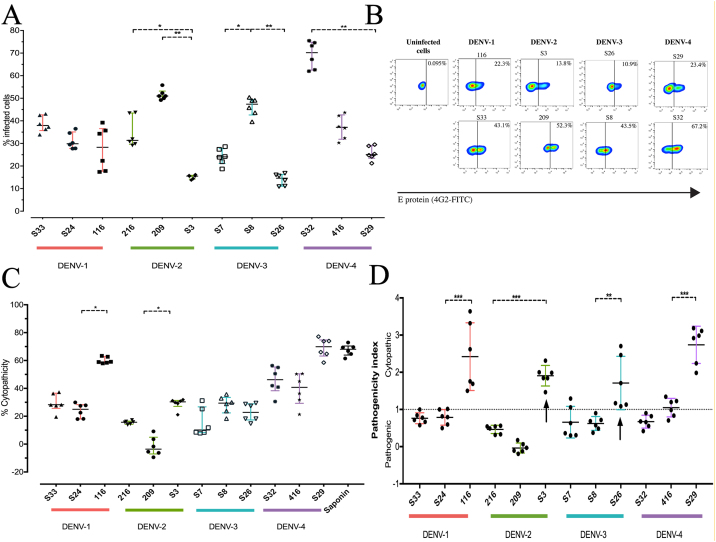
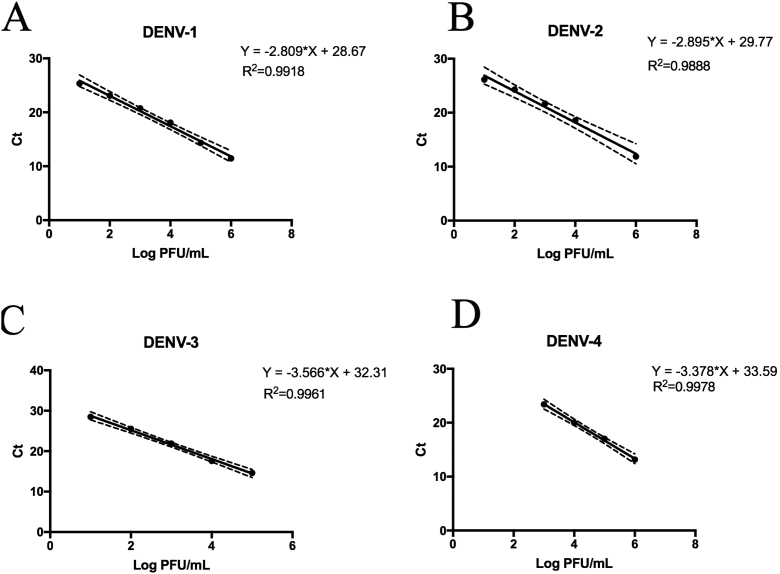
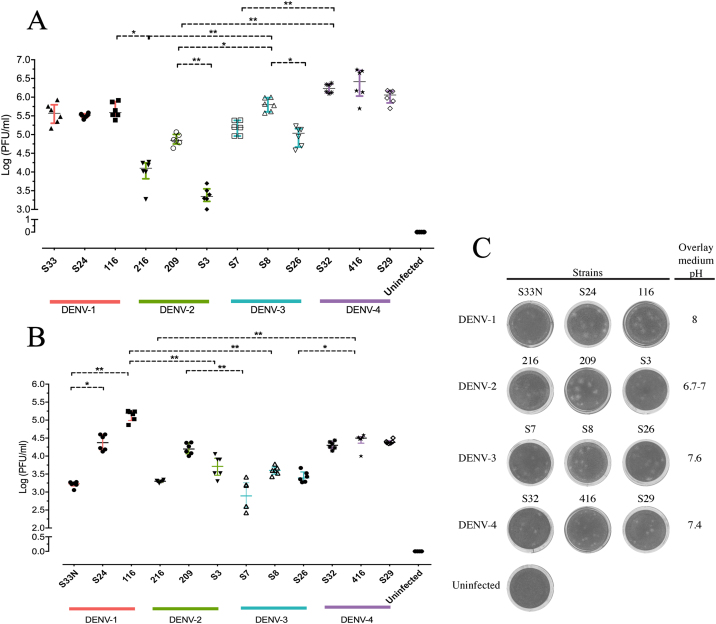
Dengue has been a significant public health problem in Colombia since the simultaneous circulation of the four dengue virus serotypes. The replicative fitness of dengue is a biological feature important for virus evolution and contributes to elucidating the behavior of virus populations and viral pathogenesis. However, it has not yet been studied in Colombian isolates. This study aimed to compare the replicative fitness of the four dengue virus serotypes and understand the association between the serotypes, their in vitro infection ability, and their replication in target cells. We used three isolates of each DENV serotype to infect Huh-7 cells at an MOI of 0.5. The percentage of infected cells was evaluated by flow cytometry, cell viability was evaluated by MTT assay, and the pathogenicity index was calculated as a ratio of both parameters. The replicative fitness was measured by the number of viral genome copies produced using quantitative PCR and the production of infectious viral progeny was measured by plaque assay. We showed that Huh-7 cells were susceptible to infection with all the different strain isolates. Nevertheless, the biological characteristics, such as infectious ability and cell viability, were strain-dependent. We also found different degrees of pathogenicity between strains of the four serotypes, representative of the heterogeneity displayed in the circulating population. When we analyzed the replicative fitness using the mean values obtained from RT-qPCR and plaque assay for the different strains, we found serotype-dependent behavior. The highest mean values of replicative fitness were obtained for DENV-1 (log 4.9 PFU/ml) and DENV-4 (log 5.28 PFU/ml), followed by DENV-2 (log 3.9 PFU/ml) and DENV-3 (log 4.31 PFU/ml). The internal heterogeneity of the replicative fitness within each serotype could explain the simultaneous circulation of the four DENV serotypes in Colombia.
登革热自四种登革病毒血清型同时流行以来,一直是哥伦比亚的一个重大公共卫生问题。登革热的复制适应性是病毒进化的一个重要生物学特征,有助于阐明病毒群体的行为和病毒发病机制。然而,在哥伦比亚分离株中尚未对其进行研究。本研究旨在比较四种登革热病毒血清型的复制适应性,并了解血清型之间的关联,它们在体外感染能力及其在靶细胞中的复制。我们使用每个 DENV 血清型的三个分离株,以 MOI 为 0.5 感染 Huh-7 细胞。通过流式细胞术评估感染细胞的百分比,通过 MTT 测定评估细胞活力,将两者的比值作为致病指数计算。通过定量 PCR 测量产生的病毒基因组拷贝数来衡量复制适应性,并通过噬斑测定测量传染性病毒后代的产生。我们表明,Huh-7 细胞易受不同株系分离株的感染。然而,如感染能力和细胞活力等生物学特征则取决于株系。我们还发现四种血清型之间的菌株存在不同程度的致病性,这代表了循环群体中显示的异质性。当我们使用来自不同株系的 RT-qPCR 和噬斑测定获得的平均值分析复制适应性时,我们发现了血清型依赖性行为。从 DENV-1(log 4.9 PFU/ml)和 DENV-4(log 5.28 PFU/ml)获得的复制适应性最高平均值,其次是 DENV-2(log 3.9 PFU/ml)和 DENV-3(log 4.31 PFU/ml)。每个血清型内复制适应性的内部异质性可以解释四种 DENV 血清型在哥伦比亚的同时流行。