Addisu Bedasa, Sefew Asnakew Tesfahun, Milkit Abiyu, Hika Amanuel, Kelem Amanuel, Hirigo Agete Tadewos
Department of Medical Laboratory Science, College of Medicine and Health Sciences, Debre Berhan University, Debre Berhan, Ethiopia.
Department of Medical Laboratory Sciences, Asrat Woldeyes Health Science Campus, Debre Berhan University, Debre Berhan, Ethiopia.
Nutr Metab Insights. 2024 Oct 16;17:11786388241288668. doi: 10.1177/11786388241288668. eCollection 2024.
Individuals who have hyperuricemia are at increased risk of cardiovascular diseases due to factors such as endothelial dysfunction, insulin resistance, and increased production of oxygen-free radicals. However, data on the prevalence and predictors of hyperuricemia among adults with cardiac diseases in Ethiopia are limited.
A cross-sectional study was conducted on 269 participants at the Ambo University referral hospital from June to September, 2022. Participant demographics and relevant data were obtained through convenient sampling. Hyperuricemia was defined according to the manufacturer's cutoff criteria. Data entry and analysis were conducted using SPSS 25. The association between the outcome and explanatory variables was assessed using a binary logistic regression model.
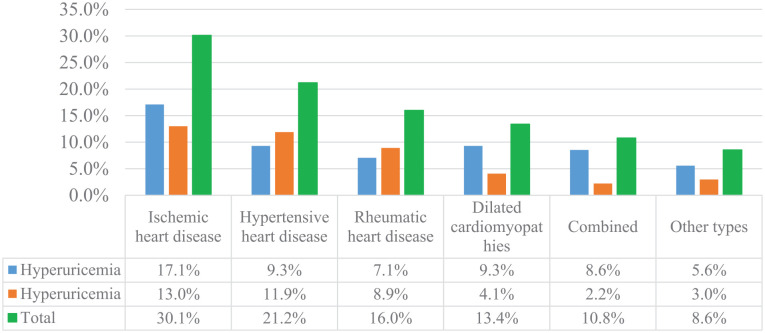
Of the study participants, 56.9% were male. The mean age of participants was 51.1 years (±15.8). The prevalence of hyperuricemia was 43.1% (95% CI: 37.1-49.1). Males presented a significantly higher prevalence of hyperuricemia compared to females (23.4% vs 19.7%, = .026). Males had 2.9 times higher odds of hyperuricemia compared to females. Significant associations with the prevalence of hyperuricemia were found for individuals with a BMI ⩾30 kg/m, age ⩾54 years, and male gender, with adjusted odds ratios (95% CI) of 2.3 (1.7-5.2), 2.9 (2.2-5.9), and 3.56 (2.1-12.8), respectively. Additionally, smoking, dyslipidemia, and waist circumference were also significantly associated with the prevalence of hyperuricemia.
Nearly half of the cardiac patients in the study were diagnosed with hyperuricemia. These findings underscores the importance of early identification and treatment of hyperuricemia, alongside lifestyle and behavioral modifications, to maintain the quality of life in this specific population.
高尿酸血症患者由于内皮功能障碍、胰岛素抵抗和氧自由基产生增加等因素,患心血管疾病的风险增加。然而,埃塞俄比亚心脏病成人患者中高尿酸血症的患病率和预测因素的数据有限。
2022年6月至9月,在安博大学转诊医院对269名参与者进行了一项横断面研究。通过便利抽样获取参与者的人口统计学和相关数据。根据制造商的临界值标准定义高尿酸血症。使用SPSS 25进行数据录入和分析。使用二元逻辑回归模型评估结果与解释变量之间的关联。
在研究参与者中,56.9%为男性。参与者的平均年龄为51.1岁(±15.8)。高尿酸血症的患病率为43.1%(95%CI:37.1-49.1)。男性高尿酸血症的患病率显著高于女性(23.4%对19.7%,P = 0.026)。男性患高尿酸血症的几率是女性的2.9倍。发现BMI⩾30kg/m、年龄⩾54岁和男性与高尿酸血症的患病率有显著关联,调整后的优势比(95%CI)分别为2.3(1.7-5.2)、2.9(2.2-5.9)和3.56(2.1-12.8)。此外,吸烟、血脂异常和腰围也与高尿酸血症的患病率显著相关。
该研究中近一半的心脏病患者被诊断为高尿酸血症。这些发现强调了早期识别和治疗高尿酸血症以及改变生活方式和行为的重要性,以维持这一特定人群的生活质量。