Ariyasingha Nuwandi M, Samoilenko Anna, Chowdhury Md Raduanul H, Nantogma Shiraz, Oladun Clementinah, Birchall Jonathan R, Bawardi Tarek, Salnikov Oleg G, Kovtunova Larisa M, Bukhtiyarov Valerii I, Shi Zhongjie, Luo Kehuan, Tan Sidhartha, Koptyug Igor V, Goodson Boyd M, Chekmenev Eduard Y
Department of Chemistry, Karmanos Cancer Institute (KCI), Integrative Biosciences (Ibio), Wayne State University, Detroit, Michigan 48202, United States.
International Tomography Center SB RAS, 3A Institutskaya St., Novosibirsk 630090, Russia.
Chem Biomed Imaging. 2024 Jul 25;2(10):698-710. doi: 10.1021/cbmi.4c00041. eCollection 2024 Oct 28.
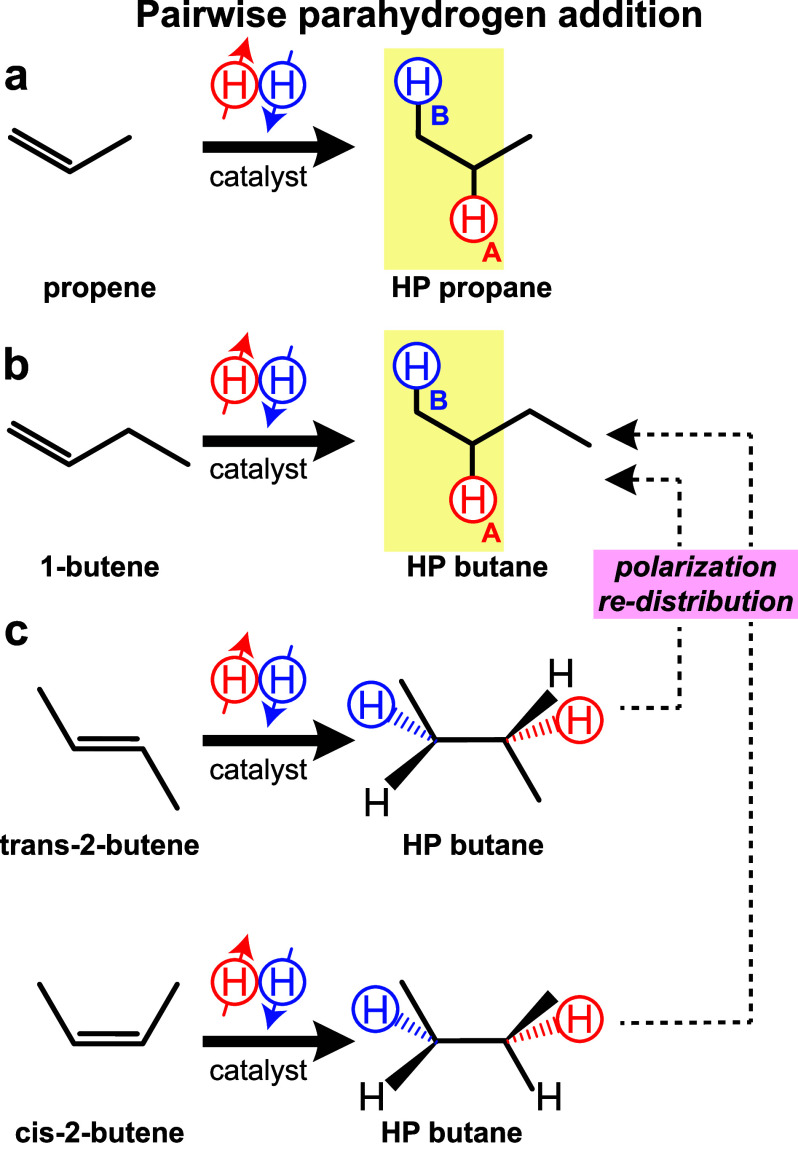
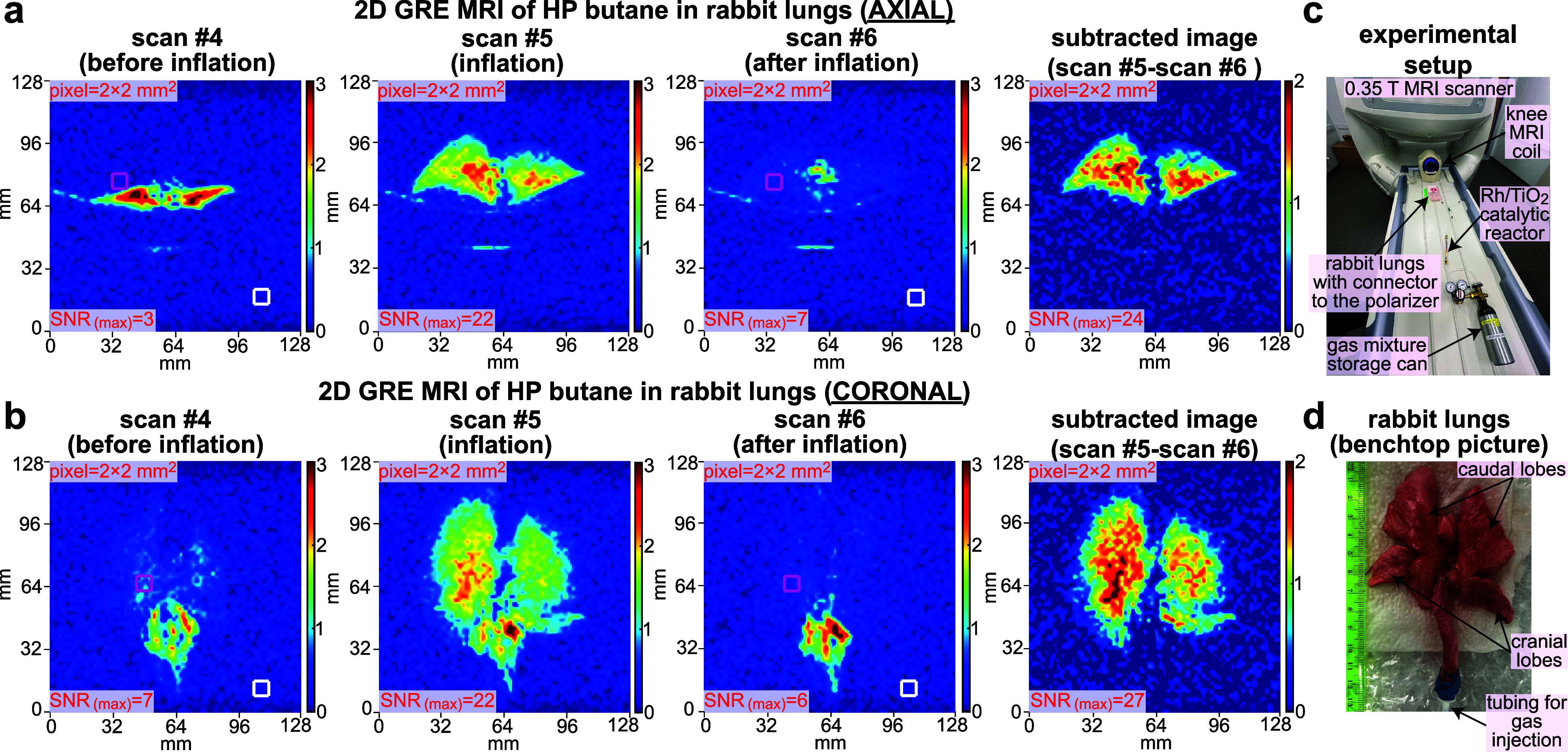
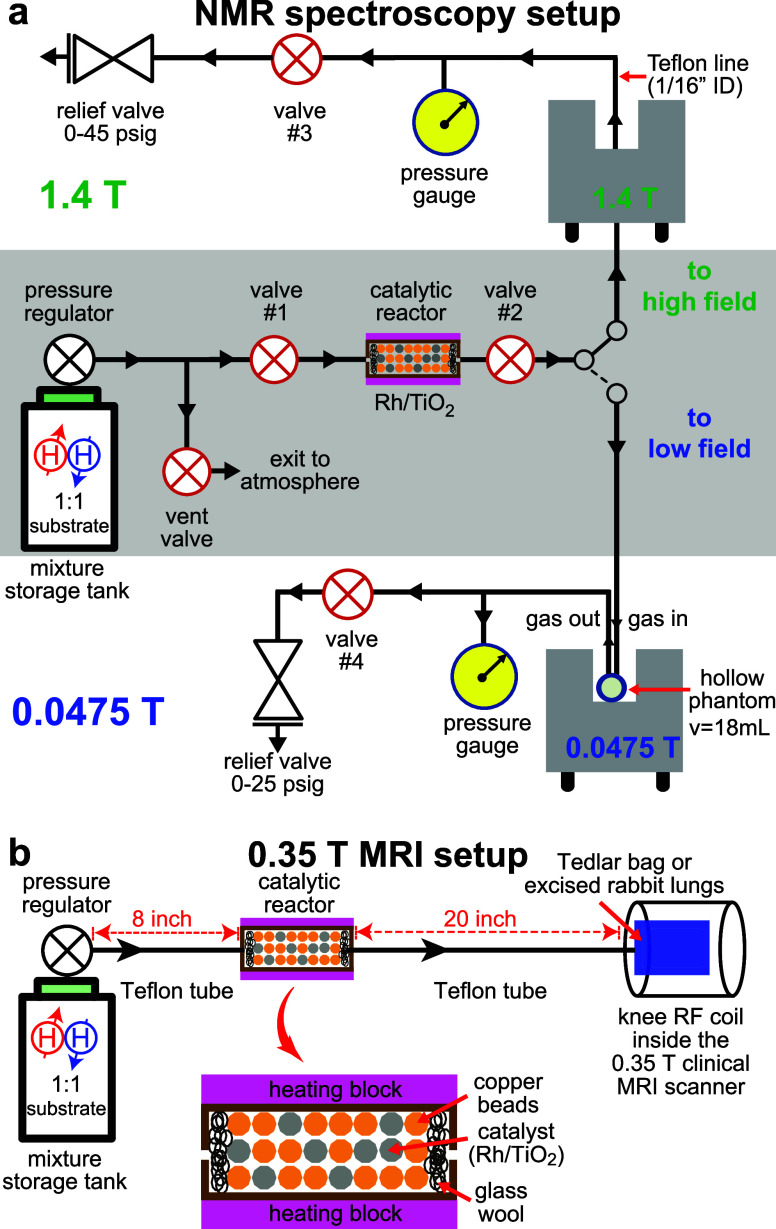
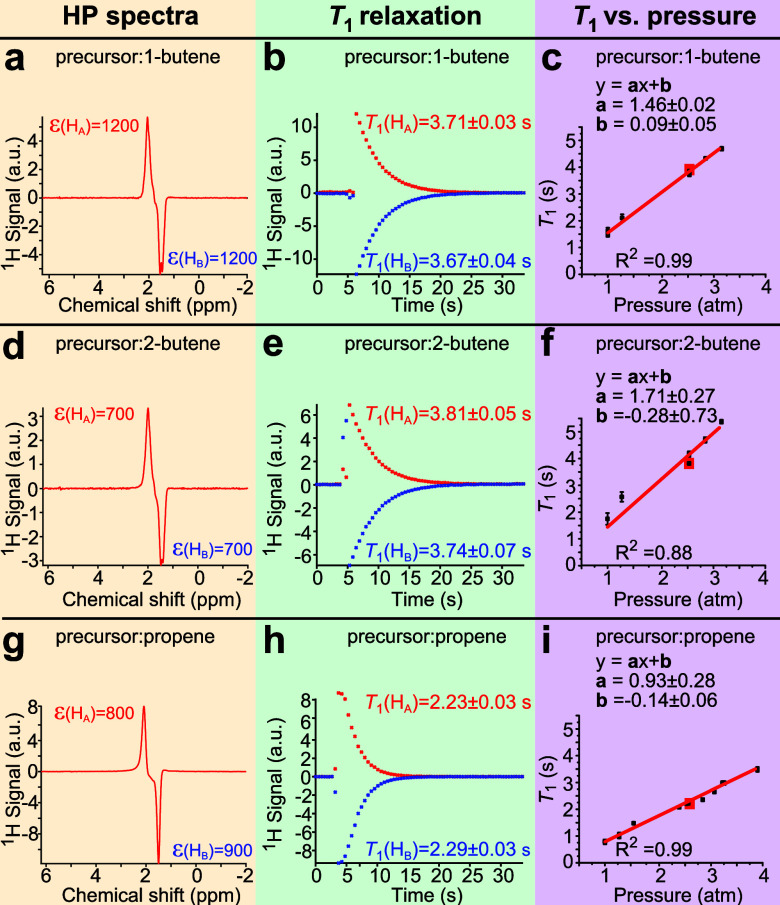
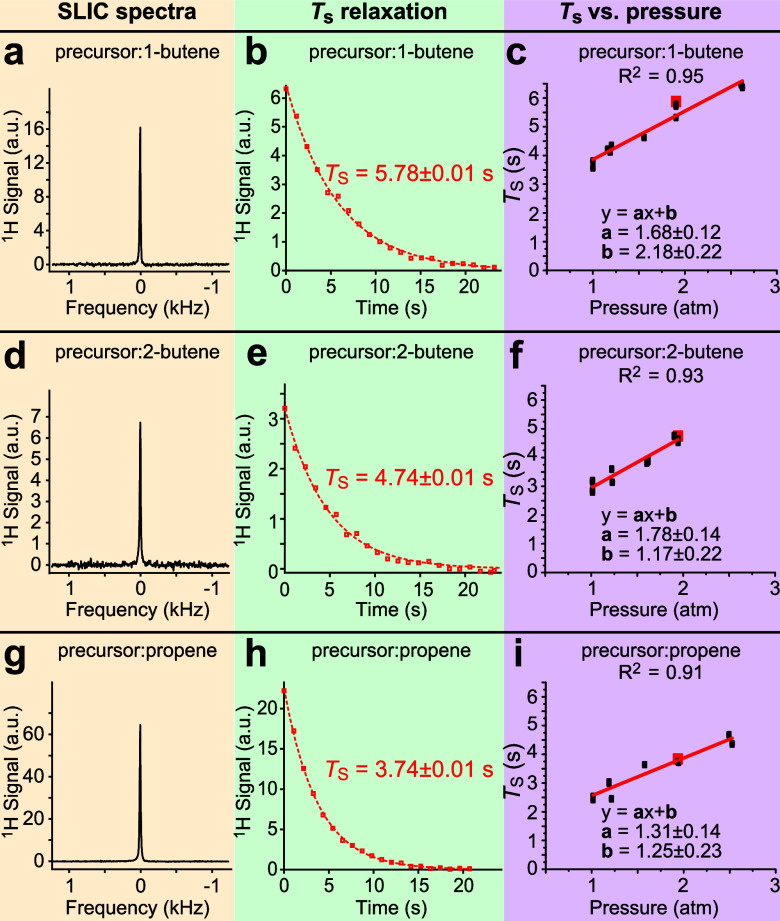
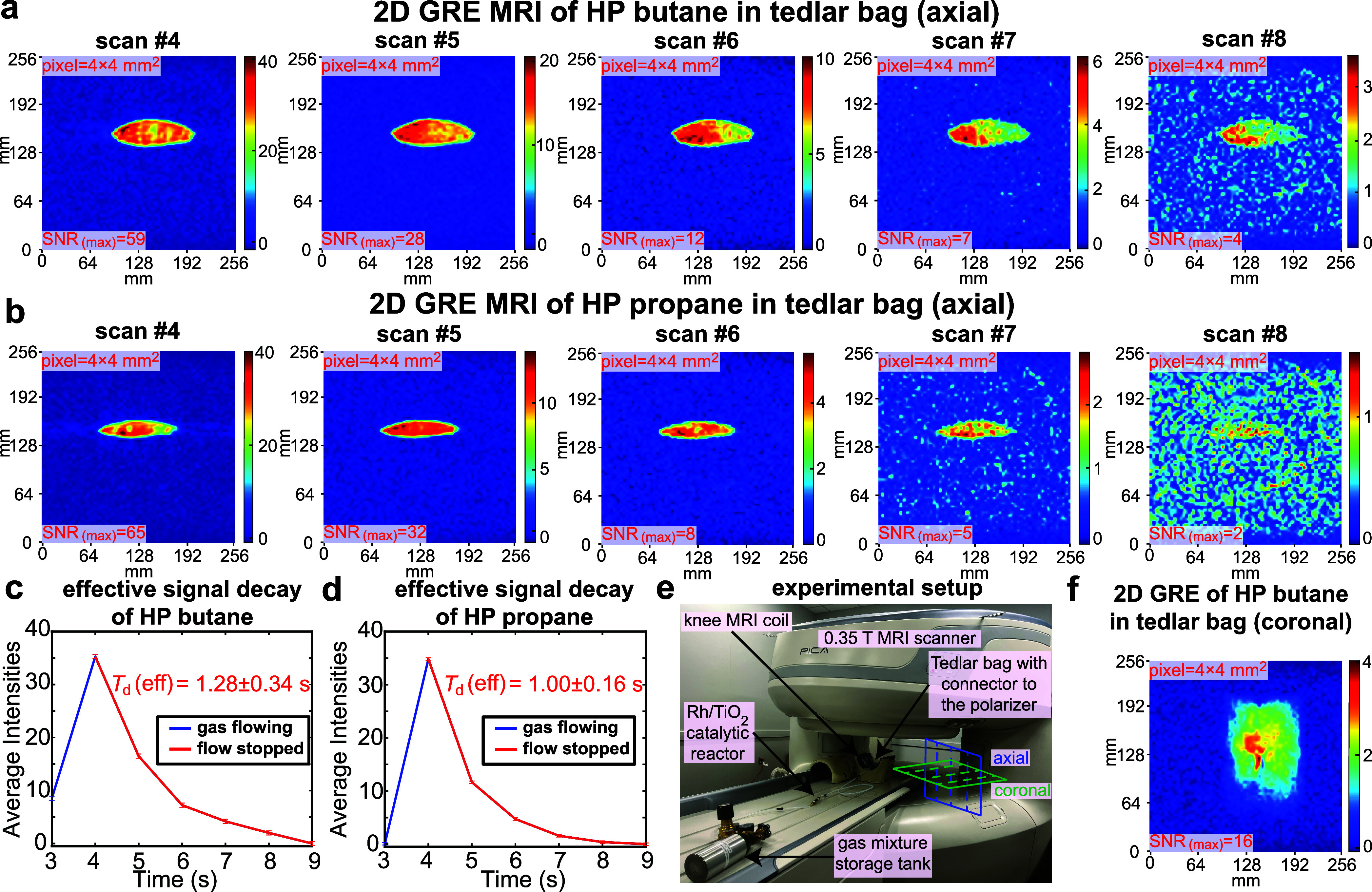
NMR hyperpolarization dramatically improves the detection sensitivity of magnetic resonance through the increase in nuclear spin polarization. Because of the sensitivity increase by several orders of magnitude, additional applications have been unlocked, including imaging of gases in physiologically relevant conditions. Hyperpolarized Xe gas recently received FDA approval as the first inhalable gaseous MRI contrast agent for clinical functional lung imaging of a wide range of pulmonary diseases. However, production and utilization of hyperpolarized Xe gas faces a number of translational challenges including the high cost and complexity of contrast agent production and imaging using proton-only (i.e., conventional) clinical MRI scanners, which are typically not suited to scan Xe nuclei. As a solution to circumvent the translational challenges of hyperpolarized Xe, we have recently demonstrated the feasibility of a simple and cheap process for production of proton-hyperpolarized propane gas contrast agent using ultralow-cost disposable production equipment and demonstrated the feasibility of lung ventilation imaging using hyperpolarized propane gas in excised pig lungs. However, previous pilot studies have concluded that the hyperpolarized state of propane gas decays very fast with an exponential decay constant of ∼0.8 s at 1 bar (physiologically relevant pressure); moreover, the previously reported production rates were too slow for potential clinical utilization. Here, we investigate the feasibility of high-capacity production of hyperpolarized butane gas via heterogeneous parahydrogen-induced polarization using Rh nanoparticle-based catalyst utilizing butene gas as a precursor for parahydrogen pairwise addition. We demonstrate a remarkable result: the lifetime of the hyperpolarized state can be nearly doubled compared to that of propane ( of ∼1.6 s and long-lived spin-state of ∼3.8 s at clinically relevant 1 bar pressure). Moreover, we demonstrate a production speed of up to 0.7 standard liters of hyperpolarized gas per second. These two synergistic developments pave the way to biomedical utilization of -hyperpolarized gas media for ventilation imaging. Indeed, here we demonstrate the feasibility of phantom imaging of hyperpolarized butane gas in Tedlar bags and also the feasibility of subsecond 2D ventilation gas imaging in excised rabbit lungs with 1.6 × 1.6 mm in-plane resolution using a clinical MRI scanner. The demonstrated results have the potential to revolutionize functional pulmonary imaging with a simple and inexpensive on-demand production of -hyperpolarized gas contrast media, followed by visualization on virtually any MRI scanner, including emerging bedside low-field MRI scanner technology.
核磁共振超极化通过增加核自旋极化显著提高了磁共振的检测灵敏度。由于灵敏度提高了几个数量级,开启了更多应用,包括在生理相关条件下对气体进行成像。超极化氙气最近获得了美国食品药品监督管理局(FDA)的批准,成为首个用于多种肺部疾病临床功能肺成像的可吸入气态磁共振成像造影剂。然而,超极化氙气的生产和应用面临诸多转化挑战,包括造影剂生产成本高且复杂,以及使用仅用于质子(即传统)的临床磁共振成像扫描仪进行成像,这类扫描仪通常不适合扫描氙原子核。作为克服超极化氙转化挑战的解决方案,我们最近证明了使用超低成本一次性生产设备生产质子超极化丙烷气体造影剂的简单且廉价方法的可行性,并证明了在切除的猪肺中使用超极化丙烷气体进行肺通气成像的可行性。然而,先前的初步研究得出结论,丙烷气体的超极化状态衰减非常快,在1巴(生理相关压力)下的指数衰减常数约为0.8秒;此外,先前报道的生产率对于潜在的临床应用来说太慢。在此,我们研究了使用基于铑纳米颗粒的催化剂,以丁烯气体作为仲氢成对加成的前体,通过多相仲氢诱导极化高容量生产超极化丁烷气体的可行性。我们展示了一个显著的结果:与丙烷相比,超极化状态的寿命几乎可以翻倍(在临床相关的1巴压力下, 约为1.6秒,长寿命自旋态 约为3.8秒)。此外,我们展示了高达每秒0.7标准升超极化气体的生产速度。这两个协同发展为超极化气体介质在通气成像的生物医学应用铺平了道路。事实上,在此我们证明了在泰德拉袋中对超极化丁烷气体进行体模成像的可行性,以及使用临床磁共振成像扫描仪在切除的兔肺中以1.6×1.6毫米平面分辨率进行亚秒级二维通气气体成像的可行性。所展示的结果有可能通过简单且廉价地按需生产超极化气体造影剂,随后在几乎任何磁共振成像扫描仪上进行可视化,包括新兴的床边低场磁共振成像扫描仪技术,彻底改变功能性肺成像。