Department of Occupational and Environmental Medicine, Seoul St. Mary's Hospital, College of Medicine, The Catholic University of Korea, Seoul, Korea.
Department of Public Health, Graduate School, The Catholic University of Korea, Seoul, Korea.
J Korean Med Sci. 2024 Nov 4;39(42):e316. doi: 10.3346/jkms.2024.39.e316.
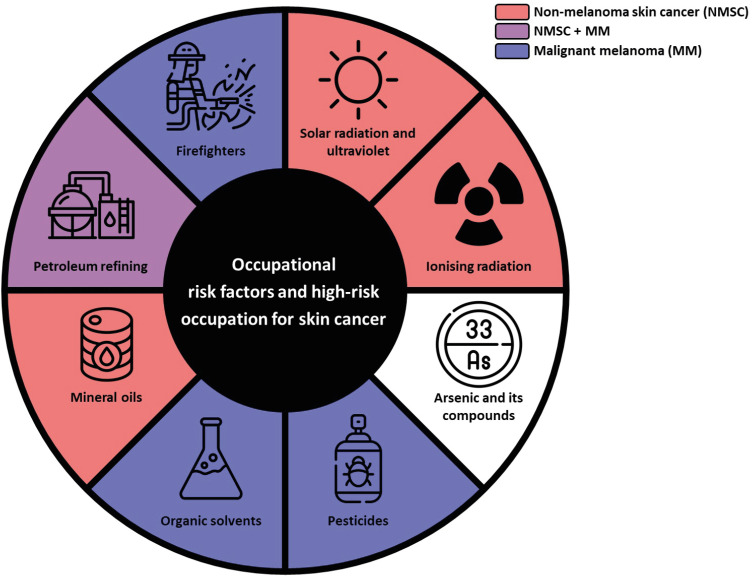
Public health and clinical medicine should identify and characterize modifiable risk factors for skin cancer in order to facilitate primary prevention. In existing literature, the impact of occupational exposure on skin cancer, including malignant melanoma and non-melanoma skin cancers, has been extensively studied. This review summarizes the available epidemiological evidence on the significance of occupational risk factors and occupations associated with a higher risk in skin cancer. The results of this review suggest that there is sufficient epidemiological evidence to support the relationship between the increased risk of non-melanoma skin cancers and occupational exposure to solar radiation, ultraviolet radiation, ionizing radiation, arsenic and its compounds, and mineral oils. Occupational exposure to pesticides and polychlorinated biphenyls appears to provide sufficient epidemiological evidence for melanoma, and a higher risk of melanoma has been reported among workers in petroleum refining and firefighters. This comprehensive analysis will establish a foundation for subsequent investigations and developing targeted interventions of focused preventive measures against skin cancer among the working population.
公共卫生和临床医学应当识别和描述可改变的皮肤癌风险因素,以便于进行初级预防。在现有文献中,职业暴露对皮肤癌(包括恶性黑色素瘤和非黑色素瘤皮肤癌)的影响已得到广泛研究。本综述总结了关于职业危险因素和与皮肤癌风险增加相关的职业的现有流行病学证据的重要性。本综述的结果表明,有足够的流行病学证据支持非黑色素瘤皮肤癌的风险增加与职业性暴露于太阳辐射、紫外线辐射、电离辐射、砷及其化合物和矿物油之间的关系。职业性暴露于杀虫剂和多氯联苯似乎为黑色素瘤提供了足够的流行病学证据,并且据报道,石油炼制和消防员等职业的工人黑色素瘤风险更高。这种全面的分析将为后续研究和制定针对工作人群皮肤癌的有针对性的预防措施奠定基础。