Rivas Manuel, Martinez-Garcia Marina
Universitat Politècnica de Catalunya, Dept d'Enginyeria Química, EEBE, Sant Adriá del Besòs, Spain.
Universitat Jaume I, Dept de Matemàtiques, Castelló, Spain.
Biomed Eng Comput Biol. 2024 Nov 4;15:11795972241272380. doi: 10.1177/11795972241272380. eCollection 2024.
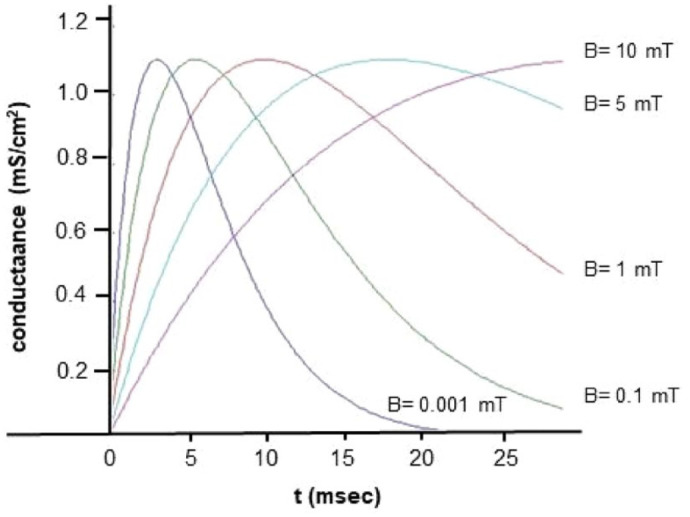
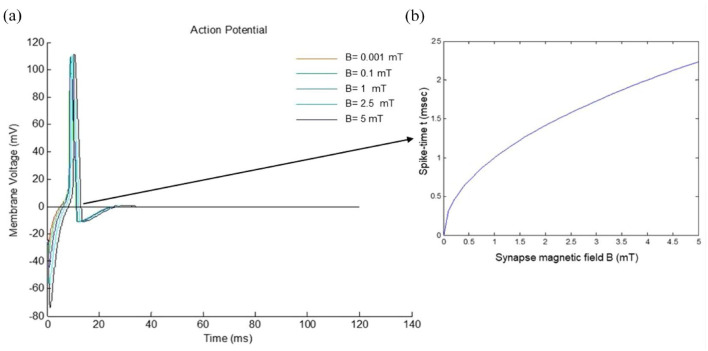
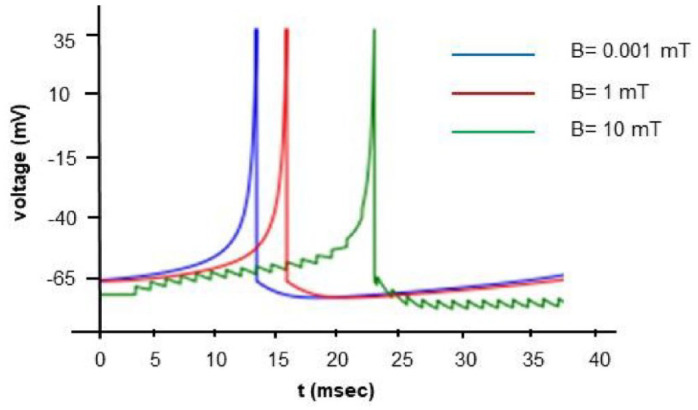
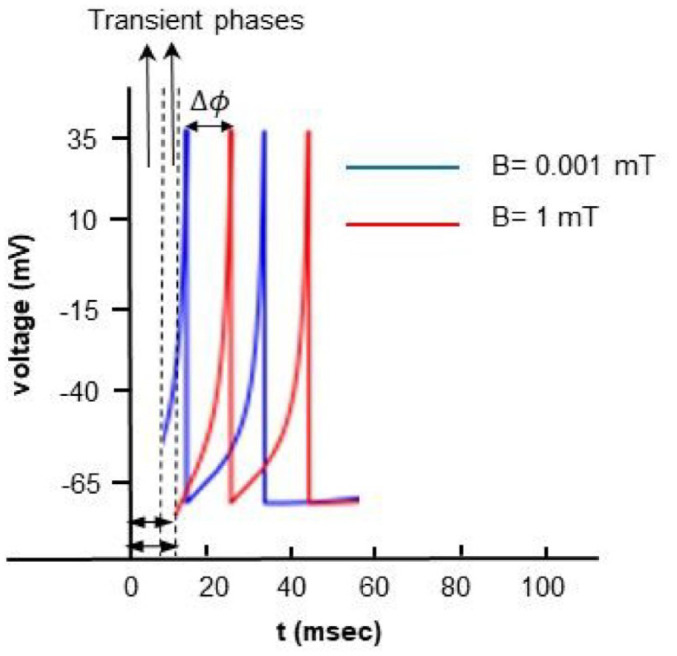
A temporal neural code reliant on the pattern of spike times rather than spike rates offers a feasible mechanism for encoding information from weak periodic external stimuli, such as static or extremely low-frequency electromagnetic fields. Our model focuses on the influence of magnetic fields on neurotransmitter dynamics near the neuron membrane. Neurotransmitter binding to specific receptor sites on membrane proteins can regulate biochemical reactions. The duration a neurotransmitter spends in the bonded state serves as a metric for the magnetic field's capacity as a chemical regulator. By initiating a physical analysis of ligand-receptor binding, utilizing the alpha function for synaptic conductance, and employing a modified version of Bell's law, we quantified the impact of magnetic fields on the bond half-life time and, consequently, on postsynaptic spike timing.
一种依赖于尖峰时间模式而非尖峰速率的时间神经编码为编码来自微弱周期性外部刺激(如静态或极低频电磁场)的信息提供了一种可行的机制。我们的模型聚焦于磁场对神经元膜附近神经递质动力学的影响。神经递质与膜蛋白上特定受体位点的结合可调节生化反应。神经递质处于结合状态的持续时间可作为衡量磁场作为化学调节剂能力的指标。通过对配体 - 受体结合进行物理分析、利用用于突触电导的α函数以及采用贝尔定律的修正版本,我们量化了磁场对结合半衰期的影响,进而对突触后尖峰时间的影响。