Department of Physics, University at Buffalo, Buffalo, United States.
Department of Physics, Philipps University Marburg, Marburg, Germany.
Elife. 2017 Aug 15;6:e27069. doi: 10.7554/eLife.27069.
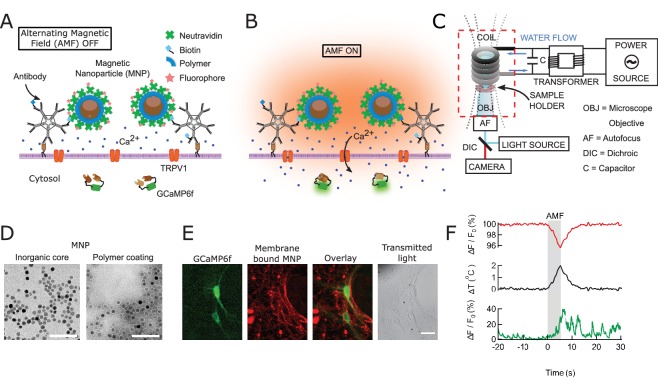
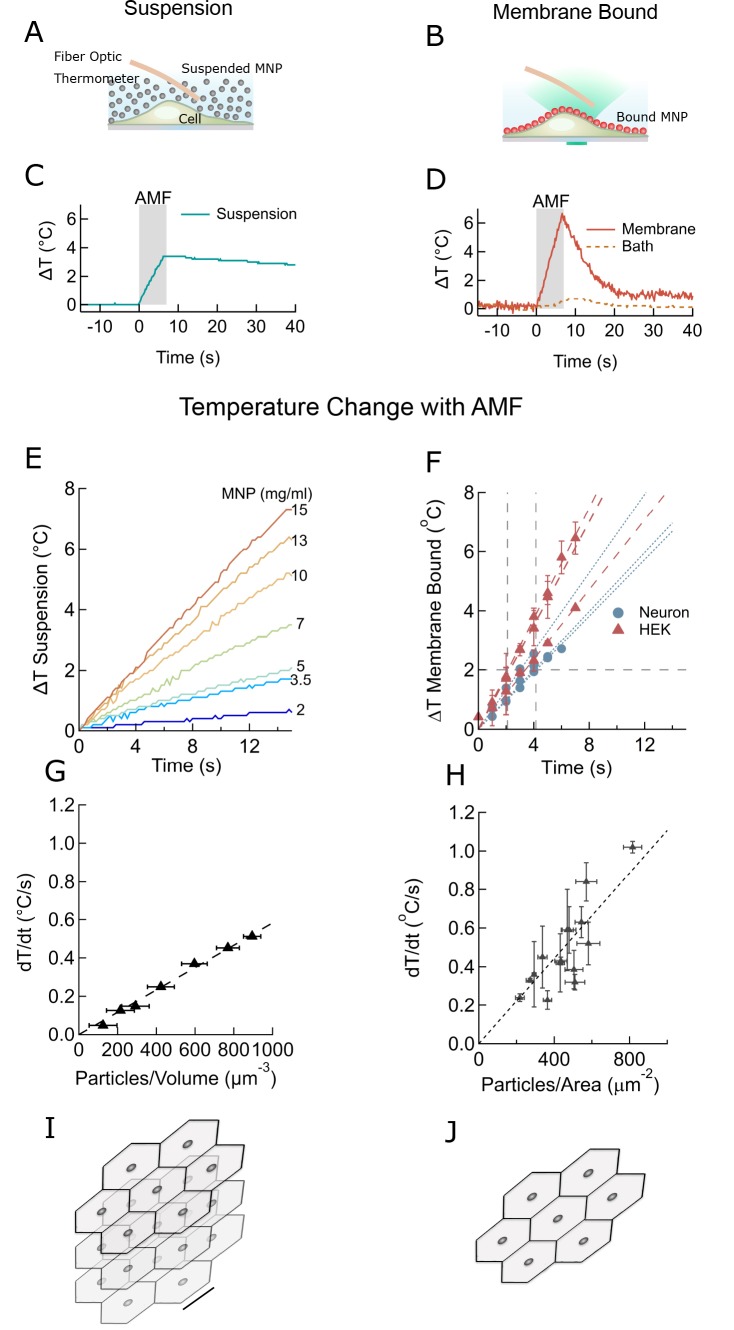
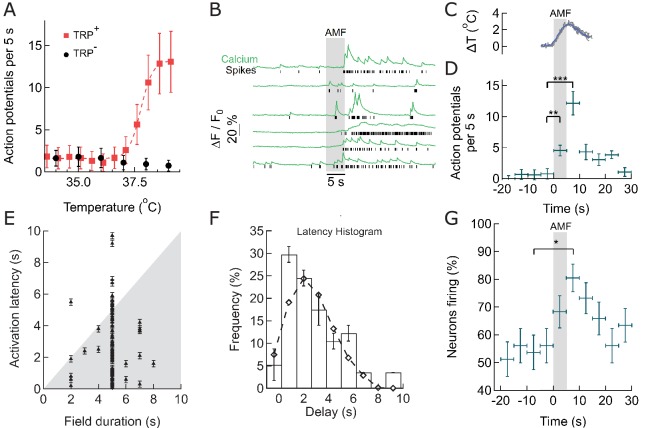
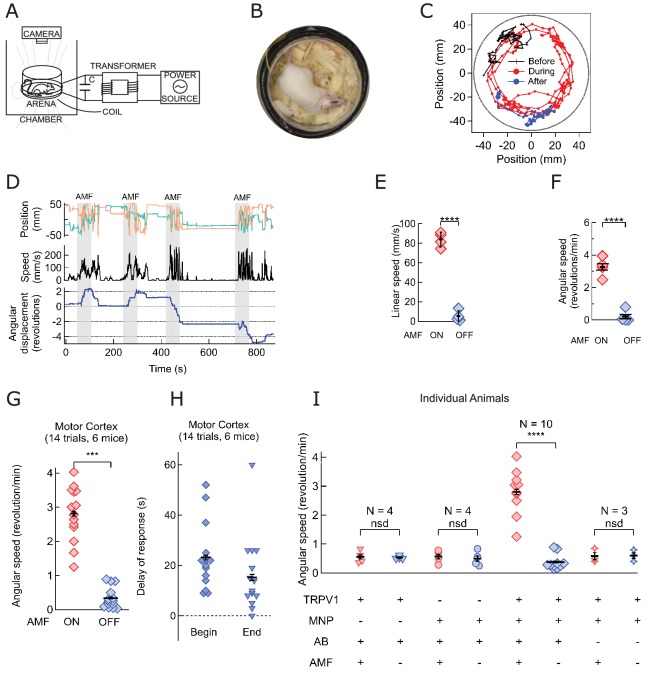
Establishing how neurocircuit activation causes particular behaviors requires modulating the activity of specific neurons. Here, we demonstrate that magnetothermal genetic stimulation provides tetherless deep brain activation sufficient to evoke motor behavior in awake mice. The approach uses alternating magnetic fields to heat superparamagnetic nanoparticles on the neuronal membrane. Neurons, heat-sensitized by expressing TRPV1 are activated with magnetic field application. Magnetothermal genetic stimulation in the motor cortex evoked ambulation, deep brain stimulation in the striatum caused rotation around the body-axis, and stimulation near the ridge between ventral and dorsal striatum caused freezing-of-gait. The duration of the behavior correlated tightly with field application. This approach provides genetically and spatially targetable, repeatable and temporarily precise activation of deep-brain circuits without the need for surgical implantation of any device.
要确定神经回路激活如何引起特定的行为,需要调节特定神经元的活动。在这里,我们证明了磁热遗传刺激提供了无束缚的深部脑激活,足以在清醒的小鼠中引发运动行为。该方法使用交变磁场来加热神经元膜上的超顺磁纳米粒子。通过表达 TRPV1 使神经元对热敏感,然后通过施加磁场来激活它们。在运动皮层中进行磁热遗传刺激会引起步态,在纹状体中进行深部脑刺激会引起身体轴的旋转,而在腹侧和背侧纹状体之间的脊附近进行刺激会引起步态冻结。行为的持续时间与磁场的应用紧密相关。这种方法提供了基因和空间上可靶向、可重复和暂时精确的深部脑回路激活,而无需手术植入任何设备。