Iljinaitė Veronika, Šiupšinskas Laimonas, Berškienė Kristina
Movement Diagnostics Clinic.
Department of Sports Medicine Lithuanian University of Health Sciences.
Int J Sports Phys Ther. 2024 Nov 1;19(11):1455-1464. doi: 10.26603/001c.124998. eCollection 2024.
It is important to assess the quality of fundamental movements, to discover deficits, evaluate mobility, balance, and stability, and identify movement dysfunction and asymmetries. However, little research has been performed on the assessment of fundamental movements with bodybuilders.
The purpose of this research was to examine the quality of professional and amateur bodybuilders' functional movements and the quality of the back squat performance. A secondary purpose was to discern whether greater experience in bodybuilding was associated with better scores on the back squat assessement (BSA).
Cross-Sectional Cohort.
Twenty-six athletes were recruited to participate. The group of professional bodybuilders consisted of five men and six women, a total of 11 athletes. The group of amateur bodybuilders consisted of seven men and eight women, a total of 15 athletes. The Functional Movement Screen™ (FMS™) was used to assess the seven included fundamental patterns that evaluate an individual's neuromuscular control, mobility, balance, and stability. The BSA was used to assess the quality of movement, dysfunction, deficit, or compensation during the squat exercise. Statistical analyses applied non-parametric tests (Wilcoxon, Mann-Whitney U, and Friedman's) for dependent and independent samples, with significance set at p<0.05, and the Spearman correlation coefficient and Chi-square test were used to assess relationships between quantitative and qualitative variables.
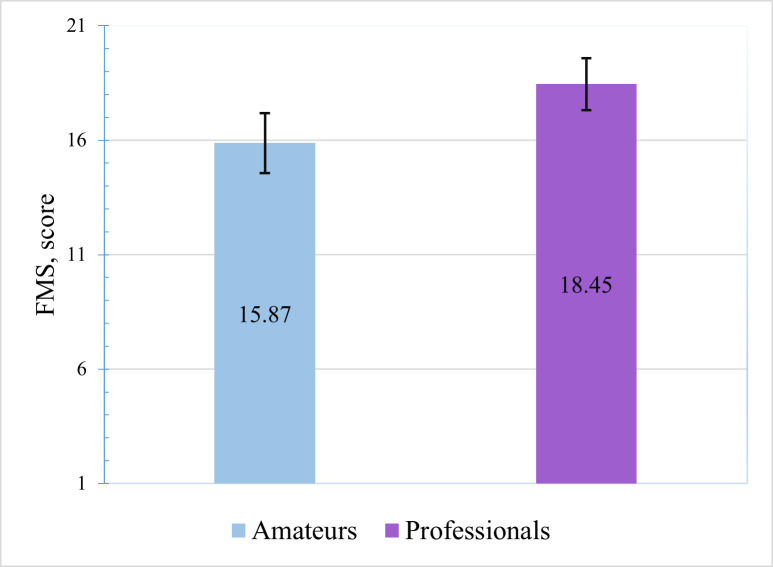
Overall, athletes with a higher total FMS™ score performed better on the BSA as well. The professional athletes scored 2.58 points higher than the amateurs on total FMS™ scores (p<0.001).Professional athletes scored better on the BSA than amateurs (p<0.001). A statistically significant, positive moderate correlation was revealed between the FMS™ total score and the squat total score (r=0.68; p=0.005).
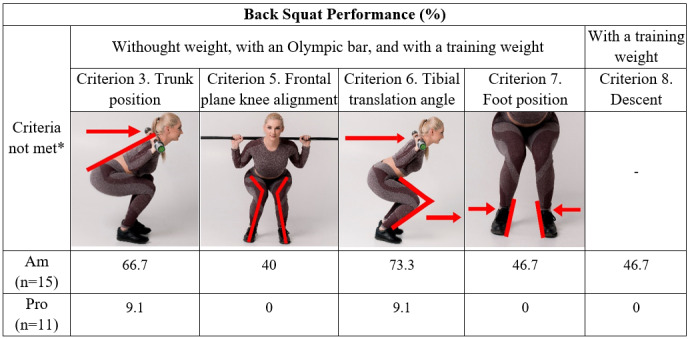
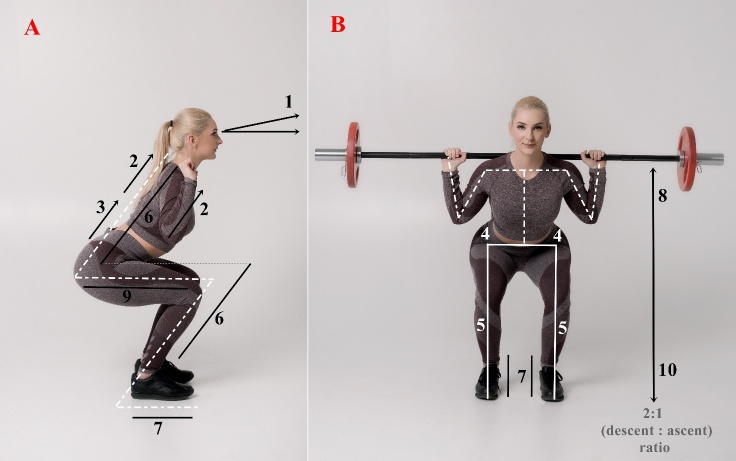
A higher FMS™ score in bodybuilders is associated with a higher BSA score. Professional bodybuilders have higher FMS™ scores and higher BSA scores than amateurs. Greater experience in bodybuilding is associated with the compliance with several BSA criteria: trunk position, frontal knee alignment, tibial translation angle, foot position in all three back squat variations with different external loads, and descent with the training weight.
3b.
评估基本动作的质量、发现缺陷、评估灵活性、平衡和稳定性以及识别动作功能障碍和不对称性很重要。然而,针对健美运动员基本动作评估的研究很少。
本研究的目的是检查职业和业余健美运动员功能性动作的质量以及后深蹲表现的质量。第二个目的是辨别在健美运动中更丰富的经验是否与后深蹲评估(BSA)中更好的分数相关。
横断面队列研究。
招募了26名运动员参与。职业健美运动员组由5名男性和6名女性组成,共11名运动员。业余健美运动员组由7名男性和8名女性组成,共15名运动员。功能性动作筛查(FMS™)用于评估所包含的七种基本模式,这些模式可评估个体的神经肌肉控制、灵活性、平衡和稳定性。BSA用于评估深蹲练习期间的动作质量、功能障碍、缺陷或代偿情况。统计分析对相关和独立样本应用非参数检验(威尔科克森检验、曼-惠特尼U检验和弗里德曼检验),显著性设定为p<0.05,斯皮尔曼相关系数和卡方检验用于评估定量和定性变量之间的关系。
总体而言,FMS™总分较高的运动员在BSA上的表现也更好。职业运动员的FMS™总分比业余运动员高2.58分(p<0.001)。职业运动员在BSA上的得分比业余运动员高(p<0.001)。FMS™总分与深蹲总分之间存在统计学上显著的正中度相关性(r=0.68;p=0.005)。
健美运动员中较高的FMS™分数与较高的BSA分数相关。职业健美运动员的FMS™分数和BSA分数高于业余运动员。在健美运动中更丰富的经验与符合多项BSA标准相关:躯干位置、额状面膝关节对线、胫骨平移角度、在三种不同外部负荷的后深蹲变化中的足部位置以及使用训练重量下蹲。
3b。