Department of Biomedical Sciences for Health, Università degli Studi di Milano, via Giuseppe Colombo 71, 20133 Milano, Italy.
IRCCS Galeazzi Orthopaedic Institute, 20122 Milano, Italy.
Int J Environ Res Public Health. 2021 Jan 18;18(2):772. doi: 10.3390/ijerph18020772.
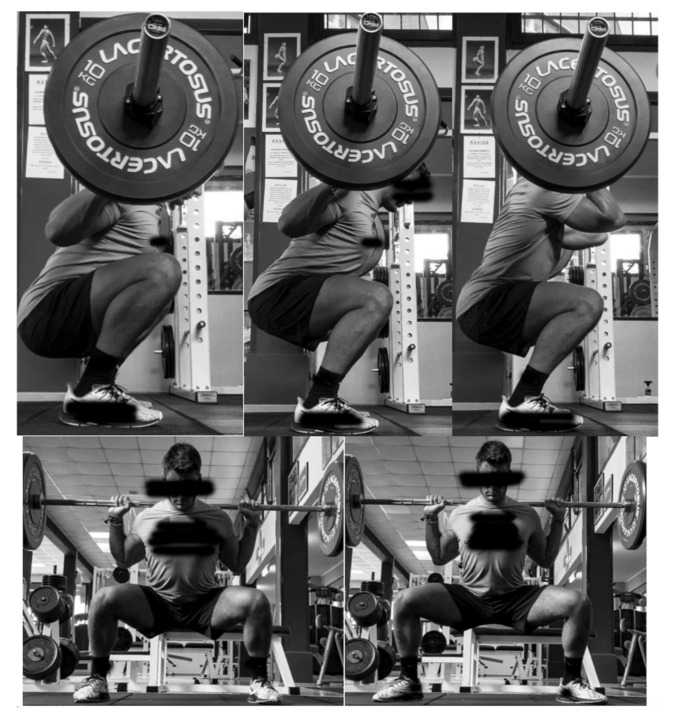
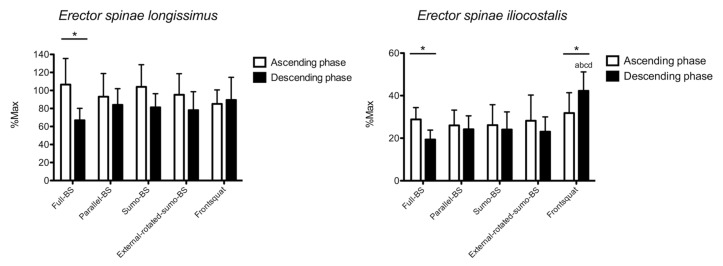
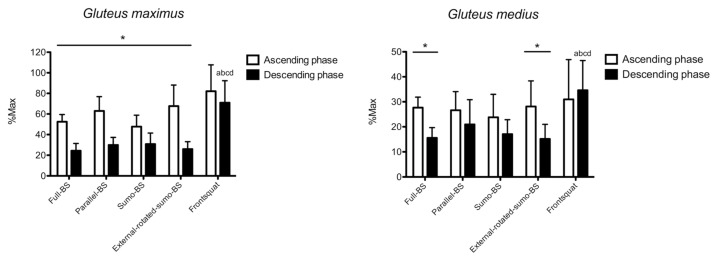
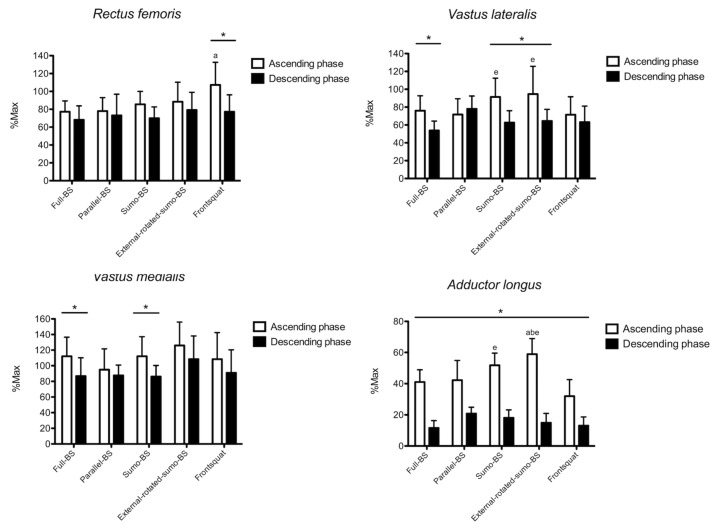
The present study investigated the activation of gluteal, thigh, and lower back muscles in different squat variations. Ten male competitive bodybuilders perform back-squat at full (full-BS) or parallel (parallel-BS) depth, using large feet-stance (sumo-BS), and enhancing the feet external rotation (external-rotated-sumo-BS) and front-squat (FS) at 80% 1-RM. The normalized surface electromyographic root-mean-square (sEMG RMS) amplitude of and was recorded during both the ascending and descending phase of each exercise. During the descending phase, greater sEMG RMS amplitude of and was found in FS vs. all other exercises ( < 0.05). Additionally, FS elicited more than all other exercises. During the ascending phase, both sumo-BS and external-rotated-sumo-BS showed greater and activation compared to all other exercises ( < 0.05). Moreover, activation was greater in FS compared to full-BS ( < 0.05). No between-exercise difference was found in and showed no between-exercise difference. FS needs more backward stabilization during the descending phase. Larger feet-stance increases thigh muscles activity, possibly because of their longer length. These findings show how bodybuilders uniquely recruit muscles when performing different squat variations.
本研究旨在探讨不同深蹲变体中臀肌、大腿肌和下背肌的激活情况。10 名男性竞技健美运动员分别采用全蹲(FS)、平行深蹲(parallel-BS)、大脚掌站位深蹲(sumo-BS)、外旋脚站位深蹲(external-rotated-sumo-BS)和 80%1-RM 的前蹲(FS)进行深蹲。在每个练习的上升和下降阶段,记录 和 的表面肌电均方根(sEMG RMS)幅度。在下降阶段,与其他所有练习相比,FS 时 和 的 sEMG RMS 幅度更大( < 0.05)。此外,FS 比其他所有练习都能引起更多的 。在上升阶段,与其他所有练习相比,sumo-BS 和 external-rotated-sumo-BS 都显示出 和 的更大激活( < 0.05)。此外,与全蹲相比,FS 时 更大( < 0.05)。和 之间没有运动差异。FS 在下降阶段需要更多的向后稳定性。更大的脚掌站位增加了大腿肌肉的活动,可能是因为它们的长度更长。这些发现表明健美运动员在进行不同的深蹲变体时如何独特地募集肌肉。