Department of Sport Performance, National Taiwan University of Sport, Taichung, Taiwan.
Department of Physical Medicine and Rehabilitation, China Medical University Hospital, Taichung, Taiwan.
Biomed Res Int. 2020 Mar 25;2020:8690540. doi: 10.1155/2020/8690540. eCollection 2020.
The aim of this study was to assess the relationships between functional movement screen (FMS), star excursion balance test (SEBT), agility test, and vertical jump test scores and sports injury risk in junior athletes. We compared these assessments and the differences between groups with high and low risks of sports injury. . Eleven volleyball, 12 basketball, and 9 handball athletes were recruited. All participants followed the routine training in school sports teams. Weekly training schedules followed a similar pattern. The 32 junior athletes (age = 16.06 ± 0.21 years; height = 167.28 ± 6.32 cm; and body mass = 68.45 ± 9.67 kg) were assessed using the FMS, SEBT, agility test, and vertical jump test in random order. The correlations of composite and individual item scores of these assessments were analyzed, and the differences between groups with high and low risks of sports injury were compared.
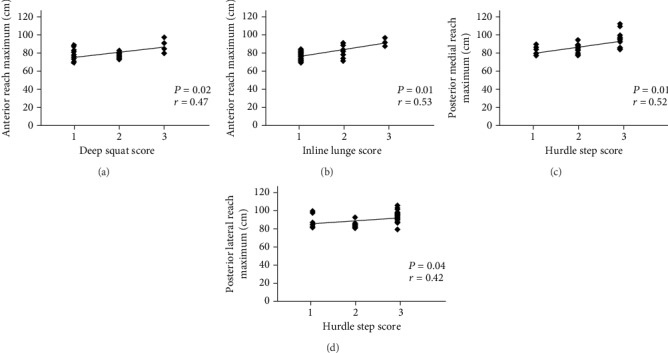
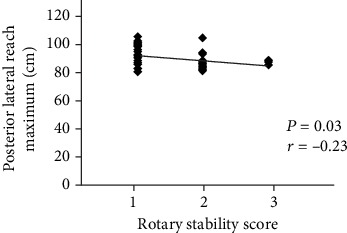
All participants completed the study protocol. No significant differences were observed between FMS, SEBT, agility test, and vertical jump test scores in groups with high and low risks of sports injuries. Fair and moderate-to-good correlations were observed for anterior reach maximum of SEBT and deep squat ( = 0.47, = 0.02) as well as inline lunge ( = 0.53, = 0.01) of FMS. The hurdle step of FMS also exhibited moderate-to-good ( = 0.52, = 0.01) and fair ( = 0.42, = 0.04) correlations with posterior medial and posterior lateral reach maximum of SEBT, respectively. A fair correlation was observed between posterior lateral reach maximum of SEBT and rotary stability of FMS ( = -0.23, = 0.03). Fair and moderate-to-good correlations were identified for agility test and maximum anterior reach in the SEBT ( = -0.42, = 0.04) and trunk stability push-up in the FMS, respectively ( = -0.57 and = 0.006).
Junior athletes with a high risk of sports injury did not exhibit differences in terms of FMS, SEBT, and physical fitness test scores. Deep squat, hurdle step, inline lunge, and rotary stability scores in the FMS were correlated with the item scores in the SEBT, which may be due to the use of similar movement patterns. Scores for anterior reach maximum in the SEBT and trunk stability push-up in the FMS were correlated with agility test scores, suggesting a similar task requirement of trunk stability and dynamic weight shifting ability.
本研究旨在评估功能性运动测试(FMS)、星形偏移平衡测试(SEBT)、敏捷性测试和垂直跳跃测试在青少年运动员运动损伤风险中的关系。我们比较了这些评估以及高风险和低风险运动损伤组之间的差异。招募了 11 名排球运动员、12 名篮球运动员和 9 名手球运动员。所有参与者均按照学校运动队的常规训练进行训练。每周的训练计划遵循相似的模式。32 名青少年运动员(年龄=16.06±0.21 岁;身高=167.28±6.32 厘米;体重=68.45±9.67 公斤)以随机顺序接受 FMS、SEBT、敏捷性测试和垂直跳跃测试评估。分析了这些评估的综合和个别项目评分的相关性,并比较了高风险和低风险运动损伤组之间的差异。
所有参与者均完成了研究方案。高风险和低风险运动损伤组之间的 FMS、SEBT、敏捷性测试和垂直跳跃测试评分无显著差异。SEBT 的前向最大伸展和深蹲(=0.47,=0.02)以及 FMS 的直线弓步(=0.53,=0.01)之间存在良好至中度相关性。FMS 的跨栏步与 SEBT 的后内和后外最大伸展也表现出中度至良好的相关性(=0.52,=0.01)和良好至中度相关性(=0.42,=0.04)。SEBT 的后外最大伸展与 FMS 的旋转稳定性之间存在中度相关性(=0.23,=0.03)。SEBT 的最大前向伸展和 FMS 的躯干稳定性俯卧撑与敏捷性测试之间存在良好至中度相关性(=0.42,=0.04)和=0.57,=0.006)。
高风险运动损伤的青少年运动员在 FMS、SEBT 和体能测试评分方面没有差异。FMS 的深蹲、跨栏步、直线弓步和旋转稳定性评分与 SEBT 的项目评分相关,这可能是由于使用了类似的运动模式。SEBT 的前向最大伸展和 FMS 的躯干稳定性俯卧撑评分与敏捷性测试评分相关,这表明对躯干稳定性和动态重心转移能力有类似的任务要求。