• 文献检索
  • 文档翻译
  • 深度研究
  • 学术资讯
  • Suppr Zotero 插件Zotero 插件
  • 邀请有礼
  • 套餐&价格
  • 历史记录
应用&插件
Suppr Zotero 插件Zotero 插件浏览器插件Mac 客户端Windows 客户端微信小程序
定价
高级版会员购买积分包购买API积分包
服务
文献检索文档翻译深度研究API 文档MCP 服务
关于我们
关于 Suppr公司介绍联系我们用户协议隐私条款
关注我们

Suppr 超能文献

核心技术专利:CN118964589B侵权必究
粤ICP备2023148730 号-1Suppr @ 2026

文献检索

告别复杂PubMed语法,用中文像聊天一样搜索,搜遍4000万医学文献。AI智能推荐,让科研检索更轻松。

立即免费搜索

文件翻译

保留排版,准确专业,支持PDF/Word/PPT等文件格式,支持 12+语言互译。

免费翻译文档

深度研究

AI帮你快速写综述,25分钟生成高质量综述,智能提取关键信息,辅助科研写作。

立即免费体验

美国成年人饮食类黄酮摄入与骨密度和骨质疏松症的关系:来自 NHANES 2007-2008、2009-2010 和 2017-2018 年的数据。

The association between dietary flavonoid intake and bone mineral density and osteoporosis in US adults: data from NHANES 2007-2008, 2009-2010 and 2017-2018.

机构信息

Department of Orthopedics, Shengjing Hospital of China Medical University, Shenyang, China.

Department of Anesthesiology, Shengjing Hospital of China Medical University, Shenyang, China.

出版信息

BMC Public Health. 2024 Nov 14;24(1):3168. doi: 10.1186/s12889-024-20700-9.

DOI:10.1186/s12889-024-20700-9
PMID:39543544
原文链接:https://pmc.ncbi.nlm.nih.gov/articles/PMC11566126/
Abstract

BACKGROUND

Epidemiological studies investigating the association between flavonoid intake and bone mineral density (BMD) draw inconsistent conclusions. Our study aims to investigate the association between flavonoid intake and BMD and osteoporosis and the mediating role of composite dietary antioxidant index (CDAI) in their relationship using data from the National Health and Nutrition Examination Survey (NHANES).

METHODS

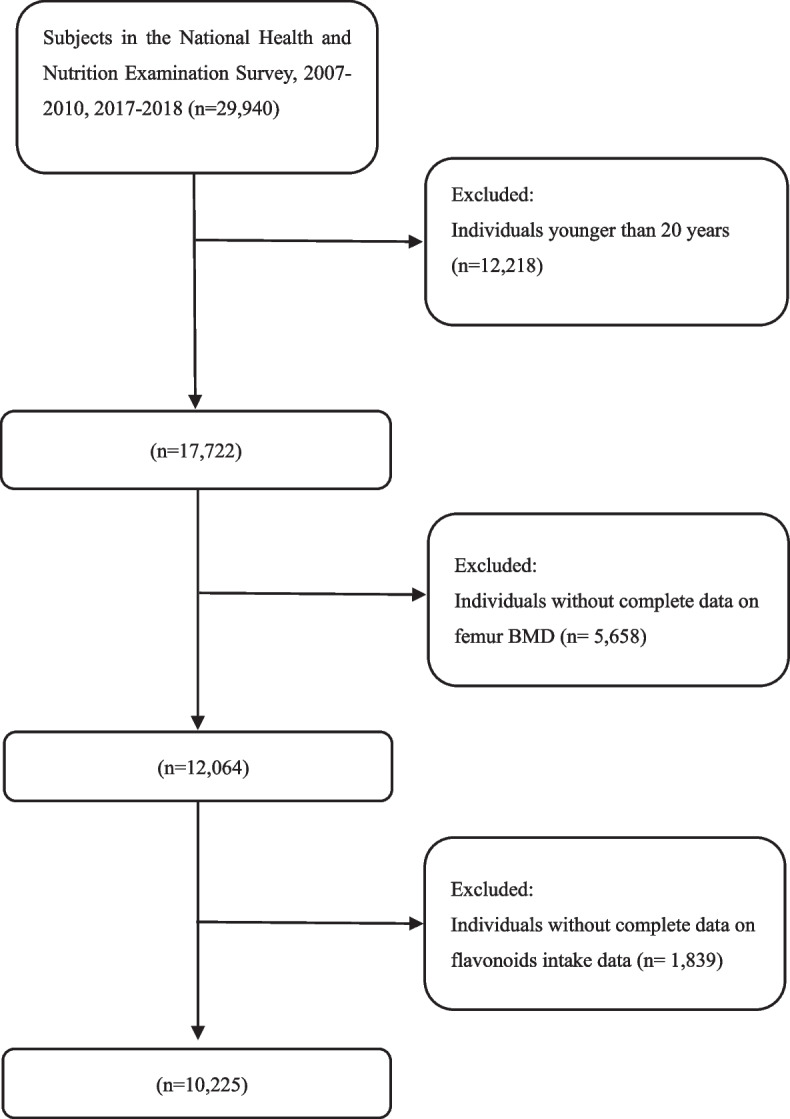
The study assessed the relationship between flavonoid intake and femur BMD and osteoporosis in 10,225 individuals from NHANES 2007-2010 and 2017-2018. Multivariable linear regression analyses were used to detect the association between flavonoid intake and femur BMD in adult Americans. Restricted cubic splines (RCS) were used to examine the nonlinear relationship between flavonoid intake and their subclasses and osteoporosis risk in individuals 20 years or older. We explored the mediating role of CDAI in the association between flavonoid intake and BMD.

RESULTS

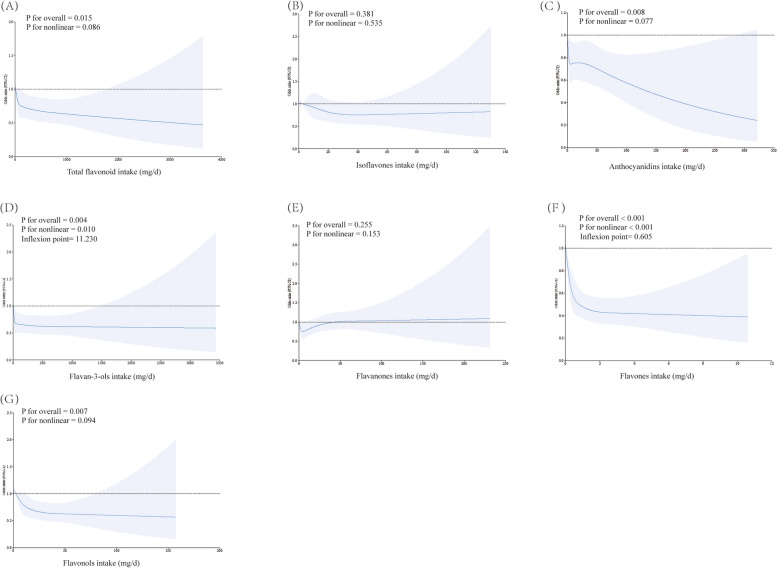
In fully adjusted multivariable regression analyses, compared with people in the first quartile, people in the fourth quartile of total flavonoid intake have a higher BMD at total femur (0.013, 95% CI: 0.004, 0.022, P = 0.001), femur neck (0.010, 95% CI: 0.004, 0.017, P = 0.001), trochanter (0.010, 95% CI: 0.004, 0.017, P = 0.001), and intertrochanter (0.012, 95% CI: 0.003, 0.020, P = 0.006). The positive relationship between flavonoid intake and femur BMD was present in both sexes. Furthermore, we found that people in the fourth quartile of total flavonoid intake have a lower risk of osteoporosis compared with the first quartile (OR = 0.686, 95% CI: 0.528-0.890, P = 0.005). RCS found a linear inverse relationship between total flavonoid intake and osteoporosis in individuals ≥ 20 years (Overall P = 0.015, nonlinear P = 0.086). Moreover, CDAI partially mediates the association of total flavonoid intake with femur BMD.

CONCLUSIONS

Our findings suggest that higher flavonoid intake is associated with higher BMD and lower risk of osteoporosis in Americans. Furthermore, we found distinct associations between different flavonoid subclasses and osteoporosis risk. More studies with stronger evidence are needed to explore the causal association between flavonoid intake and bone health and their underlying mechanisms.

摘要

背景

流行病学研究调查了黄酮类化合物摄入与骨矿物质密度(BMD)之间的关系,但得出的结论并不一致。我们的研究旨在使用来自国家健康和营养检查调查(NHANES)的数据,调查黄酮类化合物摄入与 BMD 和骨质疏松症之间的关系,以及复合膳食抗氧化指数(CDAI)在它们关系中的中介作用。

方法

本研究评估了 2007-2010 年和 2017-2018 年 NHANES 中 10225 名成年人黄酮类化合物摄入与股骨 BMD 和骨质疏松症之间的关系。多变量线性回归分析用于检测成年美国人黄酮类化合物摄入与股骨 BMD 之间的关系。受限三次样条(RCS)用于检查黄酮类化合物摄入及其亚类与 20 岁或以上个体骨质疏松症风险之间的非线性关系。我们探讨了 CDAI 在黄酮类化合物摄入与 BMD 之间关联中的中介作用。

结果

在完全调整的多变量回归分析中,与第 1 四分位组相比,第 4 四分位组的总黄酮类化合物摄入更高的总股骨 BMD(0.013,95%CI:0.004,0.022,P=0.001),股骨颈(0.010,95%CI:0.004,0.017,P=0.001),转子(0.010,95%CI:0.004,0.017,P=0.001)和转子间(0.012,95%CI:0.003,0.020,P=0.006)。黄酮类化合物摄入与股骨 BMD 之间的正相关关系在两性中均存在。此外,我们发现与第 1 四分位组相比,第 4 四分位组的总黄酮类化合物摄入者骨质疏松症的风险较低(OR=0.686,95%CI:0.528-0.890,P=0.005)。RCS 发现总黄酮类化合物摄入与 20 岁及以上个体骨质疏松症之间存在线性反比关系(总体 P=0.015,非线性 P=0.086)。此外,CDAI 部分介导了总黄酮类化合物摄入与股骨 BMD 之间的关联。

结论

我们的研究结果表明,较高的黄酮类化合物摄入与美国人更高的 BMD 和较低的骨质疏松症风险相关。此外,我们发现不同黄酮类化合物亚类与骨质疏松症风险之间存在明显的关联。需要更多具有更强证据的研究来探索黄酮类化合物摄入与骨骼健康及其潜在机制之间的因果关系。
https://cdn.ncbi.nlm.nih.gov/pmc/blobs/35cd/11566126/056e8c535511/12889_2024_20700_Fig2_HTML.jpg
https://cdn.ncbi.nlm.nih.gov/pmc/blobs/35cd/11566126/a1b83a08ea5d/12889_2024_20700_Fig1_HTML.jpg
https://cdn.ncbi.nlm.nih.gov/pmc/blobs/35cd/11566126/056e8c535511/12889_2024_20700_Fig2_HTML.jpg
https://cdn.ncbi.nlm.nih.gov/pmc/blobs/35cd/11566126/a1b83a08ea5d/12889_2024_20700_Fig1_HTML.jpg
https://cdn.ncbi.nlm.nih.gov/pmc/blobs/35cd/11566126/056e8c535511/12889_2024_20700_Fig2_HTML.jpg

相似文献

1
The association between dietary flavonoid intake and bone mineral density and osteoporosis in US adults: data from NHANES 2007-2008, 2009-2010 and 2017-2018.美国成年人饮食类黄酮摄入与骨密度和骨质疏松症的关系:来自 NHANES 2007-2008、2009-2010 和 2017-2018 年的数据。
BMC Public Health. 2024 Nov 14;24(1):3168. doi: 10.1186/s12889-024-20700-9.
2
Independent and combined associations of dietary antioxidant intake with bone mineral density and risk of osteoporosis among elderly population in United States.美国老年人饮食抗氧化剂摄入量与骨密度和骨质疏松症风险的独立和联合关联。
J Orthop Sci. 2024 Jul;29(4):1064-1072. doi: 10.1016/j.jos.2023.07.014. Epub 2023 Aug 1.
3
Association of a body shape index with femur bone mineral density among older adults: NHANES 2007-2018.成人身体形态指数与股骨骨密度的关系:NHANES 2007-2018。
Arch Osteoporos. 2024 Jul 22;19(1):63. doi: 10.1007/s11657-024-01424-0.
4
Association of selenium intake with bone mineral density and osteoporosis: the national health and nutrition examination survey.硒摄入与骨密度和骨质疏松症的关联:全国健康和营养调查。
Front Endocrinol (Lausanne). 2023 Sep 29;14:1251838. doi: 10.3389/fendo.2023.1251838. eCollection 2023.
5
Association of the composite dietary antioxidant index with bone mineral density in the United States general population: data from NHANES 2005-2010.复合膳食抗氧化指数与美国普通人群骨密度的关系:来自 NHANES 2005-2010 的数据。
J Bone Miner Metab. 2023 Sep;41(5):631-641. doi: 10.1007/s00774-023-01438-7. Epub 2023 Jun 8.
6
Bone mineral density is associated with composite dietary antioxidant index among US adults: results from NHANES.美国成年人的骨矿物质密度与复合饮食抗氧化指数相关:美国国家健康与营养检查调查结果
Osteoporos Int. 2023 Dec;34(12):2101-2110. doi: 10.1007/s00198-023-06901-9. Epub 2023 Sep 4.
7
Cardiometabolic index is associated with increased bone mineral density: a population-based cross-sectional study.代谢心血管指数与骨密度增加有关:基于人群的横断面研究。
Front Public Health. 2024 Sep 18;12:1403450. doi: 10.3389/fpubh.2024.1403450. eCollection 2024.
8
Association between composite dietary antioxidant and bone mineral density in children and adolescents aged 8-19 years: findings from NHANES.复合饮食抗氧化剂与 8-19 岁儿童和青少年骨密度的关系:来自 NHANES 的研究结果。
Sci Rep. 2024 Jul 9;14(1):15849. doi: 10.1038/s41598-024-66859-4.
9
Dietary Flavonoid and Subclass Intakes are not Associated with Markers of Bone Health in U.S. Adults Age 50+ Years.膳食类黄酮和亚类摄入量与 50 岁以上美国成年人的骨骼健康标志物无关。
J Am Nutr Assoc. 2024 Sep-Oct;43(7):604-613. doi: 10.1080/27697061.2024.2358532. Epub 2024 Jun 3.
10
Associations of Copper Intake with Bone Mineral Density and Osteoporosis in Adults: Data from the National Health and Nutrition Examination Survey.成人铜摄入量与骨密度及骨质疏松症的关联:来自美国国家健康与营养检查调查的数据
Biol Trace Elem Res. 2022 May;200(5):2062-2068. doi: 10.1007/s12011-021-02845-5. Epub 2021 Jul 20.

引用本文的文献

1
Flavonoids, Chalcones, and Their Fluorinated Derivatives-Recent Advances in Synthesis and Potential Medical Applications.类黄酮、查耳酮及其氟化衍生物——合成与潜在医学应用的最新进展
Molecules. 2025 May 30;30(11):2395. doi: 10.3390/molecules30112395.

本文引用的文献

1
Association between composite dietary antioxidant and bone mineral density in children and adolescents aged 8-19 years: findings from NHANES.复合饮食抗氧化剂与 8-19 岁儿童和青少年骨密度的关系:来自 NHANES 的研究结果。
Sci Rep. 2024 Jul 9;14(1):15849. doi: 10.1038/s41598-024-66859-4.
2
Luteolin rescues postmenopausal osteoporosis elicited by OVX through alleviating osteoblast pyroptosis via activating PI3K-AKT signaling.木犀草素通过激活 PI3K-AKT 信号通路减轻破骨细胞焦亡来拯救去卵巢诱导的绝经后骨质疏松症。
Phytomedicine. 2024 Jun;128:155516. doi: 10.1016/j.phymed.2024.155516. Epub 2024 Mar 16.
3
Icariin ameliorates osteoporosis in ovariectomized rats by targeting Cullin 3/Nrf2/OH pathway for osteoclast inhibition.
淫羊藿苷通过靶向 Cullin3/Nrf2/OH 通路抑制破骨细胞来改善去卵巢大鼠的骨质疏松症。
Biomed Pharmacother. 2024 Apr;173:116422. doi: 10.1016/j.biopha.2024.116422. Epub 2024 Mar 11.
4
protein digestibility of different soy-based products: effects of microstructure, physico-chemical properties and protein aggregation.不同大豆制品的蛋白质消化率:微观结构、物理化学性质和蛋白质聚集的影响。
Food Funct. 2023 Dec 11;14(24):10964-10976. doi: 10.1039/d3fo02410e.
5
Dietary flavonoid intake is associated with a lower risk of depressive symptoms in US adults: Data from NHANES 2007-2008, 2009-2010, and 2017-2018.膳食类黄酮摄入与美国成年人抑郁症状风险降低相关:来自 NHANES 2007-2008、2009-2010 和 2017-2018 年的数据。
J Affect Disord. 2024 Jan 15;345:293-299. doi: 10.1016/j.jad.2023.10.128. Epub 2023 Oct 27.
6
Association between the composite dietary antioxidant index and chronic kidney disease: evidence from NHANES 2011-2018.复合膳食抗氧化指数与慢性肾脏病之间的关联:来自2011 - 2018年美国国家健康与营养检查调查(NHANES)的证据
Food Funct. 2023 Oct 16;14(20):9279-9286. doi: 10.1039/d3fo01157g.
7
Association between the Composite Dietary Antioxidant Index and Atherosclerotic Cardiovascular Disease in Postmenopausal Women: A Cross-Sectional Study of NHANES Data, 2013-2018.复合膳食抗氧化指数与绝经后女性动脉粥样硬化性心血管疾病的关联:基于2013 - 2018年美国国家健康与营养检查调查(NHANES)数据的横断面研究
Antioxidants (Basel). 2023 Sep 8;12(9):1740. doi: 10.3390/antiox12091740.
8
Bone mineral density is associated with composite dietary antioxidant index among US adults: results from NHANES.美国成年人的骨矿物质密度与复合饮食抗氧化指数相关:美国国家健康与营养检查调查结果
Osteoporos Int. 2023 Dec;34(12):2101-2110. doi: 10.1007/s00198-023-06901-9. Epub 2023 Sep 4.
9
Osteoporosis and Fracture Risk among Older US Asian Adults.美国老年亚裔成年人的骨质疏松症和骨折风险。
Curr Osteoporos Rep. 2023 Oct;21(5):592-608. doi: 10.1007/s11914-023-00805-7. Epub 2023 Aug 5.
10
Dietary flavonoids intake contributes to delay biological aging process: analysis from NHANES dataset.饮食类黄酮摄入有助于延缓生物衰老过程:来自 NHANES 数据集的分析。
J Transl Med. 2023 Jul 21;21(1):492. doi: 10.1186/s12967-023-04321-1.