Erukainure Ochuko L, Nambooze Jennifer, Chukwuma Chika I, Malloum Alhadji, Aljoundi Aimen, Elamin Ghazi
Laser Research Centre, Faculty of Health Sciences, University of Johannesburg, Doornfontein 2028, South Africa.
Department of Chemistry, School of Natural Sciences, Faculty of Agriculture and Natural Science, University of the Free State, Bloemfontein 9300, South Africa.
Toxicol Rep. 2024 Oct 30;13:101788. doi: 10.1016/j.toxrep.2024.101788. eCollection 2024 Dec.
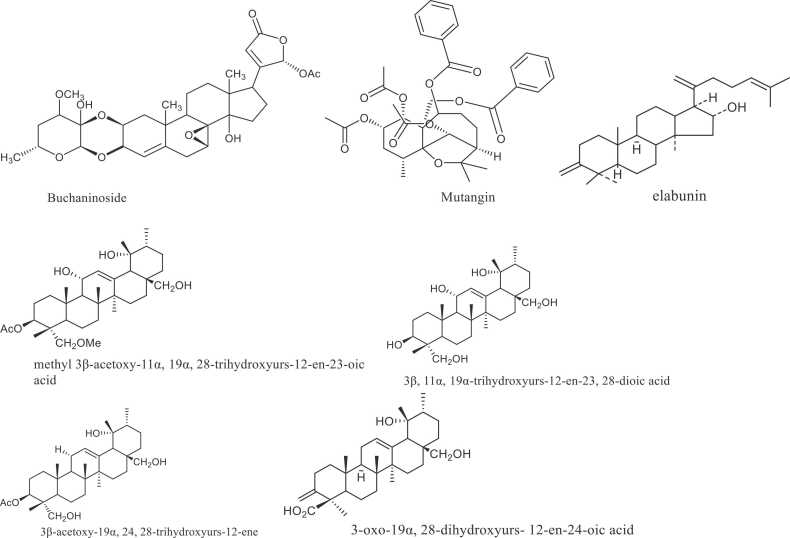
The present study investigated the cytotoxic prospects of isolated compounds from against leukemia, using computational tools. Comprehensive literature searches revealed only buchaninoside, mutangin, methyl 3β-acetoxy-11α, 19α, 28-trihydroxyurs-12-en-23-oic acid, 3β, 11α, 19α-trihydroxyurs-12-en-23, 28-dioic acid, 3β-acetoxy-19α, 24, 28-trihydroxyurs-12-ene, 3-oxo-19α,28-dihydroxyurs-12-en-24-oic acid, and elabunin have been isolated from . The compounds were subjected to Density Functional Theory (DFT) and Molecular Dynamics (MD) analyses, with Fms-like tyrosine kinase (FLT3) and catalytic binding sites of Murine Leukemia Virus (MLV) as the target proteins in lukemia. Following DFT analysis, the structures of the compounds were optimized at the PW6B95D3/Def2-TZVP level of theory; their UV-Visible peaks were in the UV region, with mutangin, 3-oxo-19α,28-dihydroxyurs-12-en-24-oic acid and elabunin exhibiting one single peak. The potent Root-Mean-Square Deviation, Root-Mean-Square Fluctuation, solvent-accessible surface area and radius of gyration values indicated a strong and stable molecular interaction between the compounds and the proteins. These were further supported by high ∆G values, with MLV showing the best interaction. Per-residue decomposition plots also revealed high energy contributions in the interactions' binding sites residues. These results indicate that the cytotoxic prospects of the isolated compounds against leukemia as indicated by its molecular interactions with FLT3 and MLV.
本研究使用计算工具,研究了从[来源未提及]中分离出的化合物对白血病的细胞毒性前景。全面的文献检索显示,仅从[来源未提及]中分离出了布查尼糖苷、变豆木素、3β-乙酰氧基-11α,19α,28-三羟基乌苏-12-烯-23-酸、3β,11α,19α-三羟基乌苏-12-烯-23,28-二酸、3β-乙酰氧基-19α,24,28-三羟基乌苏-12-烯、3-氧代-19α,28-二羟基乌苏-12-烯-24-酸和艾拉布宁。这些化合物以Fms样酪氨酸激酶(FLT3)和小鼠白血病病毒(MLV)的催化结合位点作为白血病中的靶蛋白,进行了密度泛函理论(DFT)和分子动力学(MD)分析。DFT分析后,化合物的结构在PW6B95D3/Def2-TZVP理论水平上进行了优化;它们的紫外可见峰在紫外区域,变豆木素、3-氧代-19α,28-二羟基乌苏-12-烯-24-酸和艾拉布宁呈现出一个单峰。有效的均方根偏差、均方根波动、溶剂可及表面积和回转半径值表明化合物与蛋白质之间存在强烈且稳定的分子相互作用。这些得到了高∆G值的进一步支持,其中MLV显示出最佳相互作用。每个残基的分解图还揭示了相互作用结合位点残基中的高能量贡献。这些结果表明,分离出的化合物通过与FLT3和MLV的分子相互作用,对白血病具有细胞毒性前景。