Department of thyroid surgery, Shanxi Provincial People's Hospital, Taiyuan, Shanxi, China.
Department of physical examination center, Shanxi Provincial People's Hospital, Taiyuan, Shanxi, China.
Front Endocrinol (Lausanne). 2024 Nov 7;15:1462251. doi: 10.3389/fendo.2024.1462251. eCollection 2024.
Although some evidence suggests a role for vitamin C intake in thyroid diseases, the complex interplay between vitamin C intake and thyroid function remains incompletely understood. The objective of this study was to explore the relationship between vitamin C intake and serum thyroid function in the United States adults.
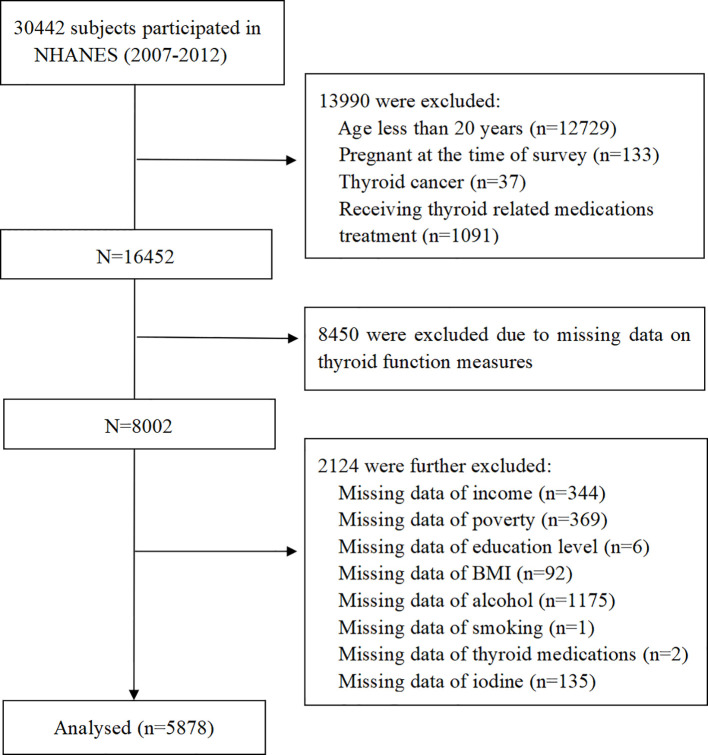
A total of 5,878 participants from the National Health and Nutrition Examination Survey (NHANES) between 2007 and 2012 were included in this study. Weighted multivariate linear regression models, subgroup analyses, and interaction terms were used to assess the association between vitamin C intake, evaluated as a continuous and categorical variable, and thyroid function. Additionally, restricted cubic spline (RCS) regression was employed to assess any nonlinear relationship that may exist between vitamin C intake and thyroid function.
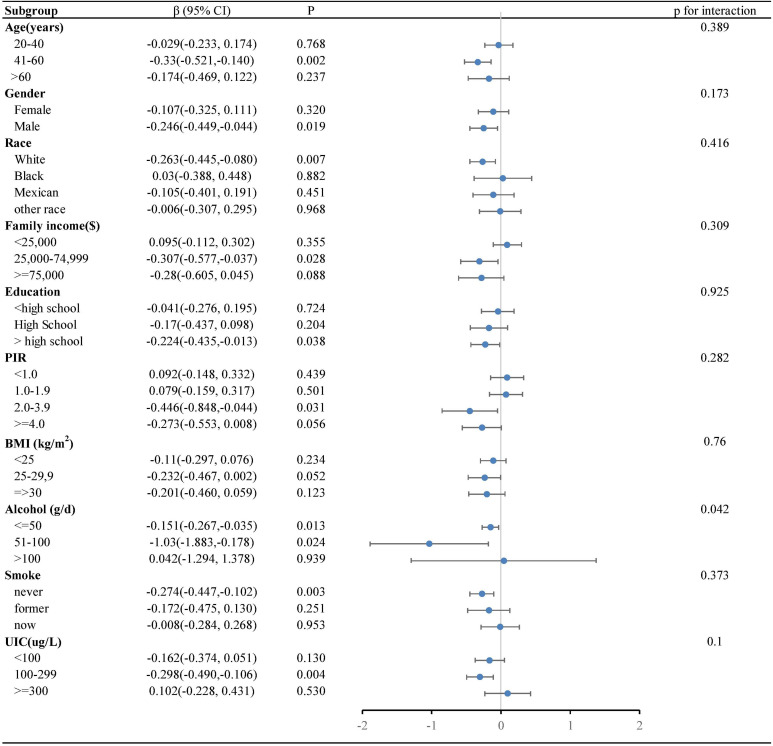
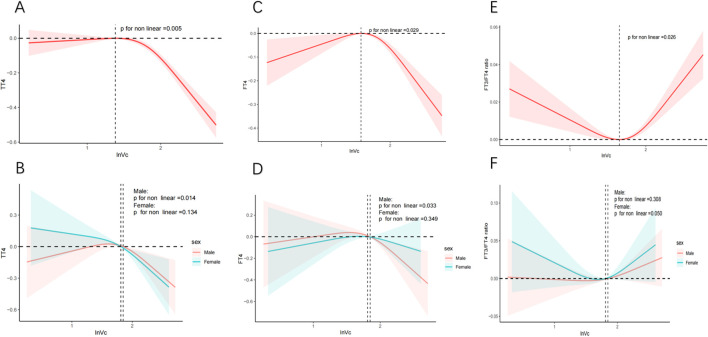
After adjusting for covariates, our research found a significant inverse correlation between vitamin C intake and total thyroxine (TT4) (β= -0.182, 0.006). Using subgroup analyses, the association was more pronounced among subjects with lower alcohol consumption(β= -0.151, 0.013, for interaction = 0.043). In RCS regression, the correlation between vitamin C and TT4 exhibited a distinct reversed L-shaped curve pattern in total participants ( for nonlinear = 0.005) and male adults ( for nonlinear = 0.014). Additionally, we found an inverted U-shaped curve pattern in the relationship between vitamin C intake and FT4 ( for nonlinear = 0.029), while an U-shaped curve relationship was observed between vitamin C consumption and the FT3/FT4 ratio ( for nonlinear = 0.026).
The findings of our study have illustrated a notable correlation between vitamin C intake and thyroid function. A high level of vitamin C intake is associated with a decreased in TT4 levels among American adults, and the association was more pronounced among subjects with lower alcohol consumption. Furthermore, our analysis revealed a nonlinear correlation between the intake of vitamin C and the levels of TT4, FT4, and FT3/FT4 ratio. Our findings support the rationale for making food-based dietary recommendations and maybe provide guidance for diet guidelines with thyroid dysfunction to a certain extent in the future.
尽管有一些证据表明维生素 C 摄入与甲状腺疾病有关,但维生素 C 摄入与甲状腺功能之间的复杂相互作用仍不完全清楚。本研究旨在探讨美国成年人维生素 C 摄入与血清甲状腺功能之间的关系。
本研究纳入了 2007 年至 2012 年期间国家健康和营养检查调查(NHANES)中的 5878 名参与者。使用加权多变量线性回归模型、亚组分析和交互项来评估维生素 C 摄入(连续变量和分类变量)与甲状腺功能之间的关系。此外,还采用限制性三次样条(RCS)回归来评估维生素 C 摄入与甲状腺功能之间可能存在的非线性关系。
在调整了协变量后,我们的研究发现维生素 C 摄入与总甲状腺素(TT4)呈显著负相关(β= -0.182,0.006)。使用亚组分析,在饮酒量较低的人群中,这种相关性更为明显(β= -0.151,0.013,交互项= 0.043)。在 RCS 回归中,总参与者( for nonlinear = 0.005)和男性成年人( for nonlinear = 0.014)中维生素 C 与 TT4 之间的关系呈现出明显的反向 L 形曲线模式。此外,我们还发现维生素 C 摄入与 FT4 之间存在倒 U 形曲线关系( for nonlinear = 0.029),而维生素 C 消耗与 FT3/FT4 比值之间存在 U 形曲线关系( for nonlinear = 0.026)。
本研究结果表明,维生素 C 摄入与甲状腺功能之间存在显著相关性。美国成年人中,维生素 C 摄入水平较高与 TT4 水平降低有关,而在饮酒量较低的人群中,这种相关性更为明显。此外,我们的分析还揭示了维生素 C 摄入与 TT4、FT4 和 FT3/FT4 比值之间的非线性关系。我们的研究结果支持基于食物的膳食推荐的合理性,并在一定程度上为未来甲状腺功能障碍的饮食指南提供了指导。