Das Lovely, Maity Ipsita, Desai Priti D, Mazumdar Paromita, Ghosh Kushal Kumar
Department of Conservative Dentistry and Endodontics, Guru Nanak Institute of Dental Sciences and Research, Kolkata, West Bengal, India.
J Conserv Dent Endod. 2024 Oct;27(10):1048-1053. doi: 10.4103/JCDE.JCDE_385_24. Epub 2024 Oct 5.
The study aimed to assess the antimicrobial effectiveness of green tea and neem extract compared to sodium hypochlorite (NaOCl) against various root canal microorganisms.
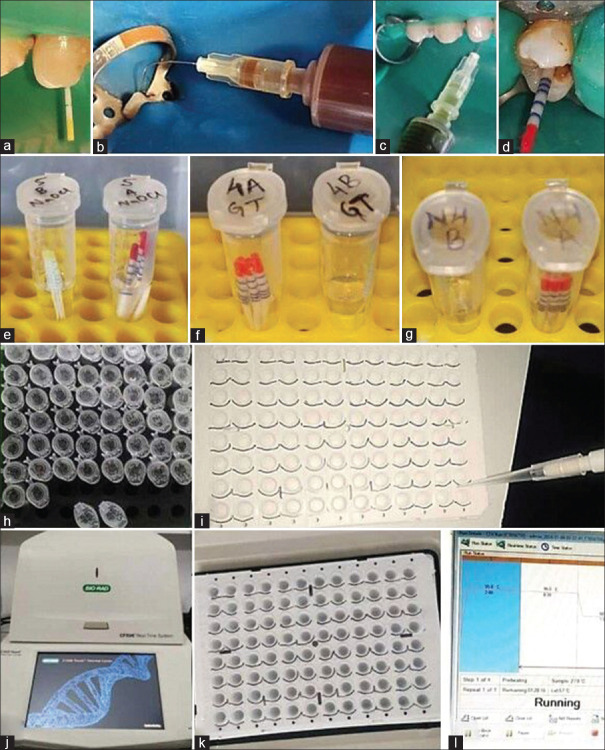
Thirty patients with pulpal necrosis were selected, providing 60 samples before and after irrigation. Groups were assigned as follows: Group A: 3% NaOCl (control), Group B: green tea, and Group C: neem extract. Samples were collected before and after irrigation in two phases. Samples were collected maintaining a strict sterile condition and stored in buffer solution at -80°C for bacterial-load measurement through real-time Polymerase chain reaction (PCR). Statistical analysis included within-group comparisons using Wilcoxon's test and the paired t-test and inter-group comparisons using the Kruskal-Wallis test with post hoc Dunn's test and one-way analysis of variance with post hoc Tukey's honestly significant difference test ( ≤ 0.05).
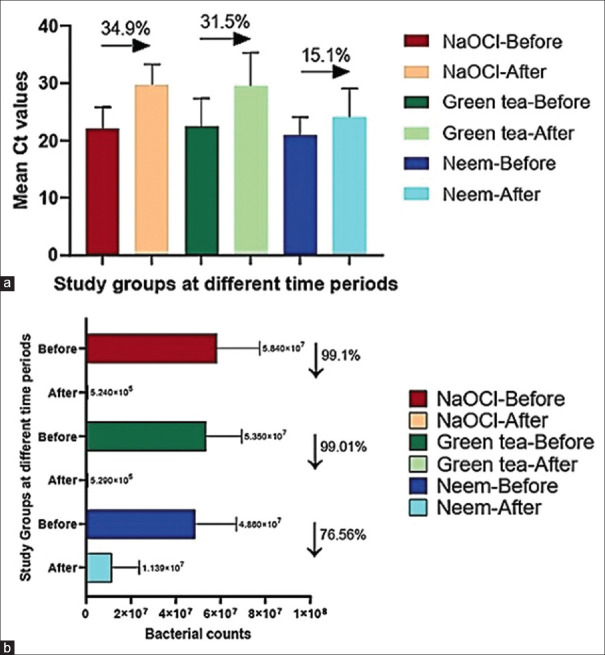
While no irrigant achieved complete bacterial eradication, all solutions exhibited significant antimicrobial activity postirrigation. NaOCl yielded the most effective results, with green tea nearly comparable, and neem extract demonstrating the lowest efficacy.
Herbal irrigants, particularly green tea, can serve as effective alternatives to chemical solutions. However, neem extract proved less effective than both green tea and NaOCl, indicating its inferiority in root canal disinfection.
本研究旨在评估与次氯酸钠(NaOCl)相比,绿茶和印楝提取物对各种根管微生物的抗菌效果。
选取30例牙髓坏死患者,在冲洗前后提供60个样本。分组如下:A组:3% NaOCl(对照组),B组:绿茶,C组:印楝提取物。样本在两个阶段冲洗前后收集。样本在严格无菌条件下收集,并储存在-80°C的缓冲溶液中,通过实时聚合酶链反应(PCR)测量细菌载量。统计分析包括使用Wilcoxon检验和配对t检验进行组内比较,以及使用Kruskal-Wallis检验和事后Dunn检验以及使用事后Tukey真实显著性差异检验的单因素方差分析进行组间比较(≤0.05)。
虽然没有一种冲洗剂能实现完全的细菌根除,但所有溶液在冲洗后均表现出显著的抗菌活性。NaOCl产生的效果最显著,绿茶的效果与之相近,而印楝提取物的效果最差。
草药冲洗剂,特别是绿茶,可以作为化学溶液的有效替代品。然而,印楝提取物被证明比绿茶和NaOCl都要低效,表明其在根管消毒方面的劣势。