Food Quality and Design, Wageningen University & Research, Wageningen, The Netherlands.
Systems and Synthetic Biology, Wageningen University & Research, Wageningen, The Netherlands.
Microbiome. 2024 Nov 30;12(1):250. doi: 10.1186/s40168-024-01975-x.
Previous studies have shown that microbial communities differ in obese and lean individuals, and dietary fiber can help reduce obesity-related conditions through diet-gut microbiota interactions. However, the mechanisms by which dietary fibers shape the gut microbiota still need to be elucidated. In this in vitro study, we examined how apple fibers affect lean and obese microbial communities on a global scale. We employed a high-throughput micro-matrix bioreactor system and a multi-omics approach to identify the key microorganisms and metabolites involved in this process.
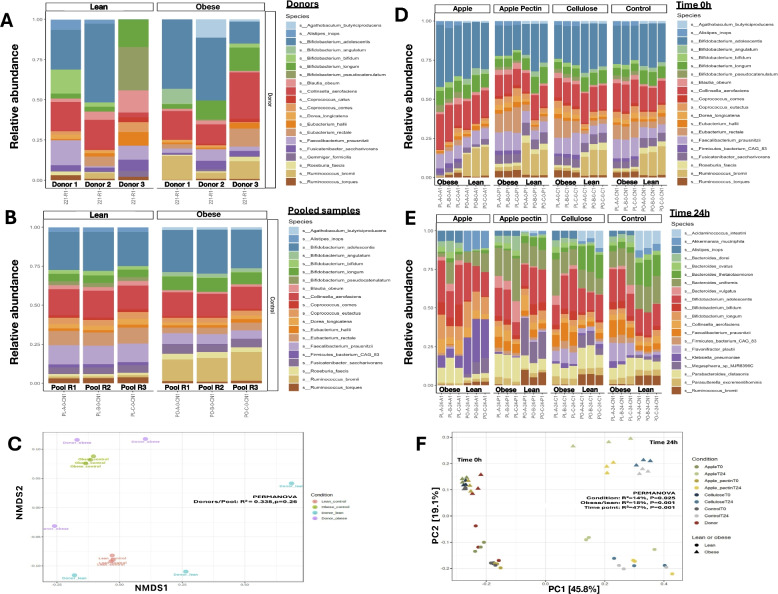
Initially, metagenomics and metabolomics data indicated that obese and lean microbial communities had distinct starting microbial communities. We found that obese microbial community had different characteristics, including higher levels of Ruminococcus bromii and lower levels of Faecalibacterium prausnitzii, along with an increased Firmicutes:Bacteroides ratio. Afterward, we exposed obese and lean microbial communities to an apple as a representative complex food matrix, apple pectin as a soluble fiber, and cellulose as an insoluble fiber. Dietary fibers, particularly apple pectin, reduced Acidaminococcus intestini and boosted Megasphaera and Akkermansia in the obese microbial community. Additionally, these fibers altered the production of metabolites, increasing beneficial indole microbial metabolites. Our results underscored the ability of apple and apple pectin to shape the obese gut microbiota.
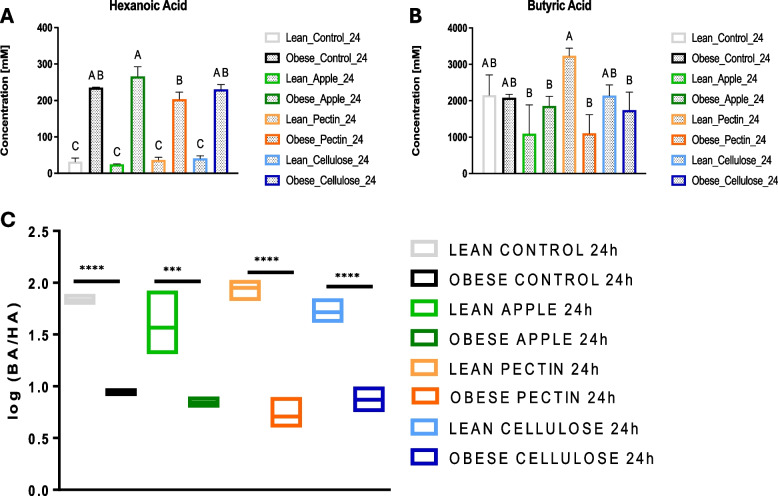
We found that the obese microbial community had higher branched-chain amino acid catabolism and hexanoic acid production, potentially impacting energy balance. Apple dietary fibers, especially pectin, influenced the obese microbial community, altering both species and metabolites. Notably, the apple pectin feeding condition affected species like Klebsiella pneumoniae and Bifidobacterium longum. By using genome-scale metabolic modeling, we discovered a mutualistic cross-feeding relationship between Megasphaera sp. MJR8396C and Bifidobacterium adolescentis. This in vitro study suggests that incorporating apple fibers into the diets of obese individuals can help modify the composition of gut bacteria and improve metabolic health. This personalized approach could help mitigate the effects of obesity. Video Abstract.
先前的研究表明,肥胖个体和瘦个体的微生物群落存在差异,膳食纤维可以通过饮食-肠道微生物群相互作用帮助减轻肥胖相关疾病。然而,膳食纤维塑造肠道微生物群的机制仍需阐明。在这项体外研究中,我们研究了苹果纤维如何在全球范围内影响瘦和肥胖的微生物群落。我们采用高通量微矩阵生物反应器系统和多组学方法来确定涉及该过程的关键微生物和代谢物。
最初,宏基因组学和代谢组学数据表明,肥胖和瘦微生物群落具有不同的起始微生物群落。我们发现肥胖微生物群落具有不同的特征,包括更高水平的 Ruminococcus bromii 和更低水平的 Faecalibacterium prausnitzii,以及更高的厚壁菌门/拟杆菌门比值。之后,我们将肥胖和瘦微生物群落暴露于苹果作为代表的复杂食物基质、苹果果胶作为可溶性纤维和纤维素作为不溶性纤维。膳食纤维,特别是苹果果胶,减少了肥胖微生物群落中的 Acidaminococcus intestini 并增加了 Megasphaera 和 Akkermansia。此外,这些纤维改变了代谢物的产生,增加了有益的吲哚微生物代谢物。我们的研究结果强调了苹果和苹果果胶塑造肥胖肠道微生物群的能力。
我们发现肥胖微生物群落具有更高的支链氨基酸代谢和己酸产生,可能影响能量平衡。苹果膳食纤维,特别是果胶,影响肥胖微生物群落,改变物种和代谢物。值得注意的是,苹果果胶喂养条件影响了像肺炎克雷伯菌和长双歧杆菌这样的物种。通过使用基因组规模的代谢建模,我们发现了 Megasphaera sp. MJR8396C 和双歧杆菌属之间的共生交叉喂养关系。这项体外研究表明,在肥胖个体的饮食中加入苹果纤维可以帮助改变肠道细菌的组成并改善代谢健康。这种个性化方法可以帮助减轻肥胖的影响。