Faure Andre J, Lehner Ben
Centre for Genomic Regulation (CRG), The Barcelona Institute of Science and Technology, Barcelona, Spain.
Current Address: ALLOX, PRBB Building, C/Dr. Aiguader, 88, 08003, Barcelona, Spain.
Genome Biol. 2024 Dec 2;25(1):303. doi: 10.1186/s13059-024-03444-y.
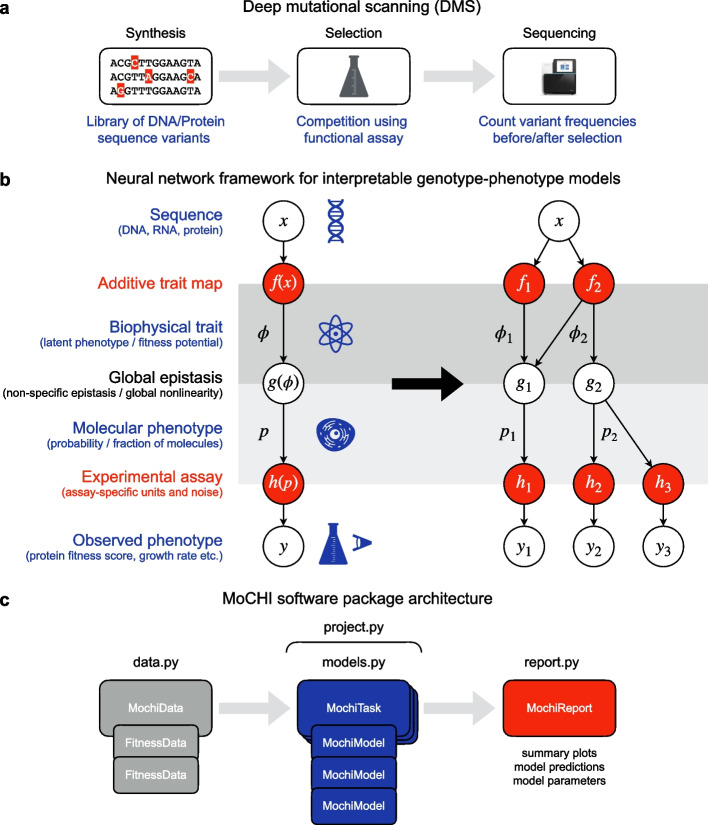
We present MoCHI, a tool to fit interpretable models using deep mutational scanning data. MoCHI infers free energy changes, as well as interaction terms (energetic couplings) for specified biophysical models, including from multimodal phenotypic data. When a user-specified model is unavailable, global nonlinearities (epistasis) can be estimated from the data. MoCHI also leverages ensemble, background-averaged epistasis to learn sparse models that can incorporate higher-order epistatic terms. MoCHI is freely available as a Python package ( https://github.com/lehner-lab/MoCHI ) relying on the PyTorch machine learning framework and allows biophysical measurements at scale, including the construction of allosteric maps of proteins.
我们展示了MoCHI,这是一种使用深度突变扫描数据来拟合可解释模型的工具。MoCHI可以推断自由能变化以及指定生物物理模型的相互作用项(能量耦合),包括从多模态表型数据中推断。当用户指定的模型不可用时,可以从数据中估计全局非线性(上位性)。MoCHI还利用集成的、背景平均的上位性来学习可以纳入高阶上位性项的稀疏模型。MoCHI作为一个依赖于PyTorch机器学习框架的Python包(https://github.com/lehner-lab/MoCHI )免费提供,并允许进行大规模的生物物理测量,包括构建蛋白质的别构图谱。