Alam Md Shahinoor, Chowdhury Mohammad Asaduzzaman, Islam Md Saiful, Islam Md Moynul, Sabur Md Abdus, Rana Md Masud
Department of Mechanical Engineering, Dhaka University of Engineering and Technology Gazipur 1707 Bangladesh
Department of Chemistry, Bangladesh Army University of Engineering and Technology, Qadirabad Cantonment Natore-6431 Bangladesh.
Nanoscale Adv. 2024 Nov 12;7(1):288-309. doi: 10.1039/d4na00738g. eCollection 2024 Dec 17.
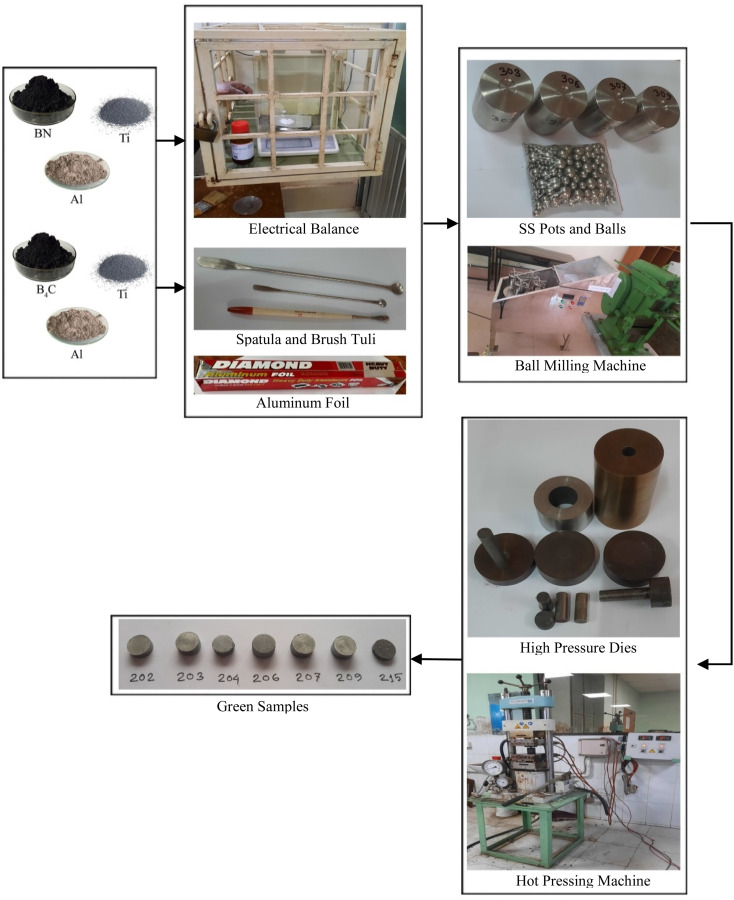
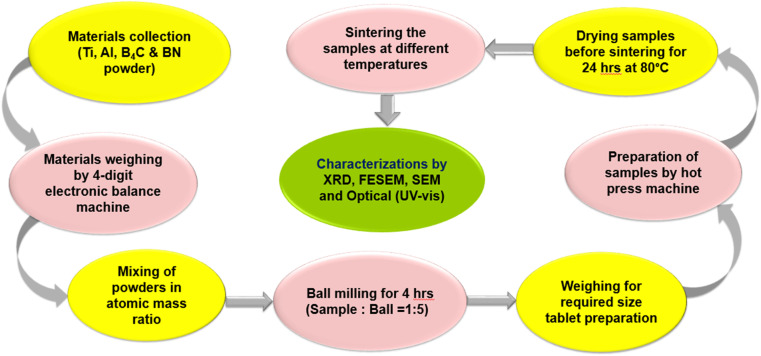
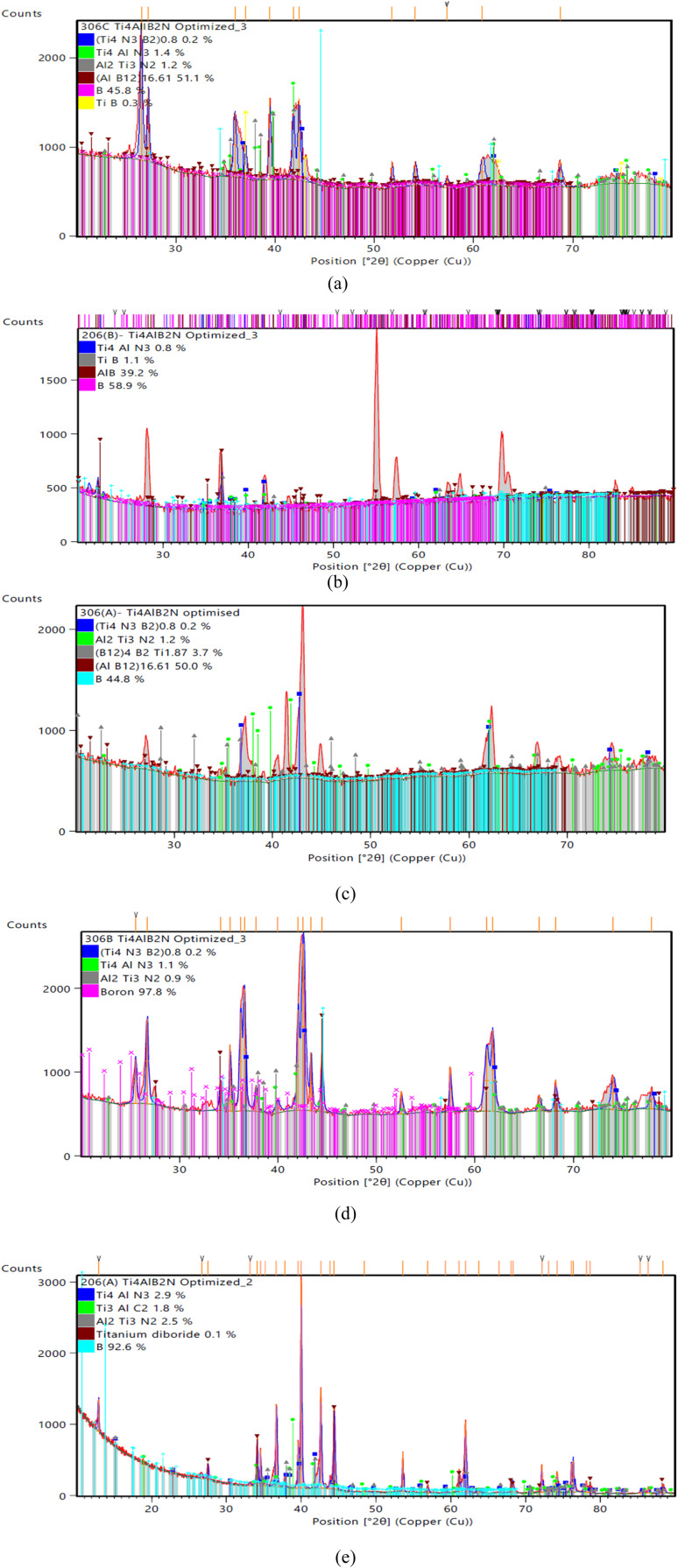
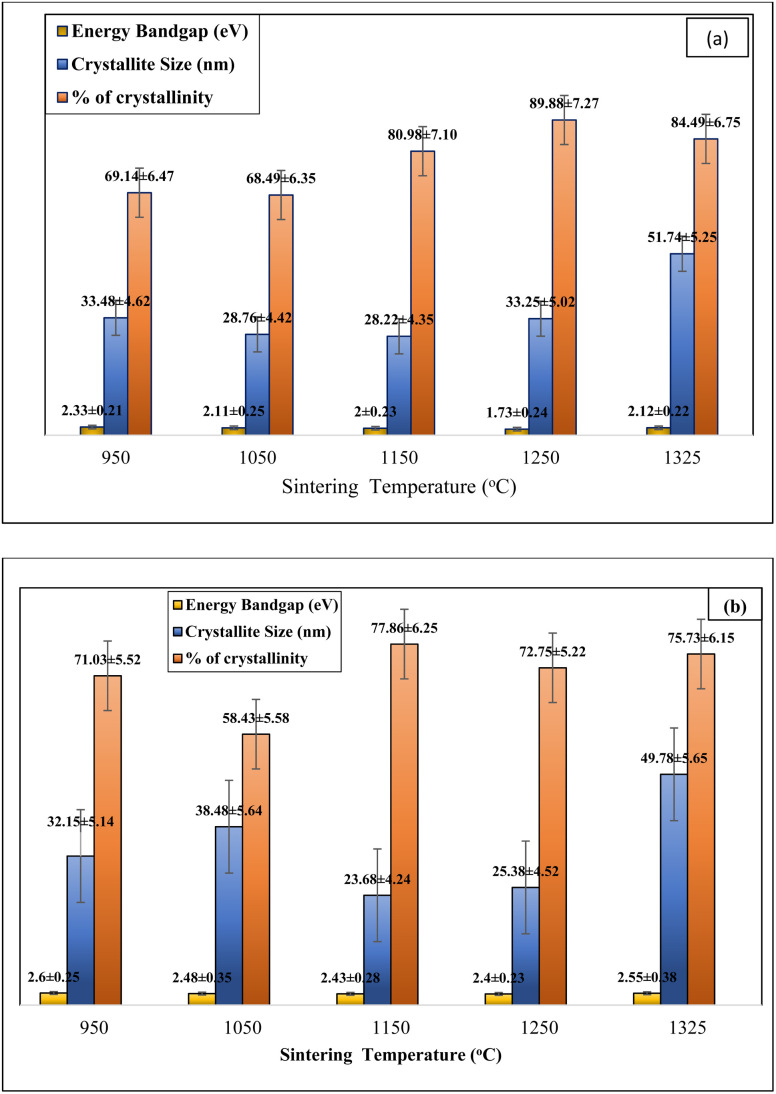
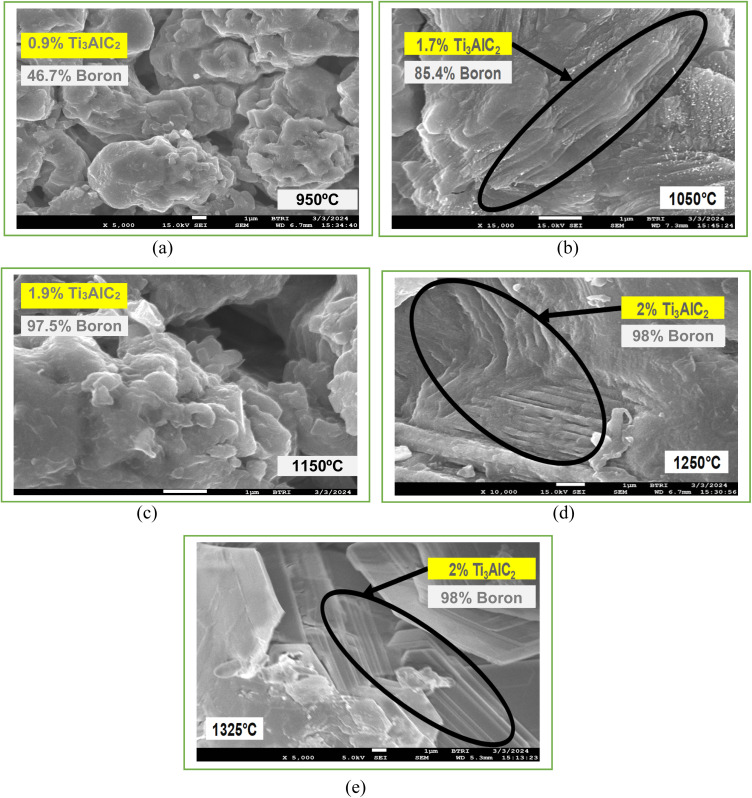
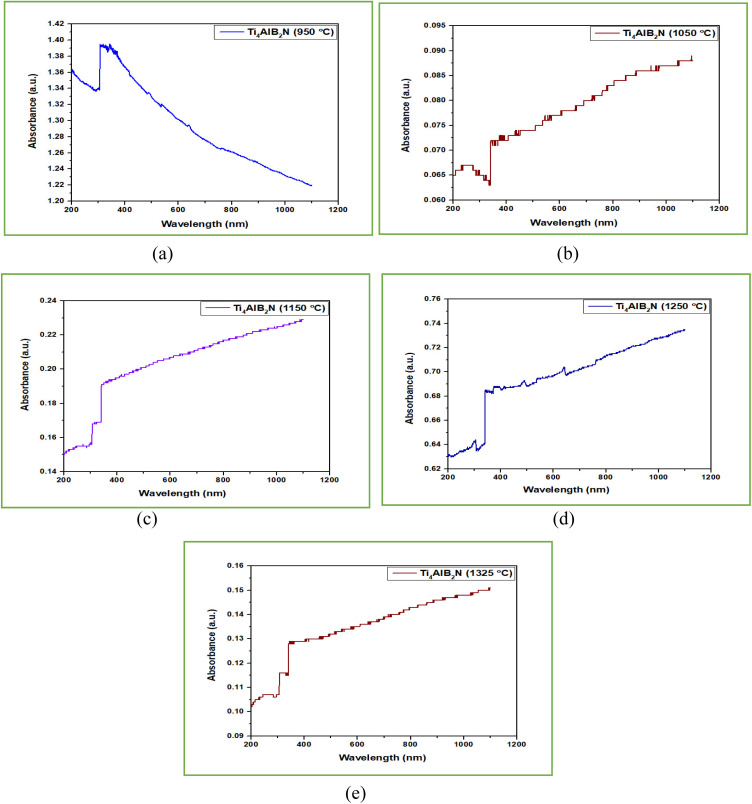
This research focuses on synthesizing chemically and thermally stable novel TiAlN and TiAlC MAX phase reinforced boron-based composites using hot pressed and inert sintering processes, enabling a sizeable and wider bandgap for semiconductor applications. The study found that the MAX phase is formed from 0.2% to 2.9% in fabricated samples with increasing sintering temperatures from 950 °C to 1325 °C. As the sintering temperature increases, the percentage of crystallinity in TiAlN MAX phase reinforced boron-based composites increases from 69.14% to 89.88%, while in TiAlC MAX phase reinforced boron-based composites, it increases from 71.02% to 77.86%. And the energy bandgap shows a declining trend from 2.33 eV to 1.78 eV for TiAlBN sample composites and 2.60 eV to 2.40 for TiAlBC sample composites. The UV-vis test for boron-based TiAlN and TiAlC MAX phase composites shows an absorbance rate ranging from 0.065 a.u. to 0.63 a.u. and 0.008 to 2.4 a.u. respectively with increasing sintering temperature. Tuning these bandgap variations for TiAlN and TiAlC MAX phase reinforced boron-based composites with sintering temperature allows for customization of the material's optical absorption and emission spectra, which is important for semiconductor properties and for electronic and optoelectronic devices.
本研究聚焦于通过热压和惰性烧结工艺合成化学和热稳定的新型TiAlN和TiAlC MAX相增强硼基复合材料,以实现适用于半导体应用的可观且更宽的带隙。研究发现,随着烧结温度从950℃升高到1325℃,在制备的样品中MAX相的形成比例为0.2%至2.9%。随着烧结温度的升高,TiAlN MAX相增强硼基复合材料的结晶度百分比从69.14%增加到89.88%,而在TiAlC MAX相增强硼基复合材料中,结晶度从71.02%增加到77.86%。并且对于TiAlBN样品复合材料,能带隙从2.33 eV呈下降趋势至1.78 eV,对于TiAlBC样品复合材料,能带隙从2.60 eV下降至2.40 eV。随着烧结温度升高,硼基TiAlN和TiAlC MAX相复合材料的紫外可见测试显示吸光度分别在0.065 a.u.至0.63 a.u.和0.008至2.4 a.u.范围内。通过烧结温度调节TiAlN和TiAlC MAX相增强硼基复合材料的这些带隙变化,可以定制材料的光吸收和发射光谱,这对于半导体性能以及电子和光电器件很重要。