Belrhiti Zakaria
Department of Public Health and Management, Mohammed VI International School of Public Health, Mohammed VI University of Sciences and Health, Casablanca, Morocco.
Mohammed VI Centre for Research and Innovation (CM6RI), Rabat, Morocco.
Int J Health Policy Manag. 2024;13:8744. doi: 10.34172/ijhpm.8744. Epub 2024 Nov 10.
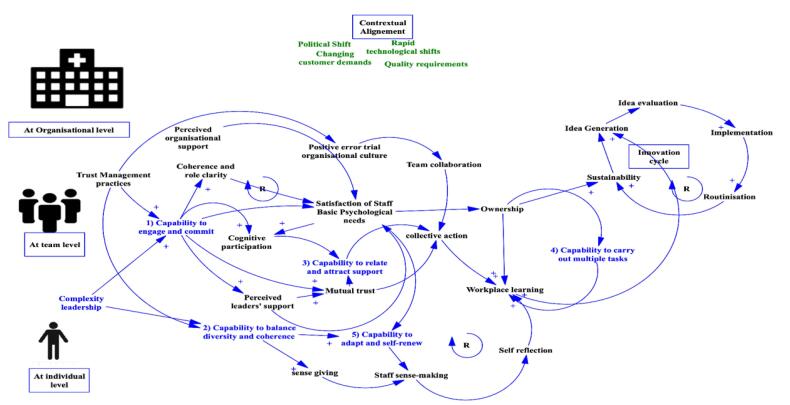
Employee-driven innovation (EDI) is still under-researched in health policy and system research, particularly in lowand middle-income countries. EDI is recognized as a lever to improve the commitment of health workers, promote quality of care, and contribute to creating value and transforming healthcare practices, services, structures, and processes. The mechanisms underlying the emergence of EDI processes and outcomes include core capabilities to cope with complexity, building spaces for learning, fostering sense-making and sense-giving, and collective problem-solving. The development of such capabilities depends on organizational and individual conditions. Organizational capabilities include complex leadership, trust management practices, task complexity, and the availability of slack resources. Individual capabilities comprise capabilities to cope with complexity, such as sense-making, autonomy, system thinking, and adaptive learning. The sustainability of EDI depends on local ownership and frontline employees' involvement during problem definition, innovation design, and implementation.
员工驱动型创新(EDI)在卫生政策和系统研究中仍未得到充分研究,尤其是在低收入和中等收入国家。EDI被视为提高卫生工作者的敬业度、提升护理质量以及为创造价值和转变医疗实践、服务、结构及流程做出贡献的一个杠杆。EDI过程和结果出现的潜在机制包括应对复杂性的核心能力、建立学习空间、促进意义建构和意义赋予以及集体解决问题。这些能力的发展取决于组织和个人条件。组织能力包括复杂领导力、信任管理实践、任务复杂性以及闲置资源的可用性。个人能力包括应对复杂性的能力,如意义建构、自主性、系统思维和适应性学习。EDI的可持续性取决于地方自主权以及一线员工在问题定义、创新设计和实施过程中的参与度。