Jung Matthias, Raghu Vineet K, Reisert Marco, Rieder Hanna, Rospleszcz Susanne, Pischon Tobias, Niendorf Thoralf, Kauczor Hans-Ulrich, Völzke Henry, Bülow Robin, Russe Maximilian F, Schlett Christopher L, Lu Michael T, Bamberg Fabian, Weiss Jakob
Department of Diagnostic and Interventional Radiology, University Medical Center Freiburg, Faculty of Medicine, University of Freiburg, Freiburg, Germany; Department of Radiology, Cardiovascular Imaging Research Center, Massachusetts General Hospital and Harvard Medical School, Boston, Massachusetts, USA.
Department of Radiology, Cardiovascular Imaging Research Center, Massachusetts General Hospital and Harvard Medical School, Boston, Massachusetts, USA.
EBioMedicine. 2024 Dec;110:105467. doi: 10.1016/j.ebiom.2024.105467. Epub 2024 Dec 1.
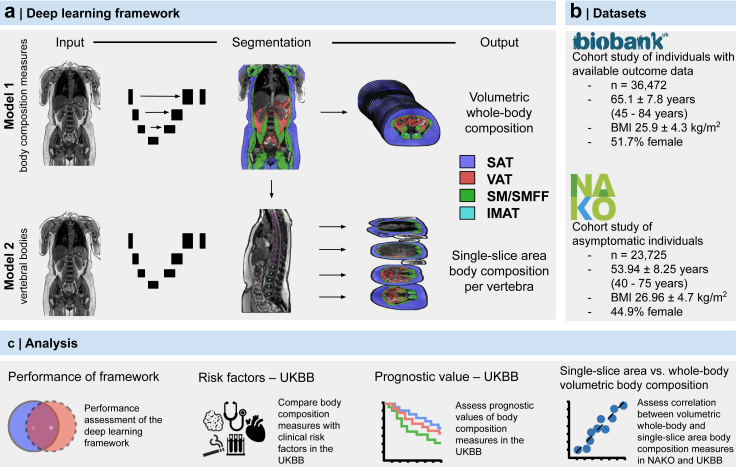
Manually extracted imaging-based body composition measures from a single-slice area (A) have shown associations with clinical outcomes in patients with cardiometabolic disease and cancer. With advances in artificial intelligence, fully automated volumetric (V) segmentation approaches are now possible, but it is unknown whether these measures carry prognostic value to predict mortality in the general population. Here, we developed and tested a deep learning framework to automatically quantify volumetric body composition measures from whole-body magnetic resonance imaging (MRI) and investigated their prognostic value to predict mortality in a large Western population.
The framework was developed using data from two large Western European population-based cohort studies, the UK Biobank (UKBB) and the German National Cohort (NAKO). Body composition was defined as (i) subcutaneous adipose tissue (SAT), (ii) visceral adipose tissue (VAT), (iii) skeletal muscle (SM), SM fat fraction (SMFF), and (iv) intramuscular adipose tissue (IMAT). The prognostic value of the body composition measures was assessed in the UKBB using Cox regression analysis. Additionally, we extracted body composition areas for every level of the thoracic and lumbar spine (i) to compare the proposed volumetric whole-body approach to the currently established single-slice area approach on the height of the L3 vertebra and (ii) to investigate the correlation between volumetric and single slice area body composition measures on the level of each vertebral body.
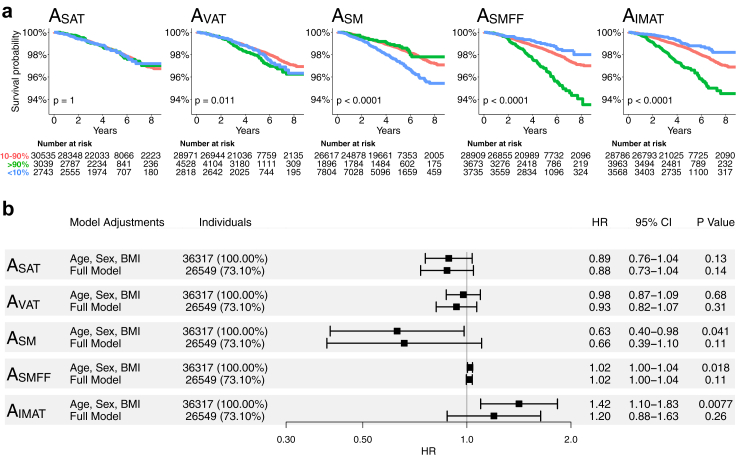
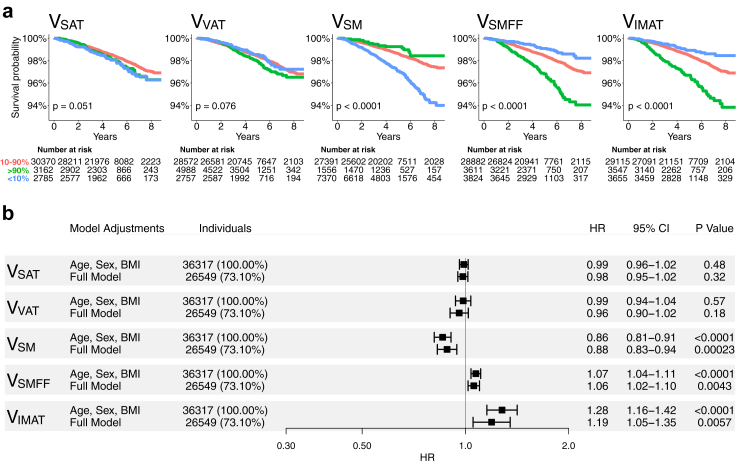
In 36,317 UKBB participants (mean age 65.1 ± 7.8 years, age range 45-84 years; 51.7% female; 1.7% [634/36,471] all-cause deaths; median follow-up 4.8 years), Cox regression revealed an independent association between V (adjusted hazard ratio [aHR]: 0.88, 95% confidence interval [CI] [0.81-0.91], p = 0.00023), V (aHR: 1.06, 95% CI [1.02-1.10], p = 0.0043), and V (aHR: 1.19, 95% CI [1.05-1.35], p = 0.0056) and mortality after adjustment for demographics (age, sex, BMI, race) and cardiometabolic risk factors (alcohol consumption, smoking status, hypertension, diabetes, history of cancer, blood serum markers). This association was attenuated when using traditional single-slice area measures. Highest correlation coefficients (R) between volumetric and single-slice area body composition measures were located at vertebra L5 for SAT (R = 0.820) and SMFF (R = 0.947), at L3 for VAT (R = 0.892), SM (R = 0.944), and at L4 for IMAT (R = 0.546) (all p < 0.0001). A similar pattern was found in 23,725 NAKO participants (mean age 53.9 ± 8.3 years, age range 40-75; 44.9% female).
Automated volumetric body composition assessment from whole-body MRI predicted mortality in a large Western population beyond traditional clinical risk factors. Single slice areas were highly correlated with volumetric body composition measures but their association with mortality attenuated after multivariable adjustment. As volumetric body composition measures are increasingly accessible using automated techniques, identifying high-risk individuals may help to improve personalised prevention and lifestyle interventions.
This project was conducted using data from the German National Cohort (NAKO) (www.nako.de). The NAKO is funded by the Federal Ministry of Education and Research (BMBF) [project funding reference numbers: 01ER1301A/B/C, 01ER1511D, and 01ER1801A/B/C/D], federal states of Germany and the Helmholtz Association, the participating universities and the institutes of the Leibniz Association. This research has been conducted using the UK Biobank Resource under Application Number 80337. MJ was funded by the Deutsche Forschungsgemeinschaft (DFG, German Research Foundation)-518480401. VKR was funded by American Heart Association Career Development Award 935176 and National Heart, Lung, and Blood Institute-K01HL168231.
从单一层面面积(A)手动提取的基于影像的身体成分测量值已显示出与心脏代谢疾病和癌症患者的临床结局相关。随着人工智能的发展,现在可以采用完全自动化的容积(V)分割方法,但这些测量值是否具有预测普通人群死亡率的预后价值尚不清楚。在此,我们开发并测试了一个深度学习框架,以自动量化来自全身磁共振成像(MRI)的容积性身体成分测量值,并研究其在一大群西方人群中预测死亡率的预后价值。
该框架是利用来自两项大型西欧基于人群的队列研究(英国生物银行[UKBB]和德国国民队列[NAKO])的数据开发的。身体成分定义为:(i)皮下脂肪组织(SAT),(ii)内脏脂肪组织(VAT),(iii)骨骼肌(SM)、SM脂肪分数(SMFF),以及(iv)肌内脂肪组织(IMAT)。在UKBB中,使用Cox回归分析评估身体成分测量值的预后价值。此外,我们提取了胸椎和腰椎每个层面的身体成分面积,(i)以将提议的容积性全身方法与目前在L3椎体高度上已确立的单一层面面积方法进行比较,以及(ii)研究每个椎体层面上容积性和单一层面面积身体成分测量值之间的相关性。
在36317名UKBB参与者中(平均年龄65.1±7.8岁,年龄范围45 - 84岁;51.7%为女性;1.7%[634/36471]全因死亡;中位随访4.8年),Cox回归显示,在对人口统计学因素(年龄、性别、BMI、种族)和心脏代谢风险因素(饮酒、吸烟状况、高血压、糖尿病、癌症病史、血清标志物)进行调整后,V(调整后风险比[aHR]:0.88,95%置信区间[CI][0.81 - 0.91],p = 0.00023)、V(aHR:1.06,95%CI[1.02 - 1.10],p = 0.0043)和V(aHR:1.19,95%CI[1.05 - 1.35],p = 0.0056)与死亡率之间存在独立关联。当使用传统的单一层面面积测量值时,这种关联减弱。容积性和单一层面面积身体成分测量值之间的最高相关系数(R)在L5椎体处为SAT(R = 0.820)和SMFF(R = 0.947),在L3椎体处为VAT(R = 0.892)、SM(R = 0.944),在L4椎体处为IMAT(R = 0.546)(所有p < 0.0001)。在23725名NAKO参与者中(平均年龄53.9±8.3岁,年龄范围40 - 75岁;44.9%为女性)发现了类似模式。
通过全身MRI进行的自动化容积性身体成分评估在一大群西方人群中预测死亡率的能力超越了传统临床风险因素。单一层面面积与容积性身体成分测量值高度相关,但在多变量调整后它们与死亡率的关联减弱。由于使用自动化技术越来越容易获得容积性身体成分测量值,识别高危个体可能有助于改善个性化预防和生活方式干预。