Zhu Haiqian, Zhao Chifeng, Zhu Haoran, Xu Xuhui, Hu Conglin, Zhang Zhenxing
Department of Stomatology, Taizhou Central Hospital (Taizhou University Hospital), No.999, Donghai Avenue, Taizhou, 318000, Zhejiang Province, People's Republic of China.
Xi'an Jiaotong University Health Science Center, Xi'an, 710000, Shaanxi Province, China.
Discov Oncol. 2024 Dec 3;15(1):739. doi: 10.1007/s12672-024-01629-2.
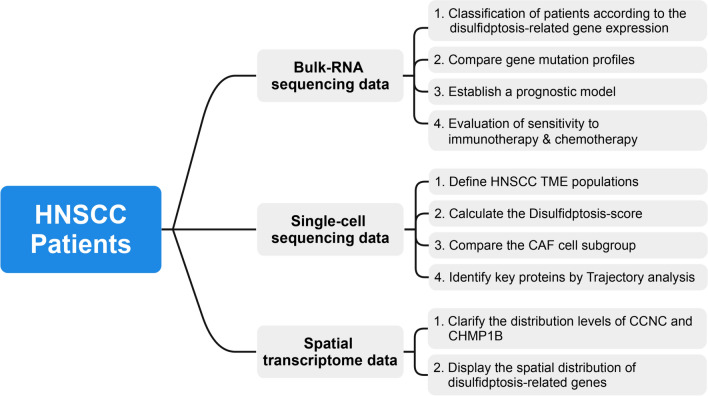
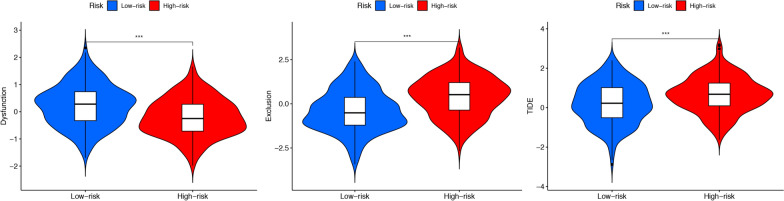
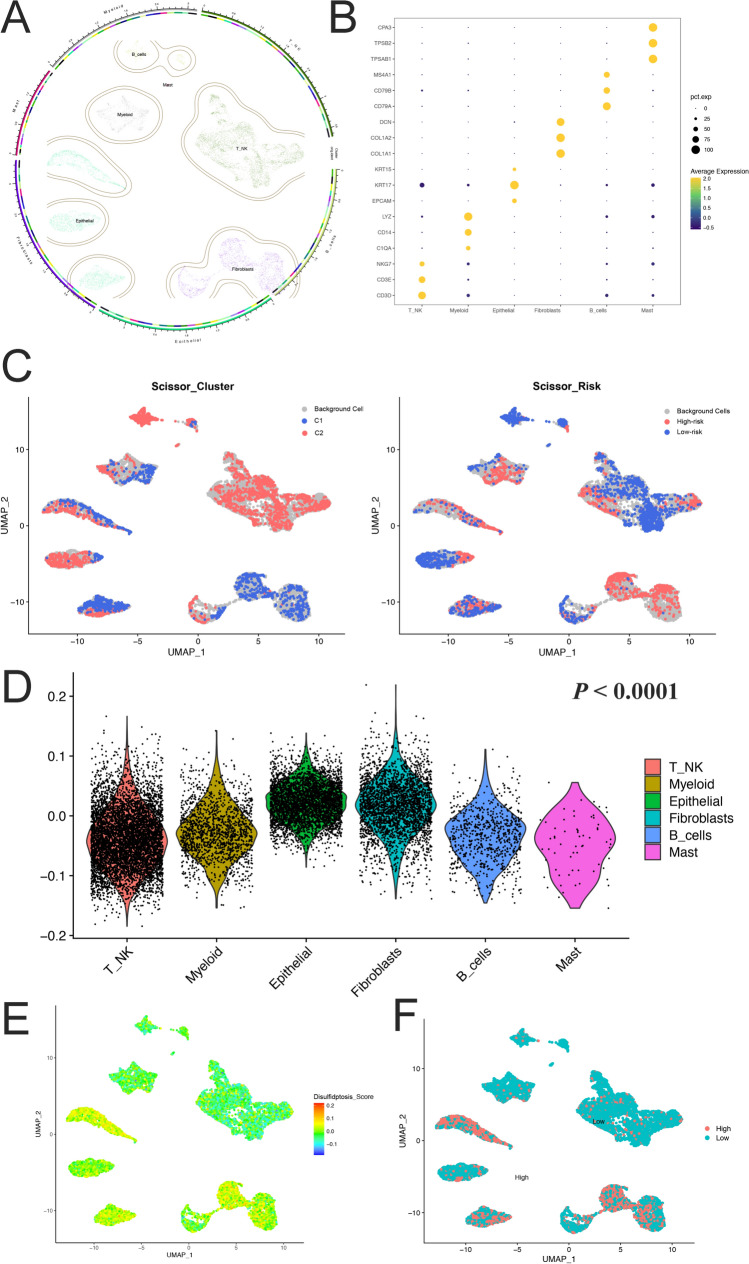
Disulfidptosis is a newfound programmed cell death (PCD) mode characterized by disulfide stress. Nevertheless, the characteristics and functional significance of disulfidptosis-related genes in head and neck squamous cell carcinoma (HNSCC) are still largely unknown. In this study, several computer-aided bioinformatic analyses were performed. The Nonnegative Matrix Factorization (NMF) method classified The Cancer Genome Atlas (TCGA) patients into two clusters according to the expression of disulfidptosis-related genes. The relative compositions of cells in the tumor microenvironment (TME), mutant landscape, lasso regression analysis, and predicted clinical outcome were performed by analyzing bulk RNA-sequencing data. Besides, single-cell sequencing data (scRNA) was analyzed by Seurat, CopyKAT, and monocle2 to reveal the expression characteristics of disulfidptosis-related genes. Moreover, the spatial distribution characteristics of each cell subgroup in the section and the functional significance of cancer-associated fibroblasts (CAFs) were elucidated by STUtility, SpaCET, and SPATA2. Here, two clusters with different expression characteristics of disulfidptosis-related genes were identified. Cluster 1 (C1) patients had a worse prognosis and a higher proportion of stromal cells but lower effector T cell infiltration than cluster 2 (C2). A novel prognostic model was established and verified in our patient cohort. Additionally, diploid and inflammatory CAFs (iCAFs) showed higher disulfidptosis-related gene expression levels. Furthermore, the CCNC and CHMP1B expressions significantly changed following CAFs differentiation. Disulfidptosis-related genes exhibited extensive and differential spatial expression on tissue sections. Collectively, our study may contribute to revealing the function of disulfidptosis, and improve the expansion of knowledge of crosstalk between cancer cells and CAFs.
二硫化物诱导的细胞焦亡是一种新发现的程序性细胞死亡(PCD)模式,其特征为二硫键应激。然而,头颈部鳞状细胞癌(HNSCC)中与二硫化物诱导的细胞焦亡相关基因的特征和功能意义仍 largely 未知。在本研究中,进行了多项计算机辅助生物信息学分析。非负矩阵分解(NMF)方法根据与二硫化物诱导的细胞焦亡相关基因的表达将癌症基因组图谱(TCGA)患者分为两个簇。通过分析批量 RNA 测序数据,对肿瘤微环境(TME)中的细胞相对组成、突变图谱、套索回归分析和预测的临床结果进行了研究。此外,通过 Seurat、CopyKAT 和 monocle2 分析单细胞测序数据(scRNA),以揭示与二硫化物诱导的细胞焦亡相关基因的表达特征。此外,通过 STUtility、SpaCET 和 SPATA2 阐明了切片中每个细胞亚组的空间分布特征以及癌症相关成纤维细胞(CAF)的功能意义。在此,鉴定出了两个具有不同二硫化物诱导的细胞焦亡相关基因表达特征的簇。簇 1(C1)患者的预后较差,基质细胞比例较高,但效应 T 细胞浸润低于簇 2(C2)。在我们的患者队列中建立并验证了一种新的预后模型。此外,二倍体和炎性 CAF(iCAF)显示出较高的二硫化物诱导的细胞焦亡相关基因表达水平。此外,CCNC 和 CHMP1B 的表达在 CAF 分化后发生了显著变化。与二硫化物诱导的细胞焦亡相关基因在组织切片上表现出广泛且差异的空间表达。总体而言,我们的研究可能有助于揭示二硫化物诱导的细胞焦亡的功能,并增进对癌细胞与 CAF 之间相互作用的认识。