Ma Ling, Yu Haijiao, Zhu Yubing, Xu Kaiyu, Zhao Aimin, Ding Lei, Gao Hong, Zhang Man
Department of Gastrointestinal Tumor Surgery, Beijing Shijitan Hospital Affiliated to Capital Medical University, Beijing, 100038, People's Republic of China.
Department of Clinical Laboratory, Beijing Shijitan Hospital Affiliated to Capital Medical University, No. 10 Tieyi Road, Haidian District, Beijing, 100038, People's Republic of China.
Proteome Sci. 2023 Feb 9;21(1):3. doi: 10.1186/s12953-023-00203-y.
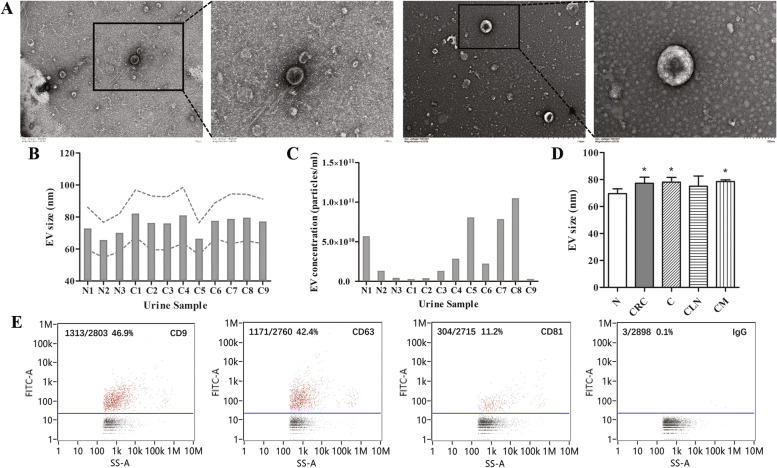
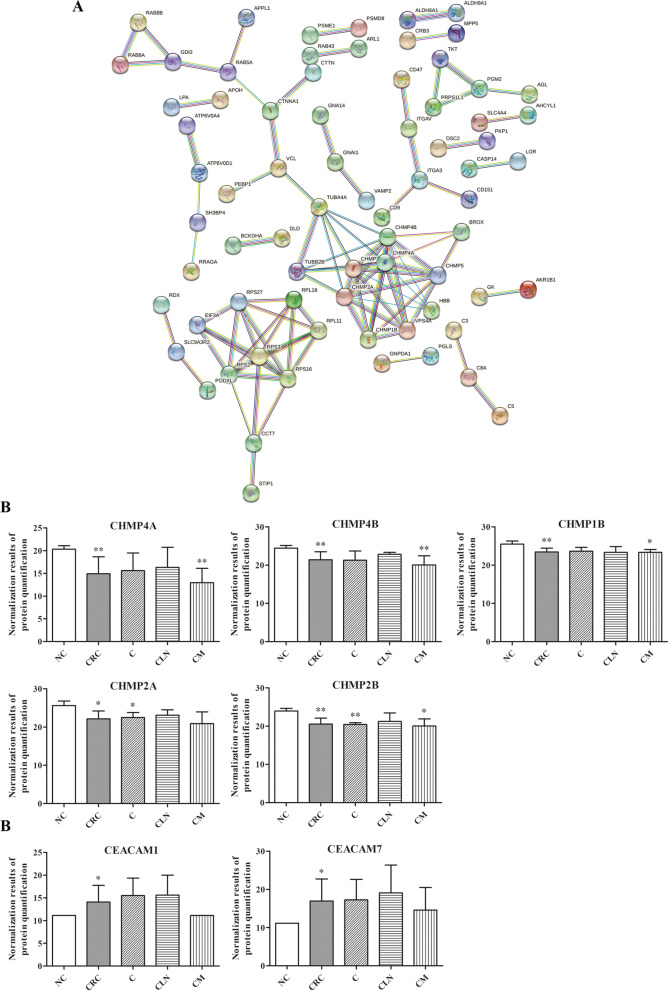
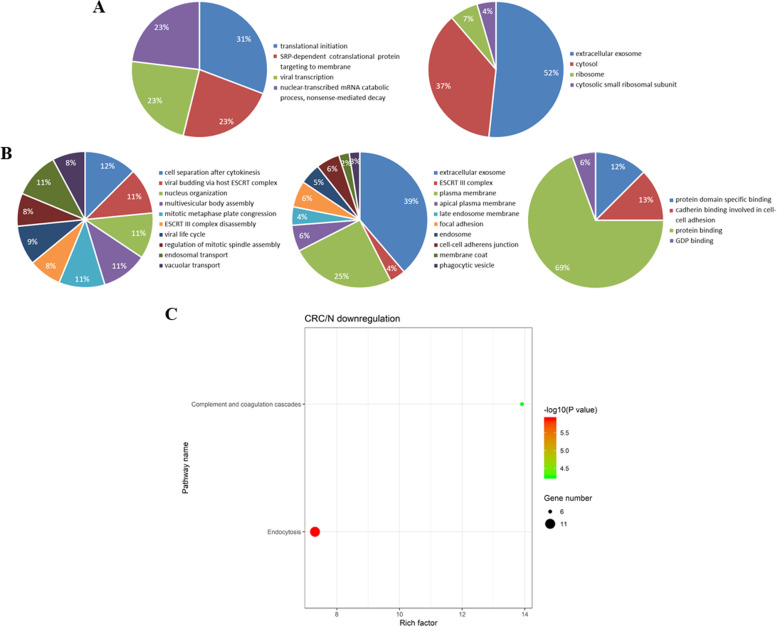
Exosomes in the body fluid are effective cell-derived membranous structures transferring various molecules to mediate intercellular communication. The expression of protein in the urinary exosomes from the colorectal cancer (CRC) patients could reflect the characteristics of tumorigenesis. The urinary exosomes with globular membrane structure, the size of 30 ~ 100 nm and positive expression of CD9, CD63 and CD81 were successfully isolated from 9 CRC patients and 3 heathy adults using the density gradient ultracentrifugation. Proteome profiles revealed by label-free liquid chromatography-tandem mass spectrometry (LC-MS/MS) indicated that several proteins were differentially expressed among different stages of CRC. Compared with normal controls, 67 proteins in CRC urinary exosomes were upregulated and 74 proteins were downregulated. The bioinformatics analysis revealed the decreased proteins were related to ESCRT III complex disassembly. The CHMP family was further determined to be the hub of interaction network of proteins enriched in ESCRT signaling. The significant decrease of CHMP4A, CHMP4B, CHMP2A, CHMP2B and CHMP1B were respectively found in the total CRC group and distant metastasis group compared with NC group. Moreover, the CEACAM family also showed significant aberrant changes in the urinary exosomes of CRC patients. The CEACAM7 and CEACAM1 were increased in the CRC patients compared with healthy individuals (P < 0.05). Significant changes of proteomic profile could be found in the urinary exosomes in the CRC patients. The differential expressed urinary exosomes derived proteins showed potential usage in diagnosis and prognosis of CRC.
体液中的外泌体是有效的细胞来源膜性结构,可传递各种分子以介导细胞间通讯。结直肠癌(CRC)患者尿液外泌体中的蛋白质表达可反映肿瘤发生的特征。采用密度梯度超速离心法,成功从9例CRC患者和3例健康成年人中分离出具有球状膜结构、大小为30~100nm且CD9、CD63和CD81呈阳性表达的尿液外泌体。无标记液相色谱-串联质谱(LC-MS/MS)揭示的蛋白质组图谱表明,CRC不同阶段有几种蛋白质差异表达。与正常对照相比,CRC尿液外泌体中有67种蛋白质上调,74种蛋白质下调。生物信息学分析显示,下调的蛋白质与内体分选转运复合体Ⅲ(ESCRT III)复合物的解体有关。CHMP家族进一步被确定为富含ESCRT信号的蛋白质相互作用网络的枢纽。与NC组相比,在CRC总组和远处转移组中分别发现CHMP4A、CHMP4B、CHMP2A、CHMP2B和CHMP1B显著降低。此外,癌胚抗原相关细胞黏附分子(CEACAM)家族在CRC患者的尿液外泌体中也显示出显著的异常变化。与健康个体相比,CRC患者的CEACAM7和CEACAM1增加(P<0.05)。CRC患者的尿液外泌体中可发现蛋白质组图谱的显著变化。差异表达的尿液外泌体衍生蛋白在CRC的诊断和预后中显示出潜在用途。