Karthiga M, Suganya E, Sountharrajan S, Balusamy Balamurugan, Selvarajan Shitharth
Department of Computer Science and Engineering, Bannari Amman Institute of Technology, Tamilnadu, India.
Department of Information Technology, Sri Sivasubramaniya Nadar (SSN) College of Engineering, Chennai, Tamilnadu, India.
Sci Rep. 2024 Dec 4;14(1):30251. doi: 10.1038/s41598-024-80448-5.
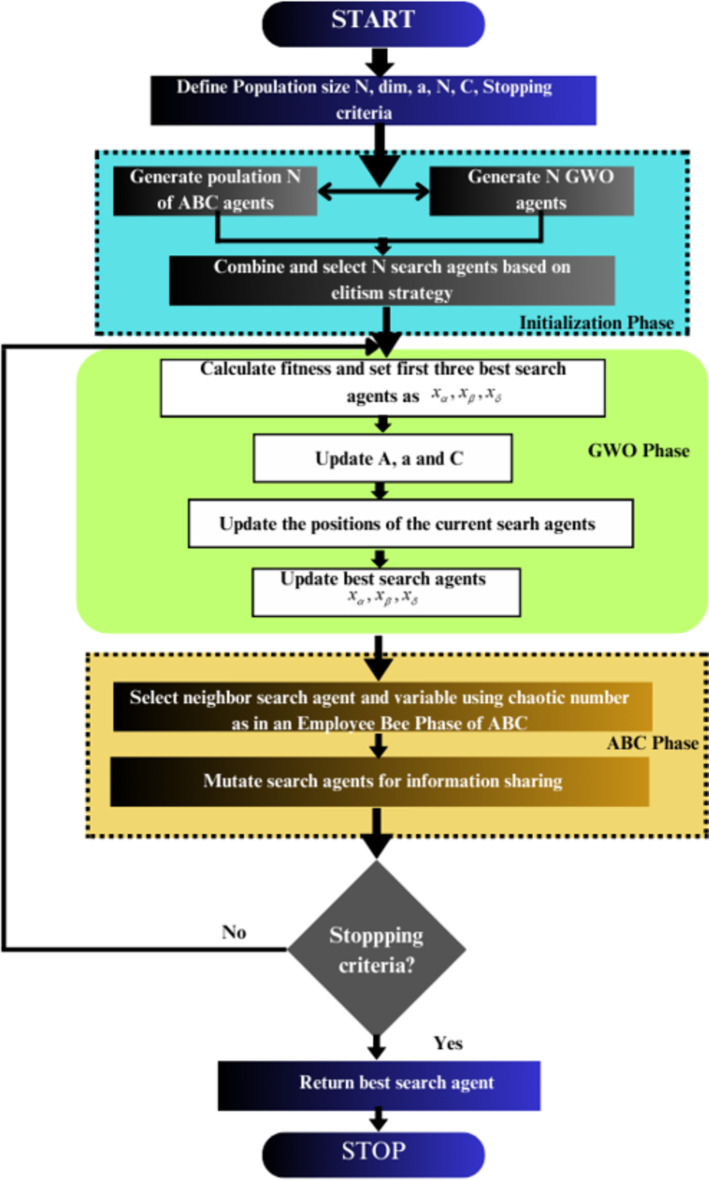
In the domain of passive brain-computer interface applications, the identification of emotions is both essential and formidable. Significant research has recently been undertaken on emotion identification with electroencephalogram (EEG) data. The aim of this project is to develop a system that can analyse an individual's EEG and differentiate among positive, neutral, and negative emotional states. The suggested methodology use Independent Component Analysis (ICA) to remove artefacts from Electromyogram (EMG) and Electrooculogram (EOG) in EEG channel recordings. Filtering techniques are employed to improve the quality of EEG data by segmenting it into alpha, beta, gamma, and theta frequency bands. Feature extraction is performed with a hybrid meta-heuristic optimisation technique, such as ABC-GWO. The Hybrid Artificial Bee Colony and Grey Wolf Optimiser are employed to extract optimised features from the selected dataset. Finally, comprehensive evaluations are conducted utilising DEAP and SEED, two publically accessible datasets. The CNN model attains an accuracy of approximately 97% on the SEED dataset and 98% on the DEAP dataset. The hybrid CNN-ABC-GWO model achieves an accuracy of approximately 99% on both datasets, with ABC-GWO employed for hyperparameter tuning and classification. The proposed model demonstrates an accuracy of around 99% on the SEED dataset and 100% on the DEAP dataset. The experimental findings are contrasted utilising a singular technique, a widely employed hybrid learning method, or the cutting-edge method; the proposed method enhances recognition performance.
在被动式脑机接口应用领域,情绪识别既至关重要又颇具挑战性。最近针对利用脑电图(EEG)数据进行情绪识别开展了大量研究。该项目的目标是开发一个系统,能够分析个体的脑电图并区分积极、中性和消极情绪状态。所建议的方法使用独立成分分析(ICA)从脑电图通道记录中的肌电图(EMG)和眼电图(EOG)去除伪迹。采用滤波技术,通过将脑电图数据分割为阿尔法、贝塔、伽马和西塔频段来提高其质量。使用混合元启发式优化技术(如ABC - GWO)进行特征提取。采用混合人工蜂群算法和灰狼优化器从选定的数据集中提取优化特征。最后,利用两个可公开获取的数据集DEAP和SEED进行全面评估。卷积神经网络(CNN)模型在SEED数据集上的准确率约为97%,在DEAP数据集上为98%。混合CNN - ABC - GWO模型在两个数据集上的准确率均达到约99%,其中ABC - GWO用于超参数调整和分类。所提出的模型在SEED数据集上的准确率约为99%,在DEAP数据集上为100%。利用单一技术、广泛使用的混合学习方法或前沿方法对实验结果进行对比;所提出的方法提高了识别性能。