Huang Di, Wang Yun-Yun, Li Bing-Hui, Wu Lan, Xie Wen-Zhong, Zhou Xia, Ma Bin
Evidence-Based Medicine Center, School of Basic Medical Sciences, Lanzhou University, Lanzhou, 730000, China.
Center for Evidence-Based and Translational Medicine, Zhongnan Hospital of Wuhan University, Wuhan, 430071, China.
Mil Med Res. 2024 Dec 4;11(1):74. doi: 10.1186/s40779-024-00583-y.
Numerous systematic reviews and meta-analyses have been published that evaluate the association between periodontal disease and systemic diseases, many of which address similar topics. Moreover, their quality requires assessment. Therefore, we performed a cross-sectional analysis to examine the evidence on the relationship between periodontal disease and systemic diseases.
The PubMed, Embase, Web of Science, and the Cochrane Library databases were systematically searched to identify relevant systematic reviews and meta-analyses. Only studies that considered periodontal disease as the exposure factor and various systemic diseases as the outcome were included. The basic characteristics and pertinent data from the selected studies were extracted. The modified version of A Measurement Tool to Assess Systematic Reviews 2 (AMSTAR 2) was employed for quality assessment, while R software was used for statistical analysis.
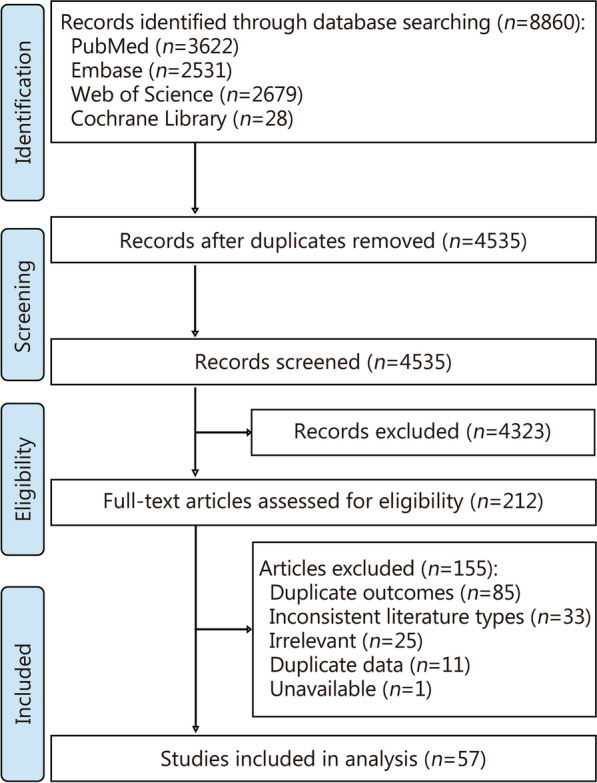
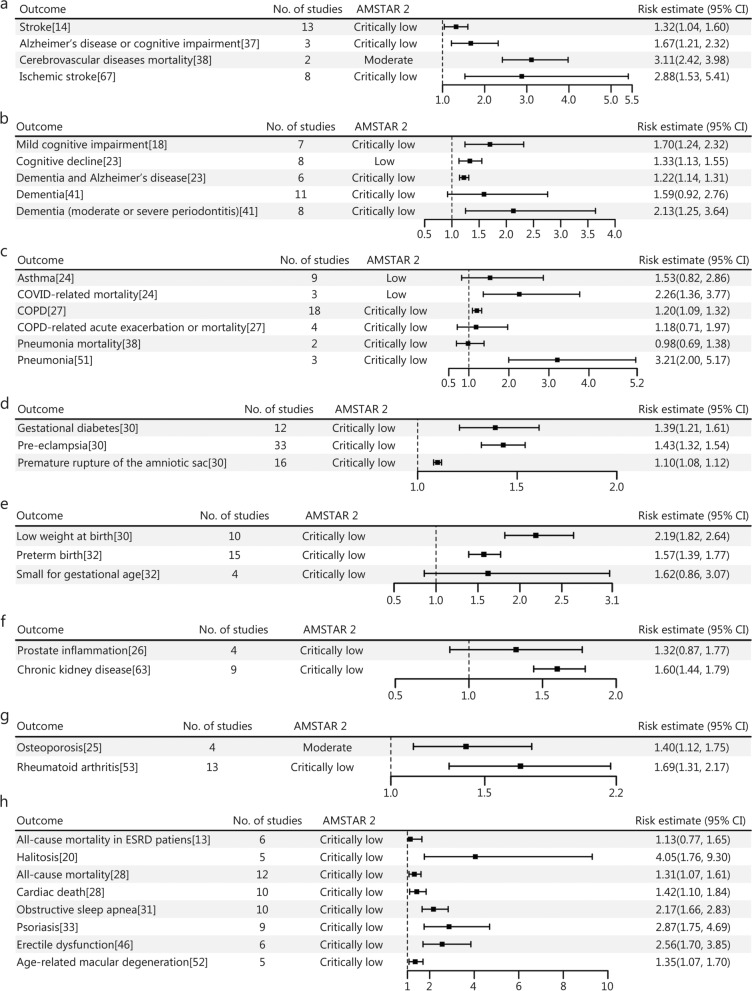
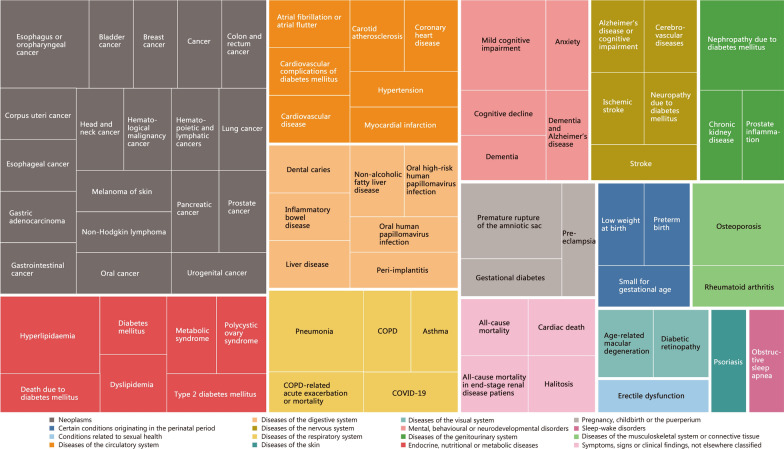
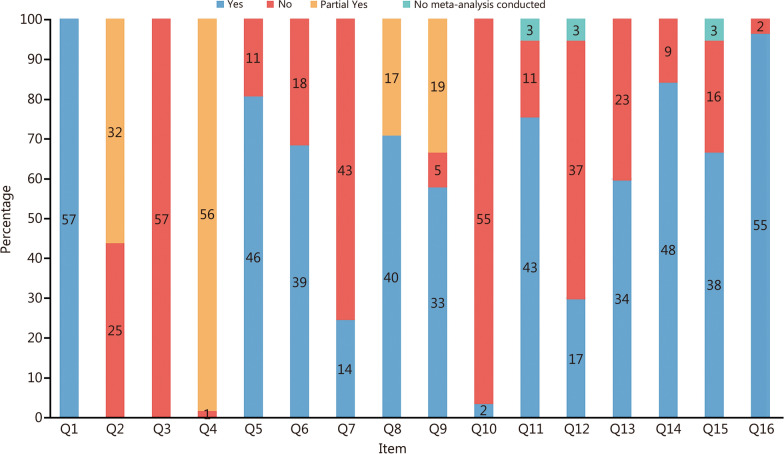
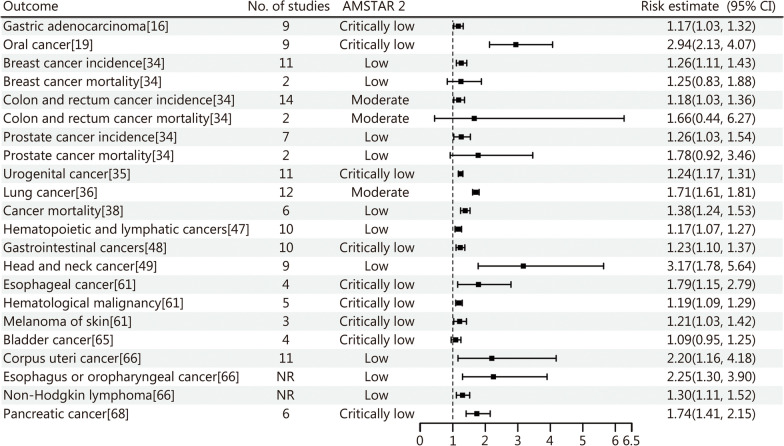
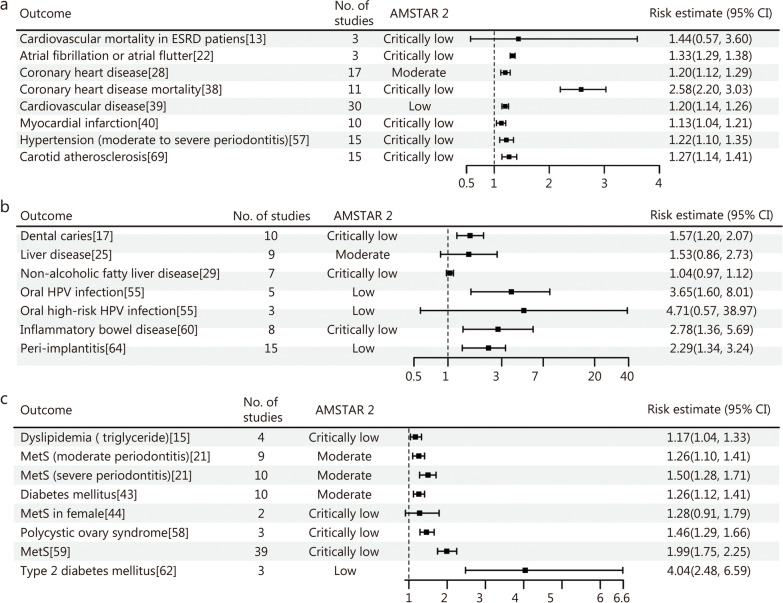
Among the 212 relevant systematic reviews and meta-analyses, 57 were finally included in our analysis. These studies involved 75 diseases and 81 disease-related outcomes, with cancer (19/81) being the most frequently addressed topic. Of the 81 outcomes, 67 demonstrated a significant association. Notably, the highest risk estimate was found for head and neck cancer [odds ratio (OR) = 3.17, 95% confidence interval (CI) 1.78 - 5.64], while the lowest was observed for premature rupture of the amniotic sac [relative risk (RR) = 1.10, 95% CI 1.08 - 1.12]. The methodological quality ratings indicated that approximately 71.93% of included studies were classified as "Critically low", with another 17.54% rated as "Low", and only about 10.53% categorized as "Moderate".
Periodontal disease significantly elevates the risks associated with 15 cancer-related, 8 cardiovascular-related, 8 metabolic-related, and 5 neurological-related outcomes. However, the overall methodological quality of existing systematic reviews and meta-analyses is generally suboptimal and requires enhancement to generate higher-quality evidence in the future.
已发表了大量系统评价和荟萃分析,评估牙周疾病与全身性疾病之间的关联,其中许多涉及相似主题。此外,它们的质量需要评估。因此,我们进行了一项横断面分析,以检验牙周疾病与全身性疾病之间关系的证据。
系统检索PubMed、Embase、Web of Science和Cochrane图书馆数据库,以识别相关的系统评价和荟萃分析。仅纳入将牙周疾病视为暴露因素、各种全身性疾病视为结局的研究。提取所选研究的基本特征和相关数据。采用《系统评价2的测量工具修订版》(AMSTAR 2)进行质量评估,同时使用R软件进行统计分析。
在212篇相关系统评价和荟萃分析中,最终57篇纳入我们的分析。这些研究涉及75种疾病和81种疾病相关结局,癌症(19/81)是最常涉及的主题。在81个结局中,67个显示出显著关联。值得注意的是风险估计最高值见于头颈癌[比值比(OR)=3.17,95%置信区间(CI)1.78 - 5.64],而最低值见于胎膜早破[相对危险度(RR)=1.10,95%CI 1.08 - 1.12]。方法学质量评级表明,纳入研究中约71.93%被归类为“极低”,另有17.54%被评为“低级别”,只有约10.53%被归类为“中级”。
牙周疾病显著增加了与15种癌症相关、与8种心血管相关、与8种代谢相关和与5种神经相关结局的风险。然而,现有系统评价和荟萃分析的总体方法学质量普遍欠佳,未来需要改进以产生更高质量的证据。