Ahn Chloe, Lelkes Yphtach, Levendusky Matthew
Annenberg School for Communication, University of Pennsylvania, 3620 Walnut St, Philadelphia, PA 19104, USA.
Department of Political Science, University of Pennsylvania, 133 S. 36th St, Philadelphia, PA 19104, USA.
PNAS Nexus. 2024 Nov 22;3(12):pgae534. doi: 10.1093/pnasnexus/pgae534. eCollection 2024 Dec.
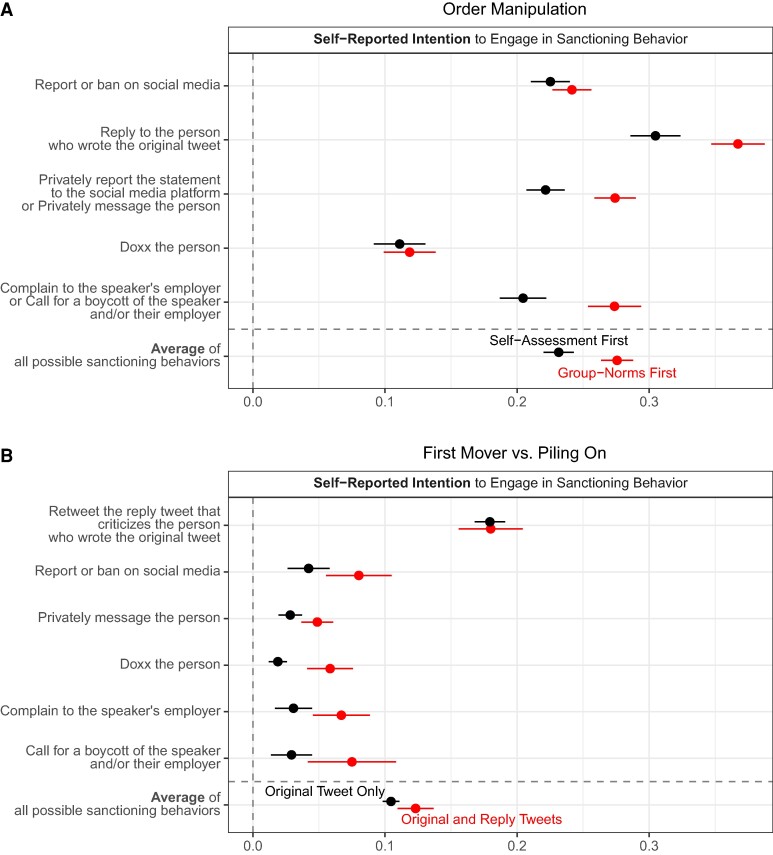
Social media is marked by online firestorms where people pile-on and shame those who say things perceived to be offensive, especially about politically relevant topics. What explains why individuals engage in this sort of sanctioning behavior? We show that two key factors help to explain this pattern. First, on these topics, both offensive speech and subsequent sanctioning are seen as informative about partisanship: people assume that those who say offensive things are out-partisans, and those who criticize them are co-partisans. Second, individuals perceive that such sanctioning is an injunctive norm and believe that their fellow co-partisans approve of it-sanctioning someone allows them to signal their partisanship by adhering to that norm. Using three original experiments, we show strong support for this argument. Sanctioning this type of offensive speech is as informative about perceived partisanship as explicit partisan electioneering. Further, people perceive that a wide variety of sanctioning behaviors are (partisan) group norms. We also show that while people are reluctant to be the first to criticize someone online, they are quite willing to pile-on to others' criticisms, which helps to explain why this behavior spreads so rapidly in online firestorms. Our results have implications for online social dynamics, as well as partisanship and partisan animosity more broadly.
社交媒体的特点是网络风暴,人们会群起而攻之,羞辱那些说出被认为具有冒犯性言论的人,尤其是在与政治相关的话题上。如何解释个人为何会参与这种制裁行为呢?我们表明有两个关键因素有助于解释这种模式。首先,在这些话题上,冒犯性言论和随后的制裁都被视为与党派关系相关的信息:人们认为那些说出冒犯性话语的人是党外人士,而那些批评他们的人是党内人士。其次,个人认为这种制裁是一种指令性规范,并相信他们的党内同志会赞成这种制裁——制裁某人能让他们通过遵守该规范来表明自己的党派立场。通过三项原创实验,我们为这一论点提供了有力支持。制裁这类冒犯性言论与明确的党派竞选活动一样,都能传达出对党派关系的认知。此外,人们认为各种各样的制裁行为都是(党派)群体规范。我们还表明,虽然人们不愿在网上率先批评某人,但他们很愿意跟风其他人的批评,这有助于解释为什么这种行为在网络风暴中传播得如此迅速。我们的研究结果对网络社会动态以及更广泛的党派关系和党派敌意都有启示。