Li Yuyang, Tang Chunxi
College of Applied Economics, Guizhou University of Finance and Economics, Guiyang, Guizhou, China.
Department of Gynaecology and Obstetrics, The First People's Hospital of Zunyi (The Third Affiliated Hospital of Zunyi Medical University), Zunyi, Guizhou, China.
Front Psychol. 2024 Dec 3;15:1447207. doi: 10.3389/fpsyg.2024.1447207. eCollection 2024.
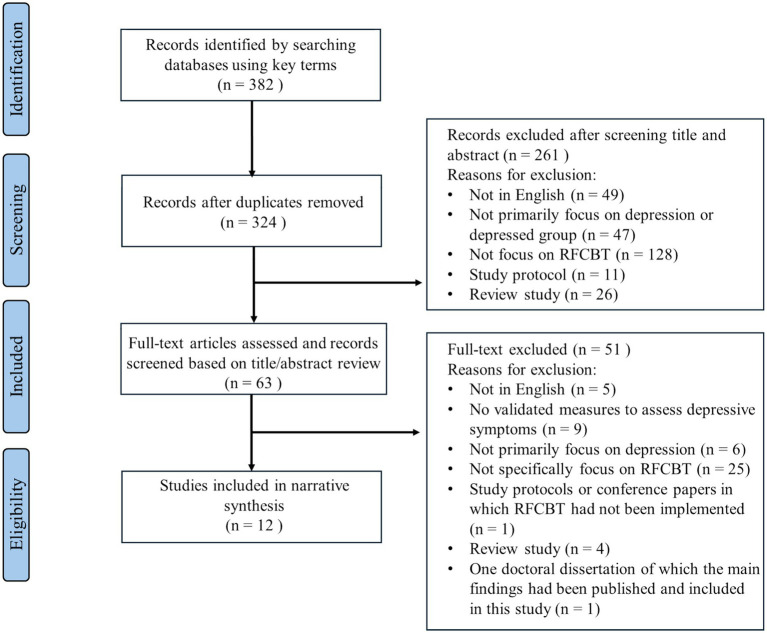
There is still potential room for improving the effectiveness of standard Cognitive Behavioral Therapy (CBT) in preventing the onset of depression, achieving full remission, and preventing relapse or recurrence of depression. Standard CBT seems less effective in reducing depressive rumination, a key risk factor leading to the onset and persistence of depression. To improve treatment efficacy for depression, rumination-focused cognitive behavioral therapy (RFCBT) was developed, which was modified from CBT and specifically targeted to manage rumination. This systematic review aimed to assess the effects of RFCBT by evaluating whether RFCBT could contribute to reducing depressive symptoms pre-post intervention. A literature search was conducted up to April 30, 2024, across four English-language databases, including PubMed, Web of Science, Google Scholar, and Embase. The search terms employed were: (depress* OR mood OR affect OR rumination) AND ("Rumination Focused Cognitive behavio* Therapy" OR RFCBT). Among the initial 328 studies identified, 12 met the inclusion criteria, of which 10 were randomized controlled trials. Intervention characteristics and results were narratively synthesized to address the review aims. This review found preliminary evidence that the RFCBT could eliminate depressive symptoms post-intervention, and might prevent individuals from developing depression, alleviate depressive symptoms, and prevent relapse of depression, as well as reduce rumination. RFCBT could be promoted to treat depressive symptoms, especially for those with a high tendency toward rumination. However, more studies with rigorous designs are required to confirm its efficacy across different stages of depression. Future studies could compare RFCBT with other psychotherapies, dismantle the psychological therapies to identify their effective components, and explore which specific groups of people might benefit most from this intervention.
在预防抑郁症发作、实现完全缓解以及预防抑郁症复发方面,标准认知行为疗法(CBT)的有效性仍有提升空间。标准CBT在减少抑郁性沉思方面似乎效果较差,而抑郁性沉思是导致抑郁症发作和持续的关键风险因素。为提高抑郁症的治疗效果,人们开发了以沉思为重点的认知行为疗法(RFCBT),它是在CBT的基础上改进而来,专门针对沉思进行管理。本系统评价旨在通过评估RFCBT在干预前后是否有助于减轻抑郁症状来评估其效果。截至2024年4月30日,我们在四个英文数据库(包括PubMed、科学网、谷歌学术和Embase)中进行了文献检索。使用的检索词为:(抑郁或情绪或情感或沉思)AND(“以沉思为重点的认知行为疗法”或RFCBT)。在最初确定的328项研究中,有12项符合纳入标准,其中10项为随机对照试验。我们对干预特征和结果进行了叙述性综合分析,以实现综述目的。本综述发现初步证据表明,RFCBT可以在干预后消除抑郁症状,并可能预防个体患抑郁症、减轻抑郁症状、预防抑郁症复发以及减少沉思。RFCBT可推广用于治疗抑郁症状,尤其是对于那些沉思倾向较高的人。然而,需要更多设计严谨的研究来证实其在抑郁症不同阶段的疗效。未来的研究可以将RFCBT与其他心理疗法进行比较,拆解心理疗法以确定其有效成分,并探索哪些特定人群可能从这种干预中获益最大。