Zhao Jianping, Cao Ai, Xie Linjun, Shao Lei
Department of Stomatology, The Fourth Affiliated Hospital of Soochow University, Suzhou, 215000, China.
Department of Pharmacy, The Affiliated Suzhou Hospital of Nanjing Medical University, Suzhou, 215000, China.
BMC Oral Health. 2024 Dec 18;24(1):1500. doi: 10.1186/s12903-024-05292-5.
This study aimed to investigate the knowledge, attitude, and practice (KAP) toward oral health management among orthodontic patients.
A cross-sectional study on orthodontic patients was conducted at Suzhou Dushu Lake Hospital from December 20, 2023, to March 19, 2024. Demographic data and KAP scores were collected using self-designed questionnaires. The cutoff for adequate KAP dimension scores was 70%.
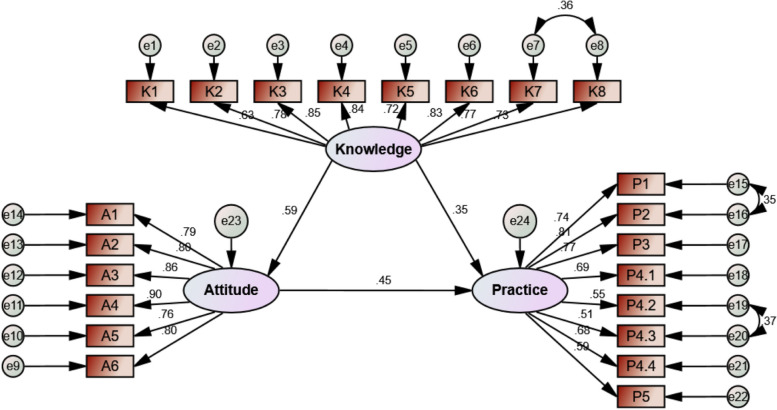
The study included 418 orthodontic patients, of whom 274 (65.55%) were female, and 144 (34.45%) were male. The average age was 32.70 ± 8.47 years (33.72 ± 8.46 in females and 32.17 ± 8.44 in males). The mean knowledge, attitude, and practice scores were 11.80 ± 4.06 (possible range: 0-16), 27.00 ± 3.18 (possible range: 6-30), and 31.13 ± 6.01 (possible range: 8-40), respectively. The proportions of participants who scored above a cutoff of 70% were 247 (59.09%) for knowledge, 403 (96.41%) for attitude, and 290 (69.38%) for practice. Multivariate logistic regression showed that knowledge score (OR = 1.243, 95% CI: [1.152-1.342], P < 0.001), attitude score (OR = 1.255, 95% CI: [1.140-1.381], P < 0.001), and wearing an appliance for 3 to 6 months (OR = 4.309, 95% CI: [1.565-11.861], P = 0.005) were independently linked to proactive practice. Structural equation modeling demonstrated that knowledge directly influenced attitude (β = 0.684, P < 0.001) and practice (β = 0.527, P < 0.001), while attitude had a direct impact on practice (β = 0.587, P < 0.001).
The majority of orthodontic patients demonstrated adequate knowledge, positive attitudes, and proactive practices toward oral health management. Nonetheless, continuous education is still essential for certain groups, such as recently fitted orthodontic patients, to ensure sustained improvement in oral health outcomes.
本研究旨在调查正畸患者对口腔健康管理的知识、态度和行为(KAP)。
于2023年12月20日至2024年3月19日在苏州独墅湖医院对正畸患者进行了一项横断面研究。使用自行设计的问卷收集人口统计学数据和KAP评分。KAP维度得分合格的临界值为70%。
该研究纳入了418名正畸患者,其中274名(65.55%)为女性,144名(34.45%)为男性。平均年龄为32.70±8.47岁(女性为33.72±8.46岁,男性为32.17±8.44岁)。知识、态度和行为的平均得分分别为11.80±4.06(可能范围:0 - 16)、27.00±3.18(可能范围:6 - 30)和31.13±6.01(可能范围:8 - 40)。得分高于70%临界值的参与者比例分别为:知识方面247名(59.09%),态度方面403名(96.41%),行为方面290名(69.38%)。多变量逻辑回归显示,知识得分(OR = 1.243,95%CI:[1.152 - 1.342],P < 0.001)、态度得分(OR = 1.255,95%CI:[1.140 - 1.381],P < 0.001)以及佩戴矫治器3至6个月(OR = 4.309,95%CI:[1.565 - 11.861],P = 0.005)与积极行为独立相关。结构方程模型表明,知识直接影响态度(β = 0.684,P < 0.001)和行为(β = 0.527,P < 0.001),而态度对行为有直接影响(β = 0.587,P < 0.001)。
大多数正畸患者在口腔健康管理方面表现出足够的知识、积极的态度和主动的行为。尽管如此,对于某些群体,如近期佩戴正畸矫治器的患者,持续教育仍然至关重要,以确保口腔健康状况持续改善。