Huang Sih-Shiang, Lin Chih-Hsien, Lin Shao-Yung, Huang Chien-Tai, Lien Wan-Ching
Department of Emergency Medicine, National Taiwan University Hospital and National Taiwan University, No.7, Chung-Shan South Road, Taipei, 100, Taiwan.
Department of Emergency Medicine, National Taiwan University Hospital, Hsin-Chu Branch, Hsin-Chu City, Taiwan.
BMC Med Educ. 2024 Dec 18;24(1):1444. doi: 10.1186/s12909-024-06458-z.
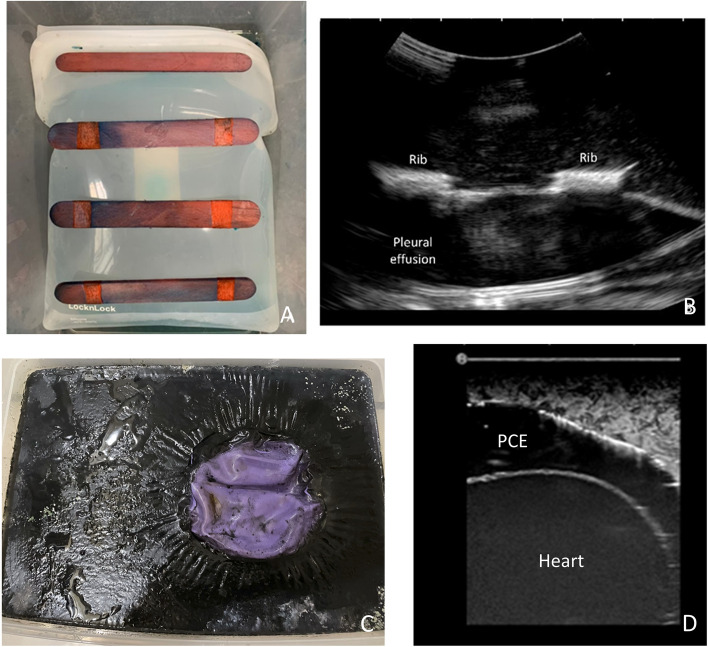
This prospective study aims to evaluate the learning effect of US-guided thoracocentesis and pericardiocentesis in novices through simulation training using handmade phantoms.
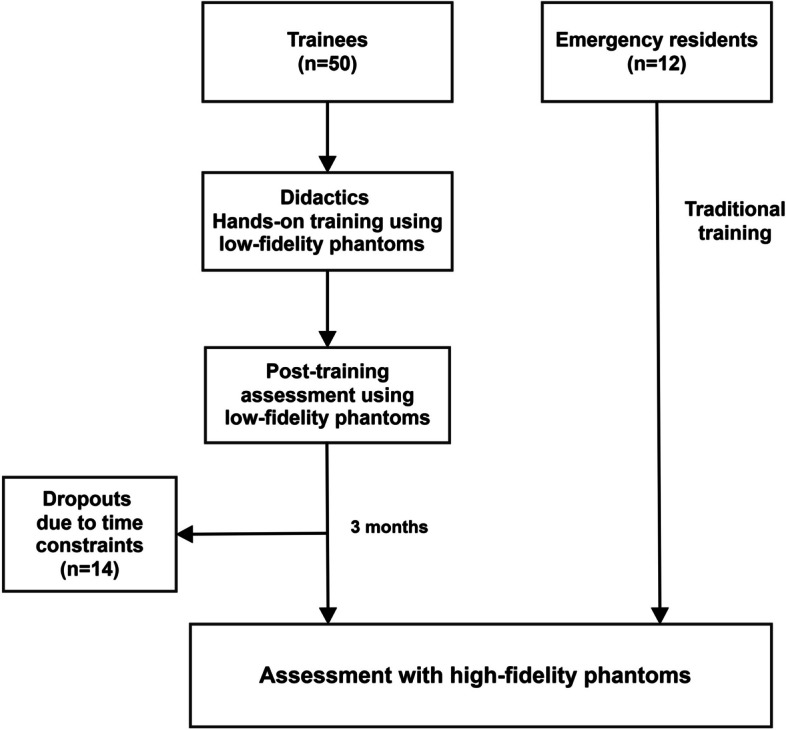
The novices included undergraduate-year (UGY) students and first postgraduate-year (PGY-1) residents. Handmade phantoms were utilized for training and immediate assessment. Novices were re-evaluated using high-fidelity phantoms three months after training, while experienced PGY-3 emergency medicine residents were recruited and evaluated with high-fidelity phantoms simultaneously. Data on their performance, puncture time, and number of attempts were collected.
Thirty-six novices (18 PGY-1 and 18 UGYs) and 12 PGY-3 emergency medicine residents were recruited. Alongside clinical observation, novices demonstrated improved skill retention and performance at the 3-month assessment compared to the immediate assessment [5 (4-5) vs. 3.5 (3-4), p = 0.0005] in thoracocentesis, achieving a comparable level of proficiency with the PGY-3 emergency medicine residents [5 (4-5) vs. 5 (5), p = 0.105]. Without clinical observation, novices exhibited a decline in skill proficiency in pericardiocentesis at the 3-month assessment [3 (3-4) vs. 4 (4-4.5), p = 0.015]. The puncture time was comparable between novices and PGY-3 emergency medicine residents for both thoracocentesis and pericardiocentesis. However, novices required a greater number of puncture attempts for pericardiocentesis.
Novices showed superior performance in thoracocentesis but experienced skill decay in pericardiocentesis at the 3-month assessment following training with handmade phantoms. This decline may be attributed to the very low frequency of pericardiocentesis cases encountered by novices after training, as well as the higher-stakes nature of the procedure. Further investigation is needed to evaluate the long-term effects of training, skill retention, and transfer of skills to actual patient care. Additionally, research should focus on determining optimal retraining intervals for pericardiocentesis and evaluating the use of standardized pericardiocentesis videos as an alternative to clinical observation.
Registered at ClinicalTrials.gov (NCT04792203) on March 7, 2021.
本前瞻性研究旨在通过使用手工制作的模型进行模拟训练,评估新手在超声引导下胸腔穿刺术和心包穿刺术方面的学习效果。
新手包括本科医学生(UGY)和第一年住院医师(PGY-1)。使用手工制作的模型进行训练和即时评估。训练三个月后,使用高保真模型对新手进行重新评估,同时招募经验丰富的PGY-3急诊医学住院医师并使用高保真模型进行评估。收集他们的操作表现、穿刺时间和穿刺尝试次数的数据。
招募了36名新手(18名PGY-1和18名UGY)和12名PGY-3急诊医学住院医师。与即时评估相比,在临床观察的情况下,新手在3个月评估时胸腔穿刺术的技能保持和操作表现有所改善[5(4-5)对3.5(3-4),p = 0.0005],达到了与PGY-3急诊医学住院医师相当的熟练程度[5(4-5)对5(5),p = 0.105]。在没有临床观察的情况下,新手在心包穿刺术的3个月评估时技能熟练程度有所下降[3(3-4)对4(4-4.5),p = 0.015]。新手和PGY-3急诊医学住院医师在胸腔穿刺术和心包穿刺术的穿刺时间上相当。然而,新手在心包穿刺术时需要更多的穿刺尝试次数。
新手在胸腔穿刺术方面表现出色,但在使用手工制作的模型训练后的3个月评估时,心包穿刺术技能出现衰退。这种衰退可能归因于新手训练后遇到的心包穿刺术病例频率极低,以及该操作风险较高。需要进一步研究来评估训练的长期效果、技能保持以及技能向实际患者护理的转移。此外,研究应侧重于确定心包穿刺术的最佳再培训间隔,并评估使用标准化心包穿刺术视频作为临床观察替代方法的效果。
于2021年3月7日在ClinicalTrials.gov(NCT04792203)注册。