Xia Qifei, Liu Qi, Qin Guoyou
School of Physical Education, Ankang College, Ankang, China.
Institute of Sports Training, Xi'an Institute of Physical Education, Xi'an, China.
Front Psychol. 2024 Nov 25;15:1411175. doi: 10.3389/fpsyg.2024.1411175. eCollection 2024.
This study aims to explore the mediating role of psychological resilience in the relationship between physical exercise and the sense of security among junior high school students, with a particular focus on variations based on only-child status.
A survey was conducted among 649 left-behind junior high school students in Gansu Province, China, utilizing the Physical Activity Rating Scale-3 (PARS-3), Security Questionnaire (SQ), and Resilience Scale for Chinese Adolescents (RSCA).
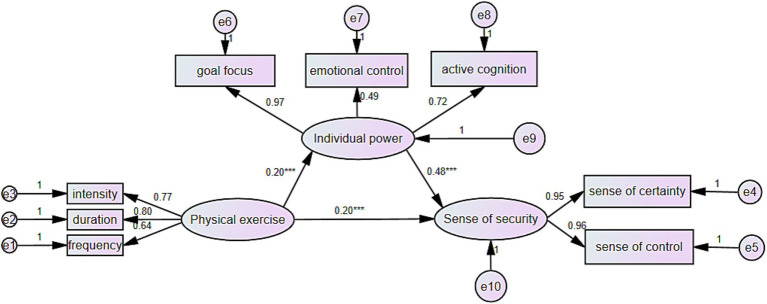
Among the participants, the mean scores for physical exercise, psychological resilience, and sense of security were 40.78 ± 29.49, 51.14 ± 10.08, and 55.75 ± 14.35, respectively. A significant positive correlation was observed between physical exercise and sense of security ( = 0.210, < 0.01), physical exercise and psychological resilience ( = 0.164, < 0.01), and psychological resilience and sense of security ( = 0.443, < 0.01). Mediation analysis revealed that psychological resilience partially mediates the effect of physical exercise on the sense of security, accounting for 33.9% of the total effect. Multi-group analysis indicated significant differences in this mediating effect between only children and children with siblings, with a stronger predictive role of psychological resilience for the sense of security among non-only children.
Participation in physical exercise can promote the improvement of sense of security through the individual power factor of improving the psychological resilience of left-behind junior high school students, and this improvement effect is more significant for non-only children.
本研究旨在探讨心理韧性在初中生体育锻炼与安全感关系中的中介作用,特别关注独生子女身份的差异。
对中国甘肃省649名初中留守儿童进行调查,采用体育活动量表-3(PARS-3)、安全感问卷(SQ)和中国青少年心理韧性量表(RSCA)。
参与者的体育锻炼、心理韧性和安全感平均得分分别为40.78±29.49、51.14±10.08和55.75±14.35。体育锻炼与安全感(r = 0.210,p < 0.01)、体育锻炼与心理韧性(r = 0.164,p < 0.01)以及心理韧性与安全感(r = 0.443,p < 0.01)之间均存在显著正相关。中介分析表明,心理韧性部分中介了体育锻炼对安全感的影响,占总效应的33.9%。多组分析表明,独生子女与非独生子女在这种中介效应上存在显著差异,心理韧性对非独生子女安全感的预测作用更强。
参与体育锻炼可通过提高初中留守儿童心理韧性这一个体因素促进安全感的提升,且这种提升效应在非独生子女中更为显著。