Akdemir Fatih, Kayigil Önder
Faculty of Medicine, Department of Urology, Yıldırım Beyazıt University, Bilkent, Polatlı caddesi, No:125/4, Gazi Mahallesi, Yenimahalle, Ankara, Turkey.
Basic Clin Androl. 2024 Dec 20;34(1):28. doi: 10.1186/s12610-024-00243-0.
To evaluate the effects of penile revascularization surgery on penile vascular hemodynamics and to assess the utility of the resistive index (RI) as an objective parameter for postoperative patient follow-up.
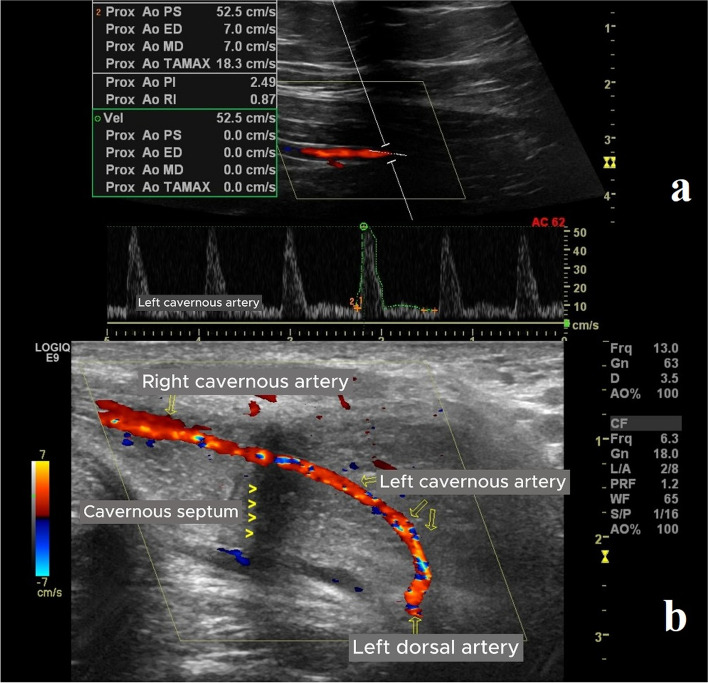
This study included a total of 35 patients who underwent penile revascularization. Penile color Doppler ultrasonography was performed preoperatively and at the third postoperative month to evaluate cavernosal arteries, dorsal arteries, deep dorsal vein, and inferior epigastric artery. During these evaluations, peak systolic velocity, end diastolic velocity, and resistive index were measured. The International Index of Erectile Function questionnaire was administered before surgery and at the third postoperative month. In addition, corpus cavernosum electromyography and cavernosometry tests were performed in all cases preoperatively. Anastomotic patency was assessed using computed tomography angiography at the end of the follow-up period.
The mean preoperative resistive index values were determined to be 0.74 ± 0.07 and 0.73 ± 0.09 cm/s for the right and left cavernosal arteries, respectively, and these values increased to 0.95 ± 0.09 and 0.96 ± 0.06 cm/s, respectively, at the last postoperative control. The mean International Index of Erectile Function-5, 15 scores for the right and left cavernosal arteries were 8.52 ± 4.83 and 19.4 ± 8.54, respectively, preoperatively, and these scores improved to 15.26 ± 4.50 and 35.76 ± 13.65, respectively, at the last postoperative follow-up.
The results of this study suggest that the resistive index can be used as an objective parameter in the diagnosis of erectile dysfunction of vascular origin and in the follow-up and management of the disease following penile revascularization.
NCT06350019/04/03/2024 (retrospectively registered).
评估阴茎血管重建手术对阴茎血管血流动力学的影响,并评估阻力指数(RI)作为术后患者随访客观参数的效用。
本研究共纳入35例行阴茎血管重建术的患者。术前及术后第三个月行阴茎彩色多普勒超声检查,评估海绵体动脉、背动脉、阴茎背深静脉及腹壁下动脉。在这些评估过程中,测量收缩期峰值流速、舒张末期流速和阻力指数。术前及术后第三个月进行国际勃起功能指数问卷调查。此外,所有病例术前均行海绵体肌电图和海绵体测压检查。随访期末采用计算机断层血管造影评估吻合口通畅情况。
术前右侧和左侧海绵体动脉的平均阻力指数值分别确定为0.74±0.07和0.73±0.09cm/s,在最后一次术后检查时,这些值分别增至0.95±0.09和0.96±0.06cm/s。术前右侧和左侧海绵体动脉的平均国际勃起功能指数-5、15评分分别为8.52±4.83和19.4±8.54,在最后一次术后随访时,这些评分分别提高至15.26±4.50和35.76±13.65。
本研究结果表明,阻力指数可作为血管性勃起功能障碍诊断及阴茎血管重建术后疾病随访和管理的客观参数。
NCT06350019/04/03/2024(回顾性注册)