Hernandes Vinicius, Heuvelmans Anouk M, Gualtieri Valentina, Meijer Dimphna H, van Woerden Geeske M, Greplova Eliska
Department of Quantum Nanoscience, Kavli Institute of Nanoscience, Delft University of Technology, Delft, Netherlands.
Department of Clinical Genetics, Erasmus Medical Center, Rotterdam, Netherlands.
Front Neurosci. 2024 Dec 5;18:1446578. doi: 10.3389/fnins.2024.1446578. eCollection 2024.
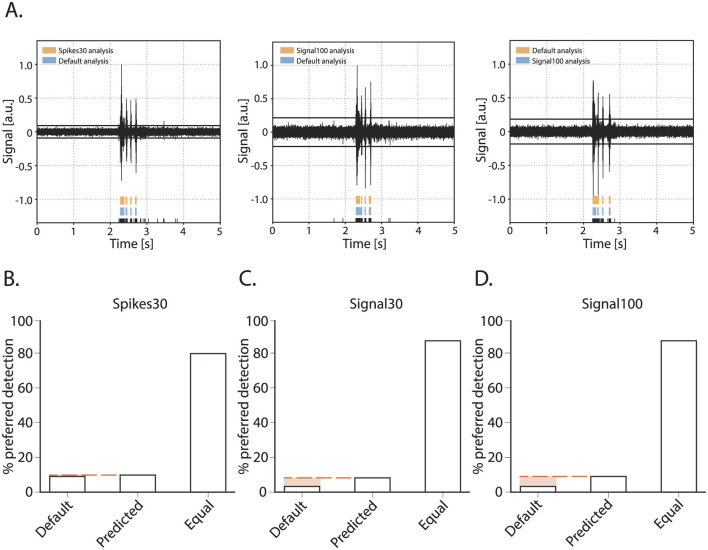
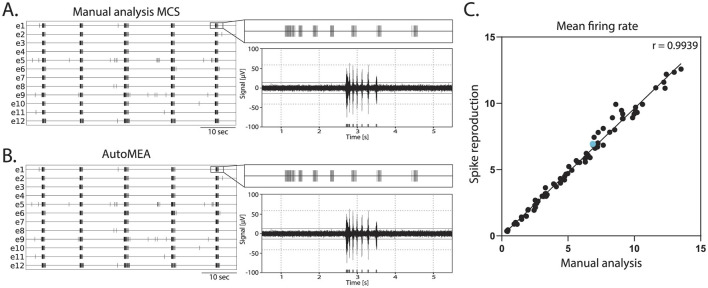
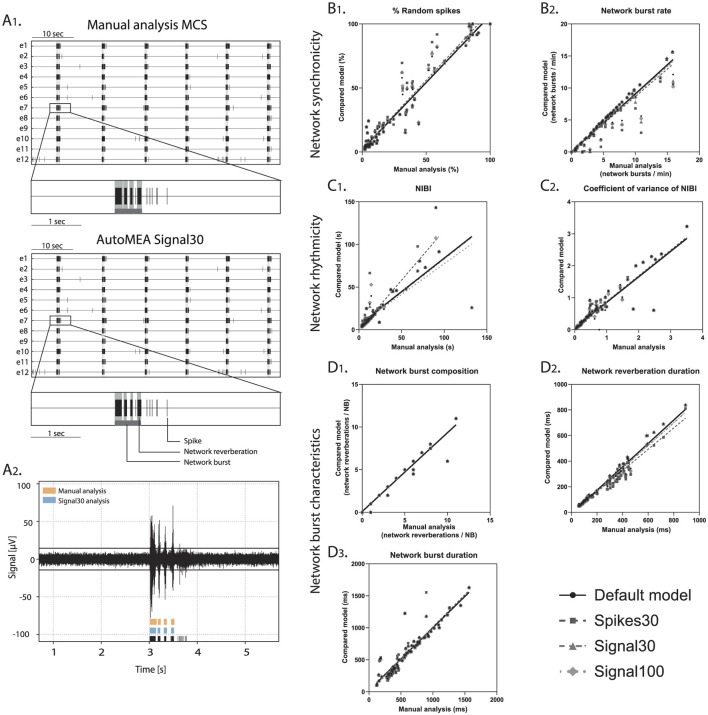
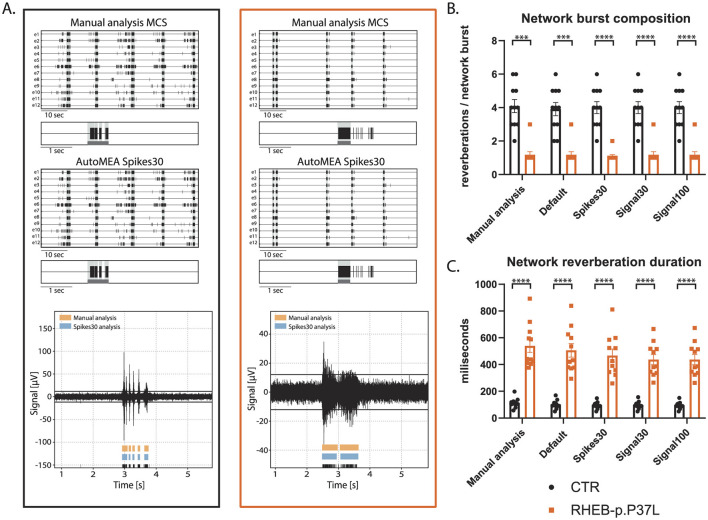
Neuronal activity in the highly organized networks of the central nervous system is the vital basis for various functional processes, such as perception, motor control, and cognition. Understanding interneuronal connectivity and how activity is regulated in the neuronal circuits is crucial for interpreting how the brain works. Multi-electrode arrays (MEAs) are particularly useful for studying the dynamics of neuronal network activity and their development as they allow for real-time, high-throughput measurements of neural activity. At present, the key challenge in the utilization of MEA data is the sheer complexity of the measured datasets. Available software offers semi-automated analysis for a fixed set of parameters that allow for the definition of spikes, bursts and network bursts. However, this analysis remains time-consuming, user-biased, and limited by pre-defined parameters. Here, we present autoMEA, software for machine learning-based automated burst detection in MEA datasets. We exemplify autoMEA efficacy on neuronal network activity of primary hippocampal neurons from wild-type mice monitored using 24-well multi-well MEA plates. To validate and benchmark the software, we showcase its application using wild-type neuronal networks and two different neuronal networks modeling neurodevelopmental disorders to assess network phenotype detection. Detection of network characteristics typically reported in literature, such as synchronicity and rhythmicity, could be accurately detected compared to manual analysis using the autoMEA software. Additionally, autoMEA could detect reverberations, a more complex burst dynamic present in hippocampal cultures. Furthermore, autoMEA burst detection was sufficiently sensitive to detect changes in the synchronicity and rhythmicity of networks modeling neurodevelopmental disorders as well as detecting changes in their network burst dynamics. Thus, we show that autoMEA reliably analyses neural networks measured with the multi-well MEA setup with the precision and accuracy compared to that of a human expert.
中枢神经系统高度组织化网络中的神经元活动是各种功能过程(如感知、运动控制和认知)的重要基础。了解神经元间的连接以及神经元回路中活动是如何被调节的,对于解释大脑的工作方式至关重要。多电极阵列(MEA)对于研究神经元网络活动及其发展的动态过程特别有用,因为它们能够对神经活动进行实时、高通量的测量。目前,利用MEA数据的关键挑战在于所测数据集的极度复杂性。现有的软件针对一组固定参数提供半自动分析,这些参数可用于定义尖峰、爆发和网络爆发。然而,这种分析仍然耗时、受用户偏见影响,并且受到预定义参数的限制。在此,我们展示了autoMEA,这是一款用于基于机器学习自动检测MEA数据集中爆发的软件。我们以使用24孔多电极阵列板监测的野生型小鼠原代海马神经元的神经网络活动为例,展示了autoMEA的功效。为了验证和评估该软件,我们展示了其在野生型神经元网络以及两个模拟神经发育障碍的不同神经元网络中的应用,以评估网络表型检测。与使用autoMEA软件进行的手动分析相比,可以准确检测到文献中通常报道的网络特征,如同步性和节律性。此外,autoMEA可以检测到海马培养物中存在的一种更复杂的爆发动态——回响。此外,autoMEA爆发检测足够灵敏,能够检测模拟神经发育障碍的网络同步性和节律性变化以及其网络爆发动态变化。因此,我们表明autoMEA能够可靠地分析使用多电极阵列设置测量的神经网络,其精度和准确性与人类专家相当。