Wang Jianmin, Mao Jiashun, Li Chunyan, Xiang Hongxin, Wang Xun, Wang Shuang, Wang Zixu, Chen Yangyang, Li Yuquan, No Kyoung Tai, Song Tao, Zeng Xiangxiang
Department of Integrative Biotechnology, Yonsei University, Incheon, 21983, Republic of Korea.
School of Informatics, Yunnan Normal University, Kunming, China.
J Cheminform. 2024 Dec 20;16(1):142. doi: 10.1186/s13321-024-00930-0.
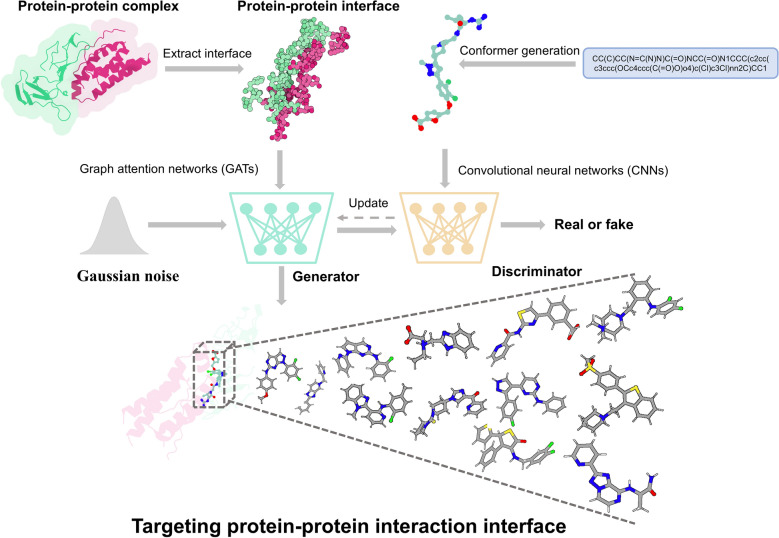
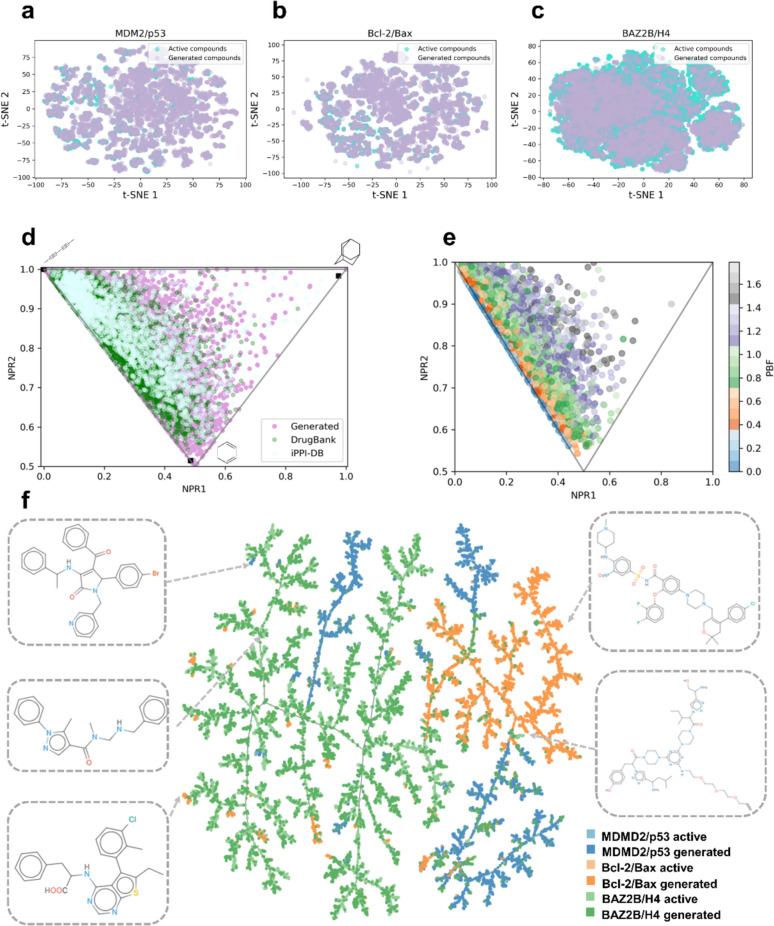
Protein-protein interactions (PPIs) play a crucial role in numerous biochemical and biological processes. Although several structure-based molecular generative models have been developed, PPI interfaces and compounds targeting PPIs exhibit distinct physicochemical properties compared to traditional binding pockets and small-molecule drugs. As a result, generating compounds that effectively target PPIs, particularly by considering PPI complexes or interface hotspot residues, remains a significant challenge. In this work, we constructed a comprehensive dataset of PPI interfaces with active and inactive compound pairs. Based on this, we propose a novel molecular generative framework tailored to PPI interfaces, named GENiPPI. Our evaluation demonstrates that GENiPPI captures the implicit relationships between the PPI interfaces and the active molecules, and can generate novel compounds that target these interfaces. Moreover, GENiPPI can generate structurally diverse novel compounds with limited PPI interface modulators. To the best of our knowledge, this is the first exploration of a structure-based molecular generative model focused on PPI interfaces, which could facilitate the design of PPI modulators. The PPI interface-based molecular generative model enriches the existing landscape of structure-based (pocket/interface) molecular generative model. SCIENTIFIC CONTRIBUTION: This study introduces GENiPPI, a protein-protein interaction (PPI) interface-aware molecular generative framework. The framework first employs Graph Attention Networks to capture atomic-level interaction features at the protein complex interface. Subsequently, Convolutional Neural Networks extract compound representations in voxel and electron density spaces. These features are integrated into a Conditional Wasserstein Generative Adversarial Network, which trains the model to generate compound representations targeting PPI interfaces. GENiPPI effectively captures the relationship between PPI interfaces and active/inactive compounds. Furthermore, in fewshot molecular generation, GENiPPI successfully generates compounds comparable to known disruptors. GENiPPI provides an efficient tool for structure-based design of PPI modulators.
蛋白质-蛋白质相互作用(PPIs)在众多生物化学和生物学过程中起着至关重要的作用。尽管已经开发了几种基于结构的分子生成模型,但与传统的结合口袋和小分子药物相比,PPI界面以及靶向PPIs的化合物表现出不同的物理化学性质。因此,生成能够有效靶向PPIs的化合物,尤其是通过考虑PPI复合物或界面热点残基来实现,仍然是一项重大挑战。在这项工作中,我们构建了一个包含活性和非活性化合物对的PPI界面综合数据集。基于此,我们提出了一种专门针对PPI界面的新型分子生成框架,名为GENiPPI。我们的评估表明,GENiPPI捕捉到了PPI界面与活性分子之间的隐含关系,并且能够生成靶向这些界面的新型化合物。此外,GENiPPI可以用有限的PPI界面调节剂生成结构多样的新型化合物。据我们所知,这是首次对专注于PPI界面的基于结构的分子生成模型进行探索,这有助于PPI调节剂的设计。基于PPI界面的分子生成模型丰富了现有的基于结构(口袋/界面)的分子生成模型格局。科学贡献:本研究介绍了GENiPPI,一种蛋白质-蛋白质相互作用(PPI)界面感知分子生成框架。该框架首先采用图注意力网络来捕捉蛋白质复合物界面的原子级相互作用特征。随后,卷积神经网络在体素和电子密度空间中提取化合物表示。这些特征被整合到条件瓦瑟斯坦生成对抗网络中,该网络训练模型生成靶向PPI界面的化合物表示。GENiPPI有效地捕捉了PPI界面与活性/非活性化合物之间的关系。此外,在少样本分子生成中,GENiPPI成功生成了与已知破坏剂相当的化合物。GENiPPI为基于结构的PPI调节剂设计提供了一个有效的工具。