Alnabih Asem, Alnabeh Nour-Alhuda, Aljeesh Yousef, Aldabbour Belal
Industrial Engineering Department, Universiti Teknikal Malaysia Melaka, Melaka, Malaysia.
Emergency Committee, Gaza Municipality, Gaza, State of Palestine.
J Health Popul Nutr. 2024 Dec 20;43(1):222. doi: 10.1186/s41043-024-00700-6.
Food insecurity is an important aspect of human suffering during wartime. Besides its ferocity, the Gaza conflict of 2023-2024 has been marked by severe food and medication shortages that exacerbated the human toll and worsened the suffering of the population.
A cross-sectional, mixed methods study that in April 2024 collected quantitative and qualitative data to assess food insecurity and malnutrition among residents of the Northern part of the Gaza Strip during the first seven months of the war. Quantitative data assessed weight loss among participants as a marker of starvation. Qualitative interviews evaluated food availability, food variability, and changing eating habits. Demographics were represented as counts and percentages. Weight was reported as mean ± SD. The Spearman Correlation Coefficient evaluated potential correlations of weight loss with sex, place of residence, and age. Statistical significance was set at a p-value less than 0.05.
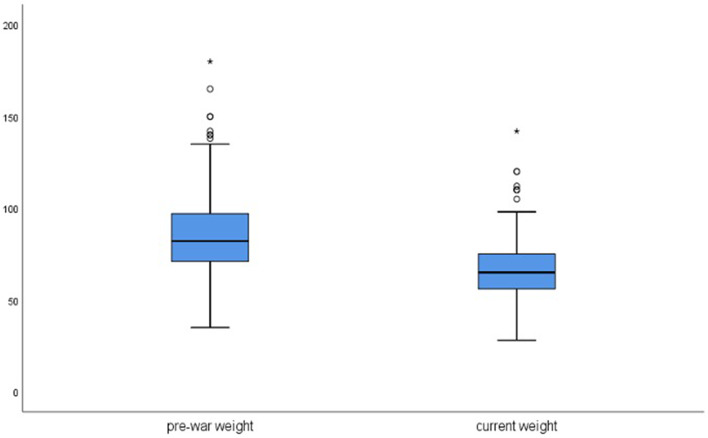
497 participants were recruited, including 330 males (66.4%) and 167 females (33.6%). The age range was (13-83 years). The mean baseline weight was 84.94 kg ± 20.06, with a weight range (35-180 kg). In April 2024, the mean weight had dropped to 66.22 kg ± 14.34, representing an average decline of 18.72 kg (new weight range 28-142 kg). Age was associated with a weak positive correlation with weight loss (r = .204, p = .000). Qualitative interviews with 95 breadwinners or homemakers revealed a high prevalence of hunger and severe shortages in food quantity, quality, and variability. Physical and financial barriers significantly impacted food sourcing. Also, due to food shortages, most participants reported high consumption of edible wild plants and unconventional types of flour such as corn flour or grounded animal feed.
The study demonstrated high levels of weight loss and marked food insecurity in the Northern Gaza Strip during the conflict. The quantitative and qualitative food shortages outlined in this study present a risk for a host of potentially serious and irreversible future complications.
粮食不安全是战时人类苦难的一个重要方面。除了其残酷性之外,2023 - 2024年的加沙冲突还以严重的食品和药品短缺为特征,这加剧了人员伤亡,并使民众的苦难更加深重。
一项横断面混合方法研究于2024年4月收集了定量和定性数据,以评估加沙地带北部居民在战争头七个月期间的粮食不安全和营养不良情况。定量数据评估参与者的体重减轻情况,以此作为饥饿的一个指标。定性访谈评估了食物供应、食物多样性以及饮食习惯的变化。人口统计学数据以计数和百分比表示。体重报告为均值±标准差。斯皮尔曼相关系数评估了体重减轻与性别、居住地点和年龄之间的潜在相关性。统计学显著性设定为p值小于0.05。
招募了497名参与者,其中包括330名男性(66.4%)和167名女性(33.6%)。年龄范围为(13 - 83岁)。平均基线体重为84.94千克±20.06,体重范围为(35 - 180千克)。在2024年4月,平均体重降至66.22千克±14.34,平均下降了18.72千克(新的体重范围为28 - 142千克)。年龄与体重减轻呈弱正相关(r = 0.204,p = 0.000)。对95名养家糊口者或家庭主妇的定性访谈显示,饥饿现象普遍存在,食物在数量、质量和多样性方面严重短缺。身体和经济障碍对食物采购产生了重大影响。此外,由于食物短缺,大多数参与者报告称食用可食用野生植物以及非常规类型面粉(如玉米粉或磨碎的动物饲料)的量很大。
该研究表明,冲突期间加沙地带北部的体重减轻程度很高,且存在明显的粮食不安全状况。本研究中概述的定量和定性食物短缺对一系列未来可能出现的严重且不可逆转的并发症构成风险。