Andersson Thomas, Engström My, Wennerblom Johanna, Gyllensten Hanna, Bjerså Kristofer
Department of Surgery, Institute of Clinical Sciences, Sahlgrenska Academy, University of Gothenburg, Gothenburg, Sweden.
Region Västra Göteland, Department of Surgery, Sahlgrenska University Hospital, Gothenburg, Sweden.
BMC Surg. 2024 Dec 21;24(1):407. doi: 10.1186/s12893-024-02667-x.
The introduction of enhanced recovery programmes (ERP) in pancreatic surgery has significantly improved clinical outcomes by decreasing the length of hospital stay, cost and complications without increasing readmissions and reoperations. To complement evidence on these outcomes, there is a need to explore patients' perspectives of a structured ERP. Therefore, this study aimed to explore the health-related quality of life (HRQoL) of patients before and after implementing ERP in pancreaticoduodenectomy ad modum Whipple (PD) at a regional surgical centre.
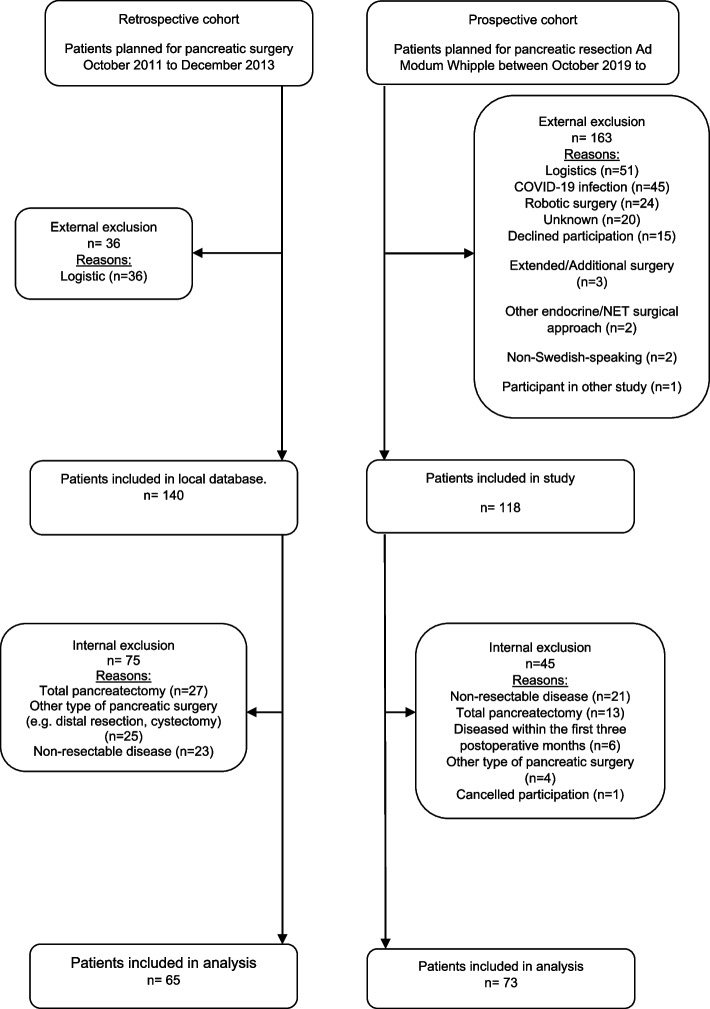
This was an explorative and comparative single-centre study in Sweden. A prospective cohort receiving ERP was included between October 2019 and December 2022 (n = 73) and was compared with a retrospective pre-ERP cohort between October 2011 and December 2013 (n = 65). EQ-5D, the European Organization for Research and Treatment of Cancer (EORCT) Quality of Life Questionnaire Cancer 30 items (QOL-C30), and EORCT Quality of Life Questionnaire pancreatic cancer module (QOL-PAN26) were collected preoperatively and at three and six months postoperatively. Demographic and clinical variables were collected from patient charts. Complications were expressed using the Clavien-Dindo Classification and the Comprehensive Complications Index (CCI).
There were no significant differences in general health, cancer- or disease-specific HRQoL between the pre-ERP and ERP cohorts. Length of stay was significantly shorter in the ERP cohort (16 vs. 11 days; p < 0.001). There was no significant difference in CCI.
No significant differences were found in the HRQoL of patients who participated in an ERP compared to those who did not. However, a significant decrease in LoS was found when ERP was applied.
Not applicable.
胰腺手术中引入强化康复计划(ERP)通过缩短住院时间、降低成本和减少并发症,同时不增加再入院率和再次手术率,显著改善了临床结局。为补充这些结局的证据,有必要探索患者对结构化ERP的看法。因此,本研究旨在探讨在一个地区性外科中心对接受Whipple式胰十二指肠切除术(PD)的患者实施ERP前后的健康相关生活质量(HRQoL)。
这是一项在瑞典进行的探索性和比较性单中心研究。纳入了2019年10月至2022年12月期间接受ERP的前瞻性队列(n = 73),并与2011年10月至2013年12月期间的回顾性ERP前队列(n = 65)进行比较。术前以及术后三个月和六个月收集欧洲五维度健康量表(EQ-5D)、欧洲癌症研究与治疗组织(EORCT)生活质量问卷癌症30项(QOL-C30)以及EORCT生活质量问卷胰腺癌模块(QOL-PAN26)。从患者病历中收集人口统计学和临床变量。使用Clavien-Dindo分类法和综合并发症指数(CCI)来表示并发症情况。
ERP前队列和ERP队列之间在总体健康、癌症或疾病特异性HRQoL方面没有显著差异。ERP队列的住院时间显著更短(16天对11天;p < 0.001)。CCI没有显著差异。
与未参与ERP的患者相比,参与ERP的患者在HRQoL方面没有发现显著差异。然而,应用ERP时发现住院时间显著缩短。
不适用。