Chen Wei-Wen, Liu Chih-Min, Tseng Chien-Chao, Huang Ching-Chun, Wu I-Chien, Chen Pei-Fen, Chang Shih-Lin, Lin Yenn-Jiang, Lo Li-Wei, Chung Fa-Po, Chao Tze-Fan, Tuan Ta-Chuan, Liao Jo-Nan, Lin Chin-Yu, Chang Ting-Yung, Kuo Ling, Wu Cheng-I, Liu Shin-Huei, Wu Jacky Chung-Hao, Hu Yu-Feng, Chen Shih-Ann, Lu Henry Horng-Shing
Institute of Computer Science and Engineering, National Yang Ming Chiao Tung University, Hsinchu, Taiwan.
Heart Rhythm Center, Division of Cardiology, Department of Medicine, Taipei Veterans General Hospital, Taipei, Taiwan.
BMC Med Res Methodol. 2024 Dec 23;24(1):318. doi: 10.1186/s12874-024-02421-0.
Undetected atrial fibrillation (AF) poses a significant risk of stroke and cardiovascular mortality. However, diagnosing AF in real-time can be challenging as the arrhythmia is often not captured instantly. To address this issue, a deep-learning model was developed to diagnose AF even during periods of arrhythmia-free windows.
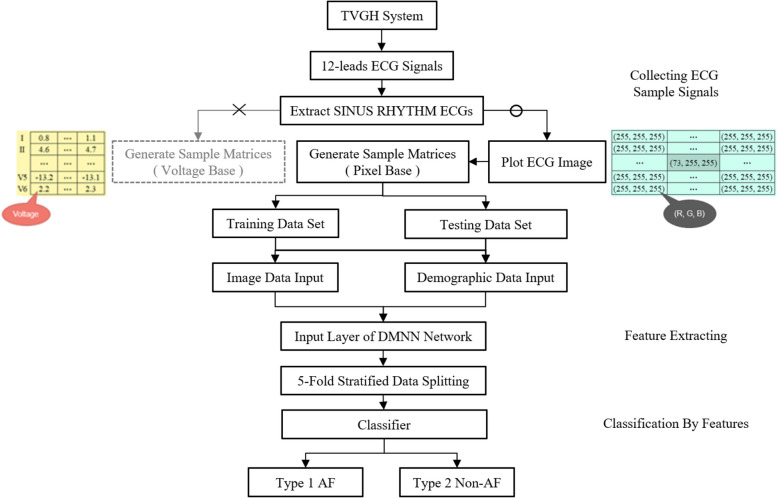
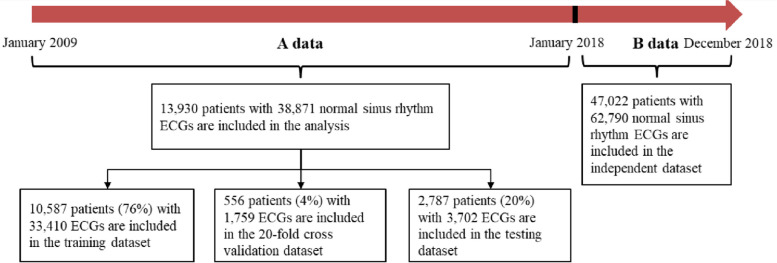
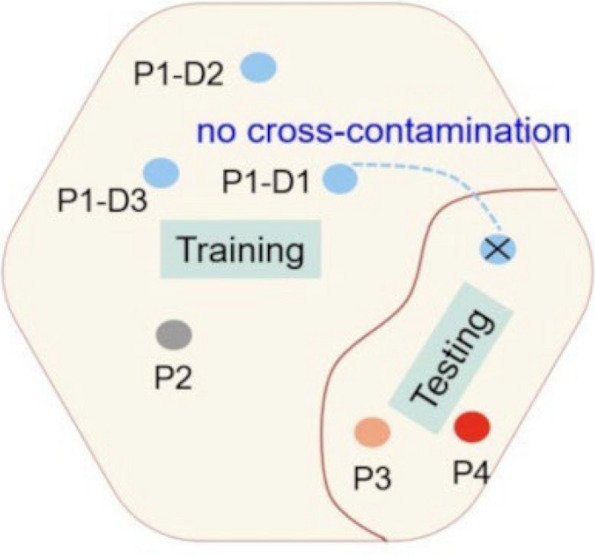
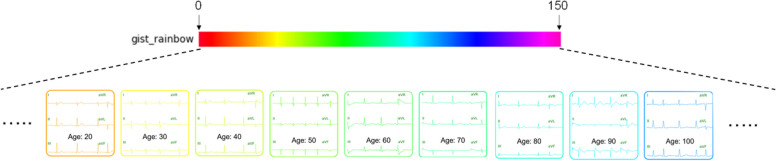
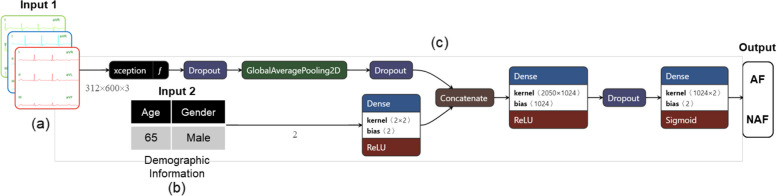
The proposed method introduces a novel approach that integrates clinical data and electrocardiograms (ECGs) using a colorization technique. This technique recolors ECG images based on patients' demographic information while preserving their original characteristics and incorporating color correlations from statistical data features. Our primary objective is to enhance atrial fibrillation (AF) detection by fusing ECG images with demographic data for colorization. To ensure the reliability of our dataset for training, validation, and testing, we rigorously maintained separation to prevent cross-contamination among these sets. We designed a Dual-input Mixed Neural Network (DMNN) that effectively handles different types of inputs, including demographic and image data, leveraging their mixed characteristics to optimize prediction performance. Unlike previous approaches, this method introduces demographic data through color transformation within ECG images, enriching the diversity of features for improved learning outcomes.
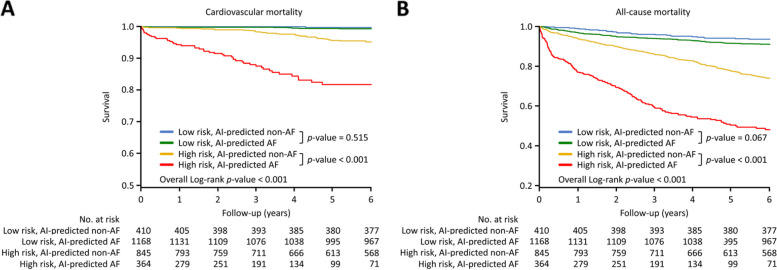
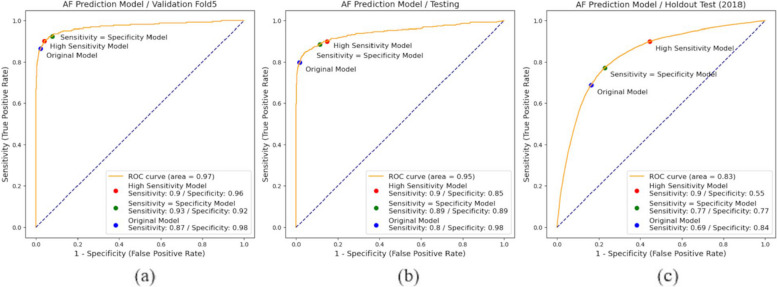
The proposed approach yielded promising results on the independent test set, achieving an impressive AUC of 83.4%. This outperformed the AUC of 75.8% obtained when using only the original signal values as input for the CNN. The evaluation of performance improvement revealed significant enhancements, including a 7.6% increase in AUC, an 11.3% boost in accuracy, a 9.4% improvement in sensitivity, an 11.6% enhancement in specificity, and a substantial 25.1% increase in the F1 score. Notably, AI diagnosis of AF was associated with future cardiovascular mortality. For clinical application, over a median follow-up of 71.6 ± 29.1 months, high-risk AI-predicted AF patients exhibited significantly higher cardiovascular mortality (AF vs. non-AF; 47 [18.7%] vs. 34 [4.8%]) and all-cause mortality (176 [52.9%] vs. 216 [26.3%]) compared to non-AF patients. In the low-risk group, AI-predicted AF patients showed slightly elevated cardiovascular (7 [0.7%] vs. 1 [0.3%]) and all-cause mortality (103 [9.0%] vs. 26 [6.4%]) than AI-predicted non-AF patients during six-year follow-up. These findings underscore the potential clinical utility of the AI model in predicting AF-related outcomes.
This study introduces an ECG colorization approach to enhance atrial fibrillation (AF) detection using deep learning and demographic data, improving performance compared to ECG-only methods. This method is effective in identifying high-risk and low-risk populations, providing valuable features for future AF research and clinical applications, as well as benefiting ECG-based classification studies.
未被检测到的心房颤动(房颤)会带来显著的中风和心血管疾病死亡风险。然而,实时诊断房颤具有挑战性,因为心律失常往往无法即时捕捉到。为解决这一问题,开发了一种深度学习模型,即使在无心律失常期也能诊断房颤。
所提出的方法引入了一种新颖的方法,即使用着色技术整合临床数据和心电图(ECG)。该技术根据患者的人口统计学信息对ECG图像重新着色,同时保留其原始特征,并纳入统计数据特征中的颜色相关性。我们的主要目标是通过将ECG图像与人口统计学数据融合进行着色来提高心房颤动(房颤)检测能力。为确保我们的数据集用于训练、验证和测试的可靠性,我们严格保持各集合之间的分离,以防止交叉污染。我们设计了一种双输入混合神经网络(DMNN),它能有效处理不同类型的输入,包括人口统计学和图像数据,利用它们的混合特征来优化预测性能。与以前的方法不同,该方法通过在ECG图像内进行颜色变换引入人口统计学数据,丰富了特征的多样性以改善学习效果。
所提出的方法在独立测试集上取得了有前景的结果,曲线下面积(AUC)达到了令人印象深刻的83.4%。这优于仅使用原始信号值作为卷积神经网络(CNN)输入时获得的75.8%的AUC。性能改进评估显示有显著提升,包括AUC增加7.6%、准确率提高11.3%、灵敏度提升9.4%、特异性增强11.6%以及F1分数大幅提高25.1%。值得注意的是,房颤的人工智能诊断与未来心血管疾病死亡相关。对于临床应用,在中位随访71.6±29.1个月期间,人工智能预测的高危房颤患者与非房颤患者相比,心血管疾病死亡率(房颤患者与非房颤患者;47例[18.7%]对34例[4.8%])和全因死亡率(176例[52.9%]对216例[26.3%])显著更高。在低风险组中,在六年随访期间,人工智能预测的房颤患者与人工智能预测的非房颤患者相比,心血管疾病(7例[0.7%]对1例[0.3%])和全因死亡率(103例[9.0%]对26例[6.4%])略有升高。这些发现强调了人工智能模型在预测房颤相关结果方面的潜在临床应用价值。
本研究引入了一种ECG着色方法,以利用深度学习和人口统计学数据增强心房颤动(房颤)检测,与仅基于ECG的方法相比性能有所提高。该方法在识别高危和低危人群方面有效,为未来房颤研究和临床应用提供了有价值的特征,也有利于基于ECG的分类研究。