Kwak Jin-Hwan, Choi Kang-Un, Park Jong-Il, Nam Jong-Ho, Lee Chan-Hee, Kim Ung, Park Jong-Seon, Son Jang-Won
Division of Cardiology, Department of Internal Medicine, Yeungnam University Medical Center, Daegu, Republic of Korea.
J Cardiovasc Imaging. 2024 Dec 23;32(1):40. doi: 10.1186/s44348-024-00040-3.
Evaluation of regional left ventricle function using two-dimensional echocardiography (2DE) in patients with ischemic heart disease has limitations due to its low objectivity and qualitative nature. In addition, 2DE is limited because multiple acoustic windows are used to obtain the image, whereas three-dimensional echocardiography (3DE) uses a single window. This study aims to demonstrate the clinical utility of 3DE segmental volume analysis for evaluating regional wall motion abnormality (RWMA).
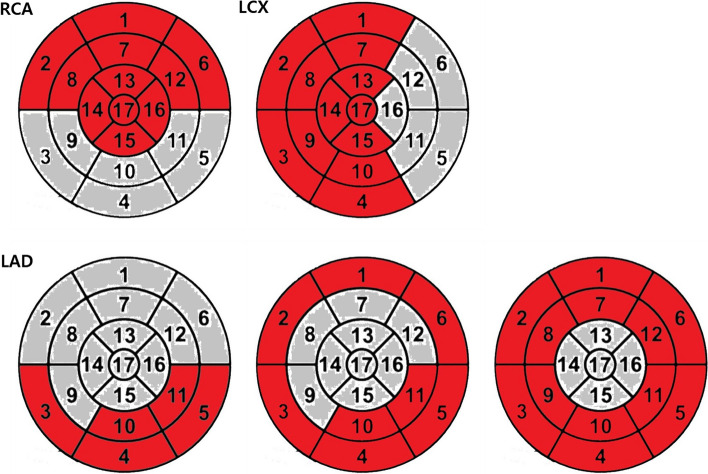
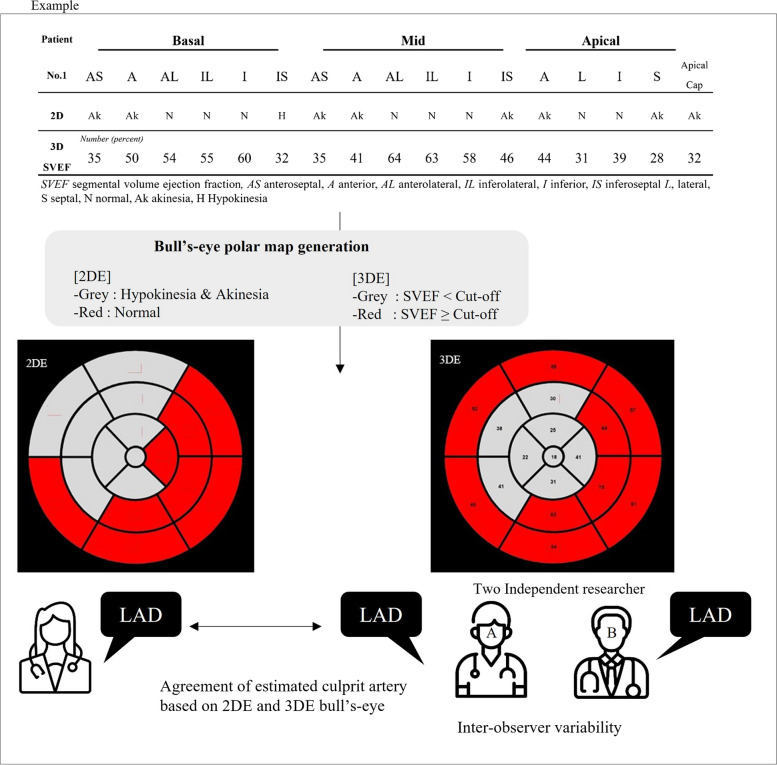
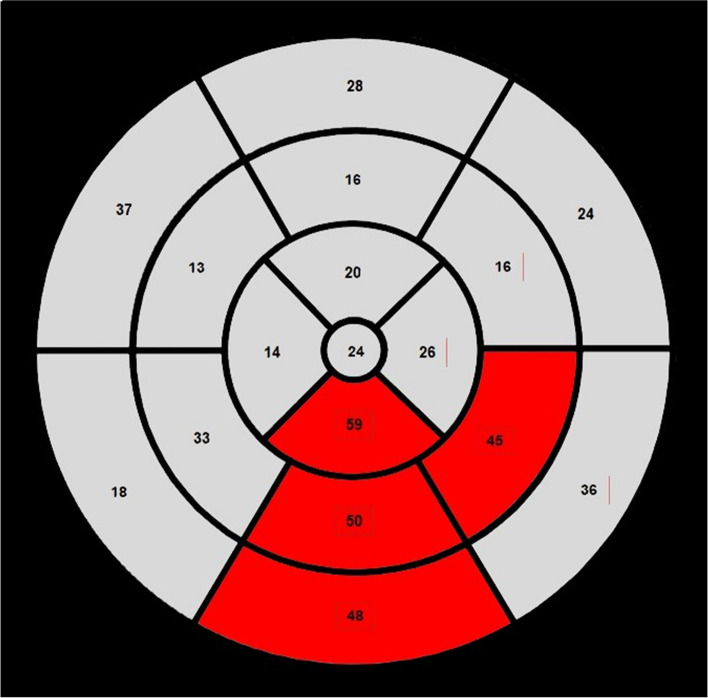
This retrospective study included 33 patients with ischemic heart disease and single-vessel territory RWMA confirmed on coronary angiography. RWMA was visually assessed using 2DE, generating 17-segment bull's-eye polar maps, and 3DE. In the 3DE study, two independent observers analyzed segmental volumes and segmental volume ejection fractions (SVEFs) using QLAB 3D quantification software. The optimal SVEF cutoff value differentiating normal from abnormal was determined using receiver operating curve analysis. The accuracy of 3DE in predicting culprit coronary arteries was compared with that of 2DE using Cohen κ coefficients, which also were used for interobserver and intraobserver variability assessments.
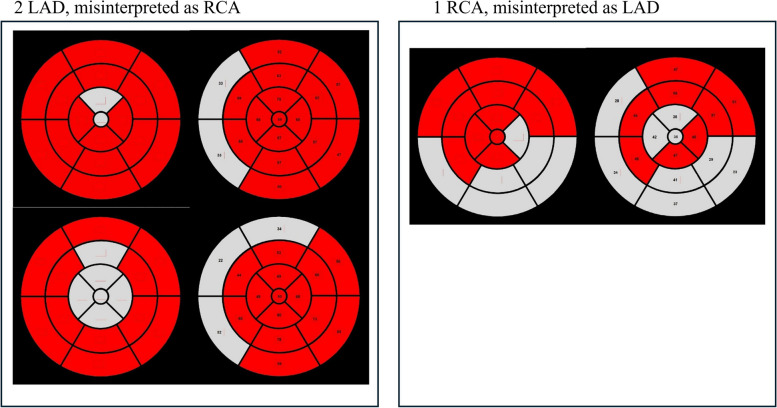
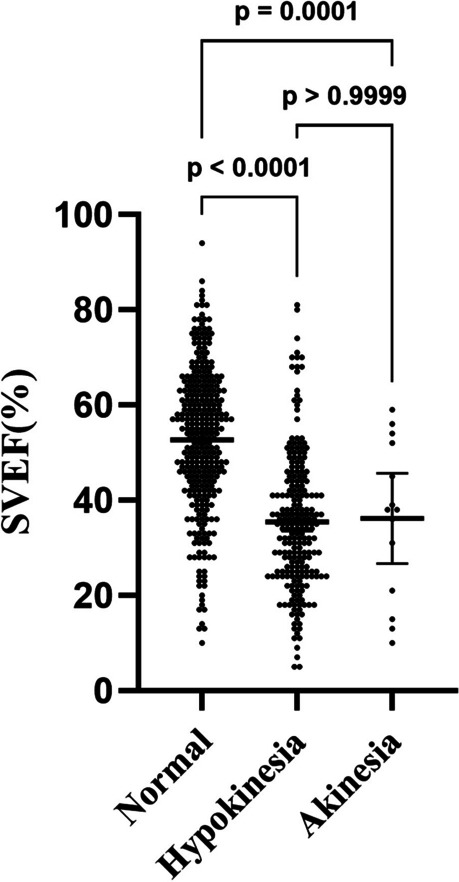
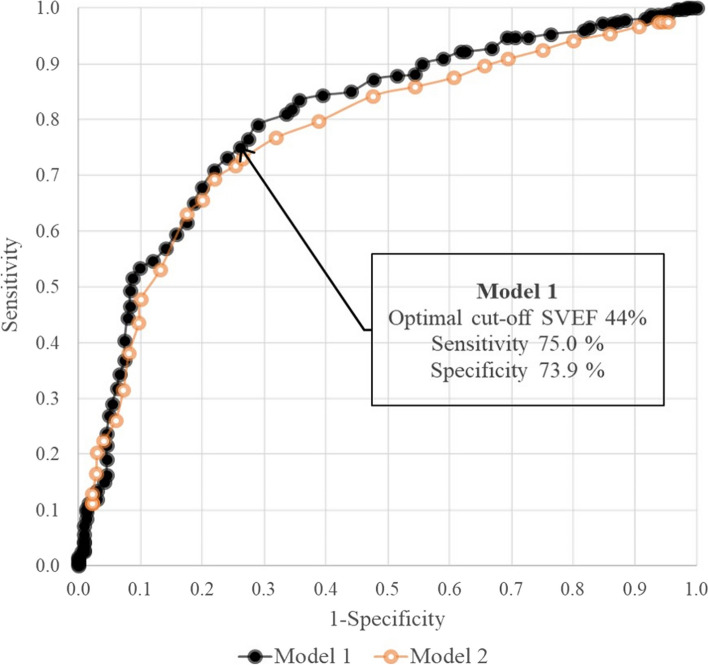
Mean 3DE SVEFs were significantly lower in segments showing RWMA on 2DE. The optimal SVEF cutoff value was 44%, with sensitivity of 75.0% and specificity of 73.9% (area under the curve, 0.801; 95% CI, 0.763-0.838; P < 0.001). The reliability of 3DE-derived bull's-eye predictions of culprit coronary arteries was 81.8% (κ = 0.672; 95% CI, 0.555-0.789; P < 0.001). Interobserver and intraobserver variabilities were 97.0% (κ = 0.947; 95% CI, 0.894-1.00; P < 0.001) and 93.9% (κ = 0.897; 95% CI, 0.827-0.967; P < 0.001), respectively.
The 3DE segmental volume analysis effectively quantified regional left ventricle function and aligned well with 2DE and coronary angiography findings in predicting culprit coronary arteries. Thus, 3DE segmental volume analysis can serve as a quantitative and objective tool for RWMA assessment in patients with ischemic heart disease.
在缺血性心脏病患者中,使用二维超声心动图(2DE)评估局部左心室功能存在局限性,因为其客观性低且具有定性性质。此外,2DE存在局限性是因为获取图像时使用多个声学窗口,而三维超声心动图(3DE)使用单个窗口。本研究旨在证明3DE节段容积分析在评估局部室壁运动异常(RWMA)方面的临床实用性。
这项回顾性研究纳入了33例经冠状动脉造影证实患有缺血性心脏病且存在单支血管供血区域RWMA的患者。使用2DE进行RWMA的视觉评估,生成17节段牛眼极坐标图,并使用3DE进行评估。在3DE研究中,两名独立观察者使用QLAB 3D定量软件分析节段容积和节段容积射血分数(SVEF)。使用受试者工作特征曲线分析确定区分正常与异常的最佳SVEF临界值。使用Cohen κ系数比较3DE预测罪犯冠状动脉的准确性与2DE的准确性,该系数也用于观察者间和观察者内变异性评估。
在2DE上显示RWMA的节段中,平均3DE SVEF显著降低。最佳SVEF临界值为44%,敏感性为75.0%,特异性为73.9%(曲线下面积,0.801;95%CI,0.763 - 0.838;P < 0.001)。3DE得出的罪犯冠状动脉牛眼预测的可靠性为81.8%(κ = 0.672;95%CI,0.555 - 0.789;P < 0.001)。观察者间和观察者内变异性分别为97.0%(κ = 0.947;95%CI,0.894 - 1.00;P < 0.001)和93.9%(κ = 0.897;95%CI,0.827 - 0.967;P < 0.001)。
3DE节段容积分析有效地量化了局部左心室功能,并且在预测罪犯冠状动脉方面与2DE和冠状动脉造影结果高度一致。因此,3DE节段容积分析可作为评估缺血性心脏病患者RWMA的定量和客观工具。