Jerald Irine, Ravindran Jayasree, Babu Monica Muniendra
Department of Biotechnology, Rajalakshmi Engineering College, Thandalam, Chennai 602105, India.
Rajalakshmi Engineering College, Thandalam, Chennai 602105, India.
Toxicol Rep. 2024 Nov 28;13:101841. doi: 10.1016/j.toxrep.2024.101841. eCollection 2024 Dec.
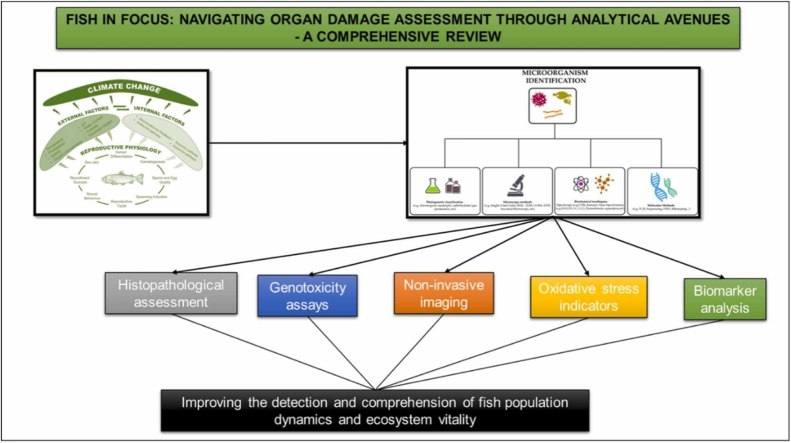
Aquatic ecosystems, critical for biodiversity and food production, confront escalating threats from anthropogenic activities like pollution and climate change, impacting fish health. This review outlines various assays used to study organ damage in fish, ranging from traditional histopathology to advanced molecular and biochemical methods. The aim is to guide researchers in selecting suitable assays for their specific questions, considering the advantages and limitations of each technique. Covered methods include histopathological assessment, biomarker analysis, genotoxicity assays, oxidative stress indicators, and non-invasive imaging. The review explores their application in monitoring environmental stressors' impacts on fish organs, emphasizing emerging trends like omics technologies and non-destructive imaging for comprehensive assessments. These innovations hold promise for early detection and understanding the implications on fish populations and ecosystem health.
水生生态系统对生物多样性和粮食生产至关重要,正面临着来自污染和气候变化等人为活动不断升级的威胁,影响着鱼类健康。本综述概述了用于研究鱼类器官损伤的各种检测方法,从传统的组织病理学方法到先进的分子和生化方法。目的是指导研究人员根据其具体问题选择合适的检测方法,同时考虑每种技术的优缺点。涵盖的方法包括组织病理学评估、生物标志物分析、遗传毒性检测、氧化应激指标和非侵入性成像。本综述探讨了它们在监测环境压力源对鱼类器官影响方面的应用,强调了组学技术和非破坏性成像等新兴趋势在综合评估中的应用。这些创新有望实现早期检测,并了解其对鱼类种群和生态系统健康的影响。