Hunter Montana Kekaimalu, Singareddy Chithra, Mundt Kenneth A
Stantec ChemRisk, Boston, MA, United States.
Harvard T H. Chan School of Public Health, Department of Epidemiology, Boston, MA, United States.
Front Public Health. 2024 Dec 9;12:1479750. doi: 10.3389/fpubh.2024.1479750. eCollection 2024.
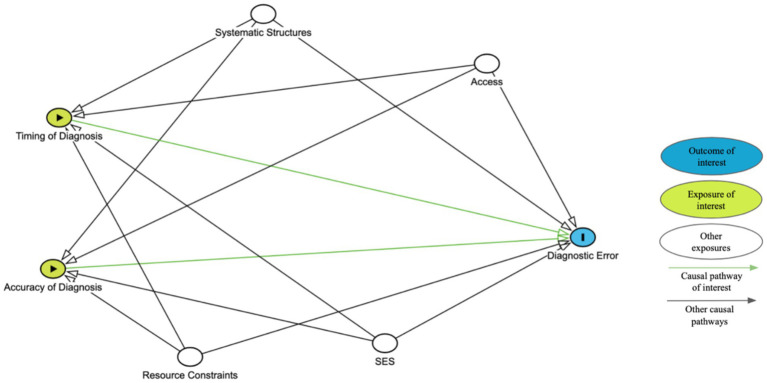
Diagnostic errors burden the United States healthcare system. Depending on how they are defined, between 40,000 and 4 million cases occur annually. Despite this striking statistic, and the potential benefits epidemiological approaches offer in identifying risk factors for sub-optimal diagnoses, diagnostic error remains an underprioritized epidemiolocal research topic. Magnifying the challenge are the array of forms and definitions of diagnostic errors, and limited sources of data documenting their occurrence. In this narrative review, we outline a framework for improving epidemiological applications in understanding risk factors for diagnostic error. This includes explicitly defining diagnostic error, specifying the hypothesis and research questions, consideration of systemic including social and economic factors, as well as the time-dependency of diagnosis relative to disease progression. Additional considerations for future epidemiological research on diagnostic errors include establishing standardized research databases, as well as identifying potential important sources of study bias.
诊断错误给美国医疗系统带来了负担。根据定义方式的不同,每年会出现4万至400万例诊断错误。尽管这一统计数据惊人,且流行病学方法在识别次优诊断的风险因素方面具有潜在益处,但诊断错误仍是流行病学研究中未得到充分重视的课题。诊断错误的形式和定义繁多,记录其发生情况的数据来源有限,这进一步加剧了挑战。在这篇叙述性综述中,我们概述了一个框架,以改进流行病学在理解诊断错误风险因素方面的应用。这包括明确界定诊断错误、明确假设和研究问题、考虑包括社会和经济因素在内的系统性因素,以及诊断相对于疾病进展的时间依赖性。未来关于诊断错误的流行病学研究的其他考虑因素包括建立标准化研究数据库,以及识别潜在的重要研究偏差来源。