Lou Linbing, Xu Lei, Wang Xiaofei, Xia Cunyi, Dai Jihang, Hu Le
Department of Orthopedics, Northern Jiangsu People's Hospital Affiliated to Yangzhou University, No.98, Nantong West Road, Guangling District, Yangzhou, 225000, Jiangsu, China.
Department of Orthopedics, The Yangzhou School of Clinical Medicine of Dalian Medical University, Yangzhou, Jiangsu, China.
Eur J Med Res. 2024 Dec 26;29(1):626. doi: 10.1186/s40001-024-02244-1.
To identify independent risk factors for perioperative hidden blood loss (HBL) in intertrochanteric femoral fractures (ITFs) and to develop a predictive model.
We enrolled 231 patients with ITFs who underwent proximal femoral nail antirotation (PFNA) surgery at the Orthopedics Department of Northern Jiangsu People's Hospital, Jiangsu Province, China, from January 2021 to December 2023. Hidden blood loss was calculated using the OSTEO formula, and independent risk factors were screened using the Least Absolute Shrinkage and Selection Operator (LASSO) logistic regression. A nomogram prediction model was subsequently constructed based on multivariate logistic regression.
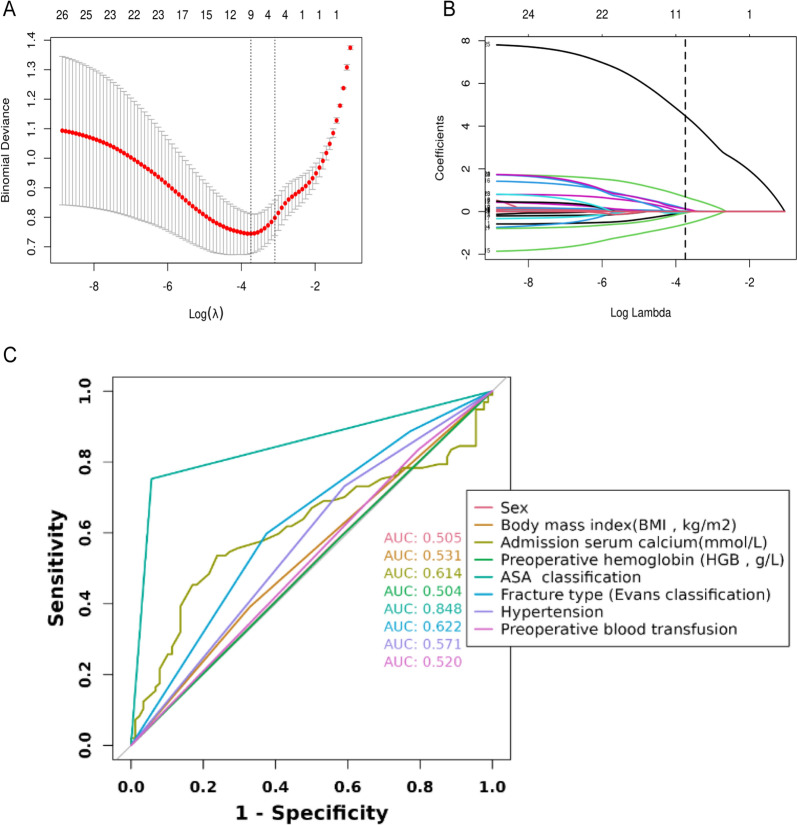
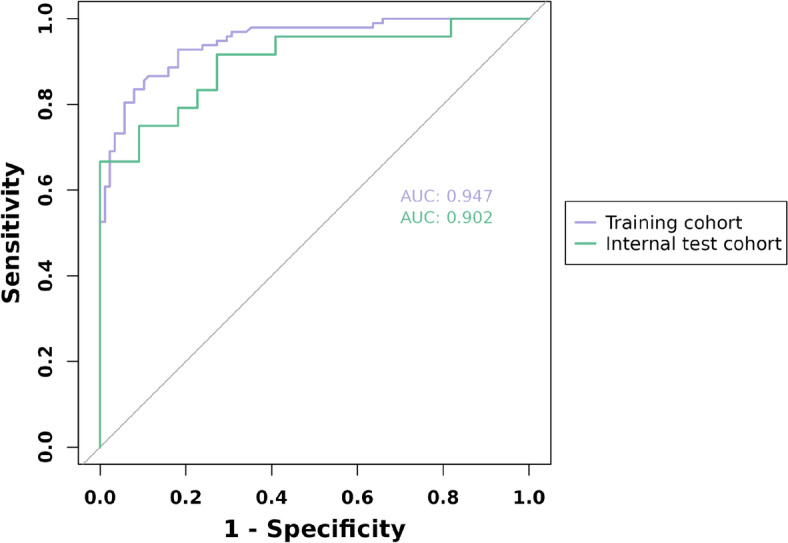
The LASSO regression identified eight key predictive factors: sex, body mass index (BMI), Admission serum calcium (mmol/L), American Society of Anesthesiologists (ASA) physical status classification, fracture type (Evans), hypertension, preoperative blood transfusion, and preoperative hemoglobin (HGB, g/L). The nomogram model demonstrated excellent predictive performance in both the training and validation sets, with area under the curve (AUC) values of 0.947 and 0.902, respectively. Calibration curves and decision curve analyses further confirmed the strong agreement between model predictions and actual observations, as well as the net clinical benefit.
The nomogram model facilitates an intuitive and quantitative assessment of the risk of perioperative hidden blood loss in patients with ITFs, providing robust support for clinical decision-making.
确定股骨转子间骨折(ITF)围手术期隐性失血(HBL)的独立危险因素,并建立预测模型。
我们纳入了2021年1月至2023年12月在中国江苏省苏北人民医院骨科接受股骨近端抗旋髓内钉(PFNA)手术的231例ITF患者。使用OSTEO公式计算隐性失血量,并使用最小绝对收缩和选择算子(LASSO)逻辑回归筛选独立危险因素。随后基于多变量逻辑回归构建列线图预测模型。
LASSO回归确定了八个关键预测因素:性别、体重指数(BMI)、入院时血清钙(mmol/L)、美国麻醉医师协会(ASA)身体状况分级、骨折类型(Evans)、高血压、术前输血和术前血红蛋白(HGB,g/L)。列线图模型在训练集和验证集中均表现出出色的预测性能,曲线下面积(AUC)值分别为0.947和0.902。校准曲线和决策曲线分析进一步证实了模型预测与实际观察结果之间的高度一致性以及净临床效益。
列线图模型有助于直观、定量地评估ITF患者围手术期隐性失血的风险,为临床决策提供有力支持。