Ayubcha Cyrus, Sajed Sulaiman, Omara Chady, Veldman Anna B, Singh Shashi B, Lokesha Yashas Ullas, Liu Alex, Aziz-Sultan Mohammad Ali, Smith Timothy R, Beam Andrew
Harvard Medical School, Boston, MA 02115, USA.
Department of Epidemiology, Harvard T.H. Chan School of Public Health, Boston, MA 02115, USA.
J Imaging. 2024 Dec 12;10(12):319. doi: 10.3390/jimaging10120319.
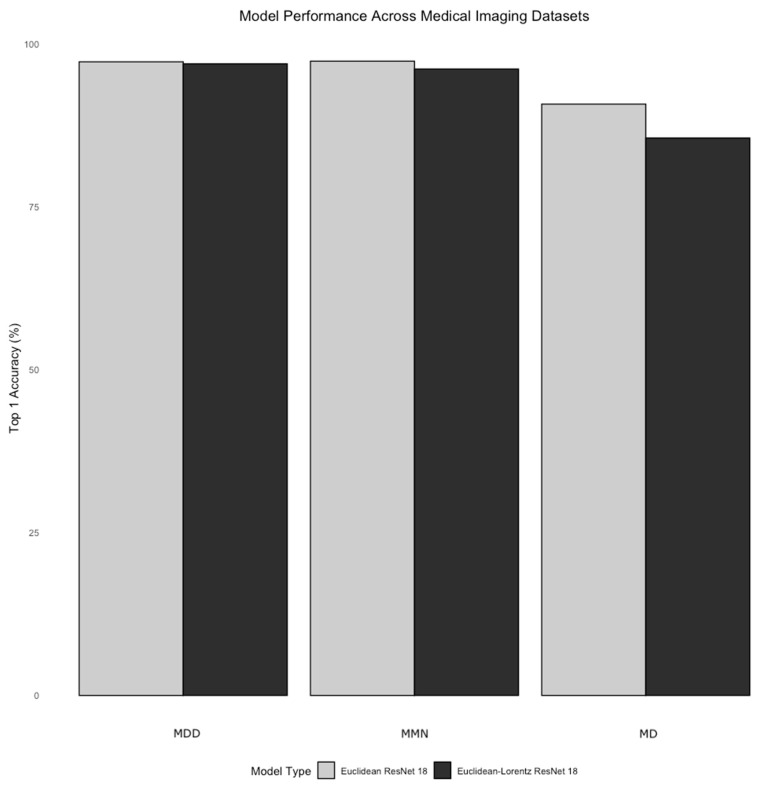
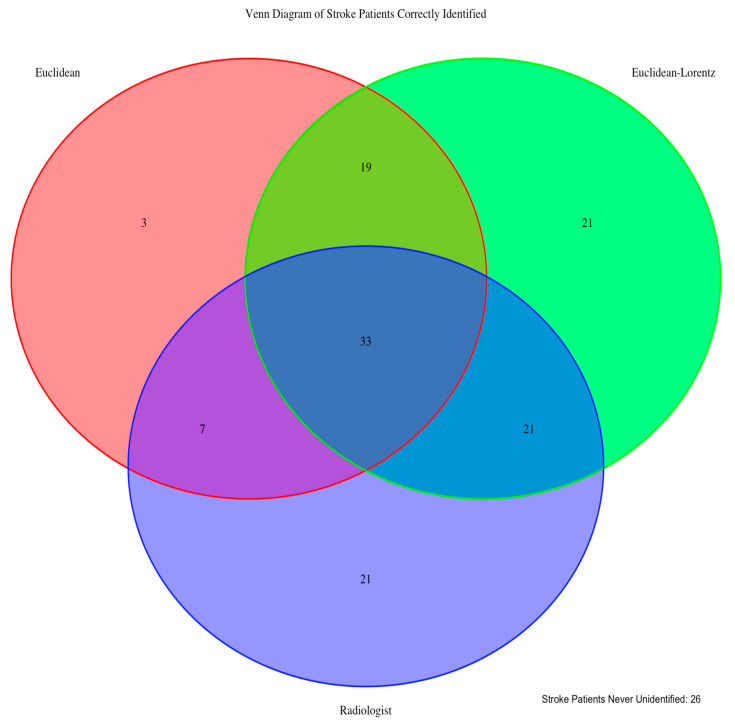
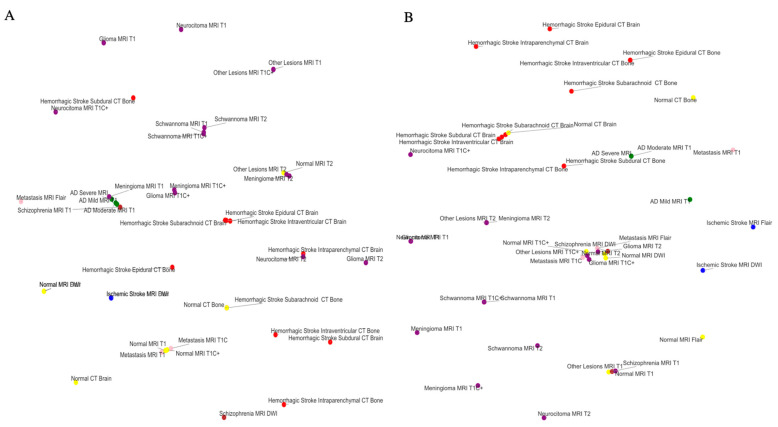
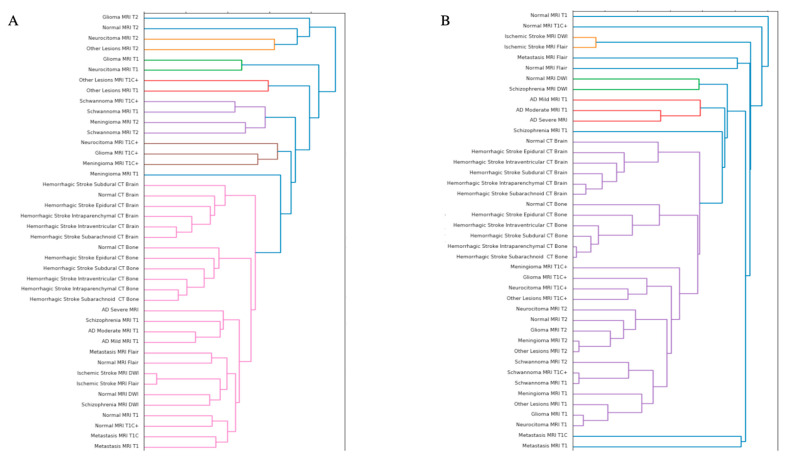
Deep learning has shown significant value in automating radiological diagnostics but can be limited by a lack of generalizability to external datasets. Leveraging the geometric principles of non-Euclidean space, certain geometric deep learning approaches may offer an alternative means of improving model generalizability. This study investigates the potential advantages of hyperbolic convolutional neural networks (HCNNs) over traditional convolutional neural networks (CNNs) in neuroimaging tasks. We conducted a comparative analysis of HCNNs and CNNs across various medical imaging modalities and diseases, with a focus on a compiled multi-modality neuroimaging dataset. The models were assessed for their performance parity, robustness to adversarial attacks, semantic organization of embedding spaces, and generalizability. Zero-shot evaluations were also performed with ischemic stroke non-contrast CT images. HCNNs matched CNNs' performance in less complex settings and demonstrated superior semantic organization and robustness to adversarial attacks. While HCNNs equaled CNNs in out-of-sample datasets identifying Alzheimer's disease, in zero-shot evaluations, HCNNs outperformed CNNs and radiologists. HCNNs deliver enhanced robustness and organization in neuroimaging data. This likely underlies why, while HCNNs perform similarly to CNNs with respect to in-sample tasks, they confer improved generalizability. Nevertheless, HCNNs encounter efficiency and performance challenges with larger, complex datasets. These limitations underline the need for further optimization of HCNN architectures. HCNNs present promising improvements in generalizability and resilience for medical imaging applications, particularly in neuroimaging. Despite facing challenges with larger datasets, HCNNs enhance performance under adversarial conditions and offer better semantic organization, suggesting valuable potential in generalizable deep learning models in medical imaging and neuroimaging diagnostics.
深度学习在实现放射诊断自动化方面已显示出显著价值,但可能因缺乏对外部数据集的通用性而受到限制。利用非欧几里得空间的几何原理,某些几何深度学习方法可能提供一种提高模型通用性的替代方法。本研究调查了双曲卷积神经网络(HCNN)在神经成像任务中相对于传统卷积神经网络(CNN)的潜在优势。我们对HCNN和CNN在各种医学成像模态和疾病上进行了比较分析,重点是一个汇编的多模态神经成像数据集。评估了模型的性能对等性、对对抗性攻击的鲁棒性、嵌入空间的语义组织和通用性。还使用缺血性中风非增强CT图像进行了零样本评估。在不太复杂的环境中,HCNN与CNN的性能相当,并表现出卓越的语义组织和对对抗性攻击的鲁棒性。虽然在识别阿尔茨海默病的样本外数据集中HCNN与CNN相当,但在零样本评估中,HCNN的表现优于CNN和放射科医生。HCNN在神经成像数据中提供了增强的鲁棒性和组织性。这可能是为什么尽管HCNN在样本内任务方面与CNN表现相似,但它们具有更好的通用性的原因。然而,HCNN在处理更大、更复杂的数据集时面临效率和性能挑战。这些限制凸显了进一步优化HCNN架构的必要性。HCNN在医学成像应用,特别是神经成像方面的通用性和弹性方面有显著改进。尽管在处理更大的数据集时面临挑战,但HCNN在对抗条件下提高了性能,并提供了更好的语义组织,表明在医学成像和神经成像诊断的通用深度学习模型中具有宝贵的潜力。