Barić Renata, Erdeljac Tanja
Faculty of Kinesiology, University of Zagreb, 10000 Zagreb, Croatia.
MEDILAB, 21000 Split, Croatia.
Sports (Basel). 2024 Nov 21;12(12):315. doi: 10.3390/sports12120315.
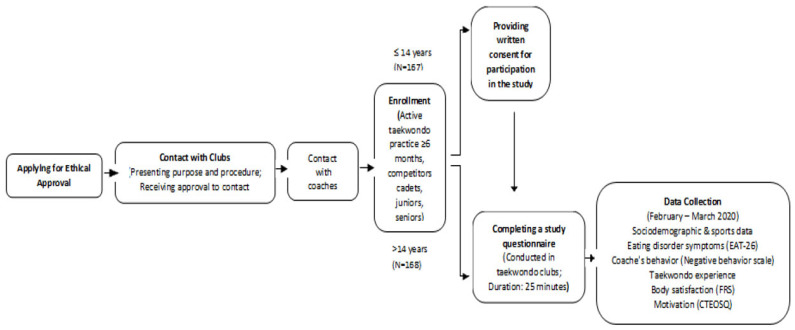
Taekwondo is a weight-classified combat sport. Taekwondo athletes often resort to restrictive eating behaviors and weight reduction, especially just before competitions, which, in the long run, endanger their physical and mental health. This study aimed to determine the incidence of eating disorder (ED) symptoms regarding sex, age, and competitive level categories and examine the correlation and contribution of coach behavior, body satisfaction, and goal orientation to the development of ED symptoms in different subgroups. A total of 335 active Croatian taekwondo athletes, with a mean age of 14.7 years, among whom were 132 males and 203 females (range 10-26 yrs, = 3.06), completed the Croatian version of the Eating Attitude Test, Figure Rating Scale, Croatian Task and Ego Orientation in Sport Questionnaire, Negative Coach Behavior Questionnaire, and a questionnaire related to taekwondo practice. The results showed that ED symptoms were more present in female than male athletes ( < 0.001), while there was no statistically significant difference among the age and competitive level categories between elite and non-elite athletes. The risk of ED was significantly correlated ( < 0.001) with taekwondo athletes' body dissatisfaction, coach pressure, and task goal orientation. In general, regression analyses showed that athletes' body image dissatisfaction ( = 0.310; < 0.001), coach pressure on diet and weight ( = 0.156; < 0.005), and athletes' task goal orientation ( = 0.120; < 0.032) are statistically significant predictors that explain the variance in ED symptoms in Croatian taekwondo athletes. The culture of taekwondo sports represents a risk factor for ED development.
跆拳道是一项按体重分级的格斗运动。跆拳道运动员经常采取限制性饮食行为并进行减重,尤其是在比赛前,从长远来看,这会危及他们的身心健康。本研究旨在确定饮食失调(ED)症状在性别、年龄和竞技水平类别方面的发生率,并检验教练行为、身体满意度和目标定向对不同亚组中ED症状发展的相关性和影响。共有335名活跃的克罗地亚跆拳道运动员参与,平均年龄为14.7岁,其中男性132名,女性203名(年龄范围10 - 26岁,标准差 = 3.06),他们完成了克罗地亚版的饮食态度测试、体型评定量表、克罗地亚体育任务和自我定向问卷、负面教练行为问卷以及一份与跆拳道训练相关的问卷。结果显示,女性运动员比男性运动员更易出现ED症状(P < 0.001),而精英运动员和非精英运动员在年龄和竞技水平类别之间没有统计学上的显著差异。ED风险与跆拳道运动员的身体不满、教练压力和任务目标定向显著相关(P < 0.001)。总体而言,回归分析表明,运动员的身体形象不满(β = 0.310;P < 0.001)、教练在饮食和体重方面的压力(β = 0.156;P < 0.005)以及运动员的任务目标定向(β = 0.120;P < 0.032)是解释克罗地亚跆拳道运动员ED症状差异的统计学显著预测因素。跆拳道运动文化是ED发展的一个风险因素。